Search results for: “resume”

  • Reviews

    We’ve upskilled 2,00,000+ learners like you over the last decade

    Read real stories and verified reviews. Don’t let ~1% of negative experiences define the other 99% of our story.

    🌟
    🏆
    Enrolled!
    Mastering Skills!
    Job Ready!

    Google
    4.6 ★
    (2,500+ Real Reviews)
    CR Course Report
    4.8 ★
    (Verified Reviews)
    Switchup
    4.7 ★
    (Verified Reviews)
    Trustpilot
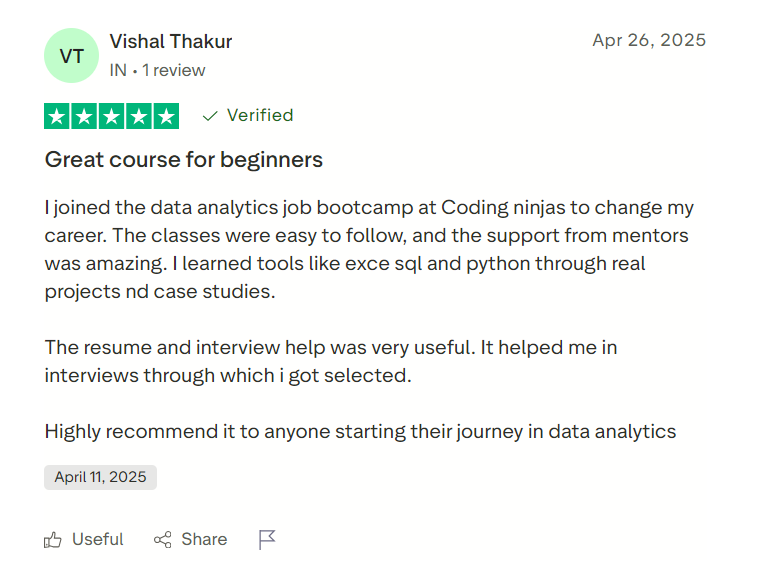
    Coding Ninjas Review by Vishal Vishal Thakur Enrolled in Data Analytics Bootcamp
    “I joined the data analytics job bootcamp at Coding ninjas to change my career. The classes were easy to follow, and the support from mentors was amazing. I learned tools like excel sql and python through real projects and case studies. The resume and interview help was very useful. Highly recommend it to anyone starting their journey in data analytics.”
    Trustpilot
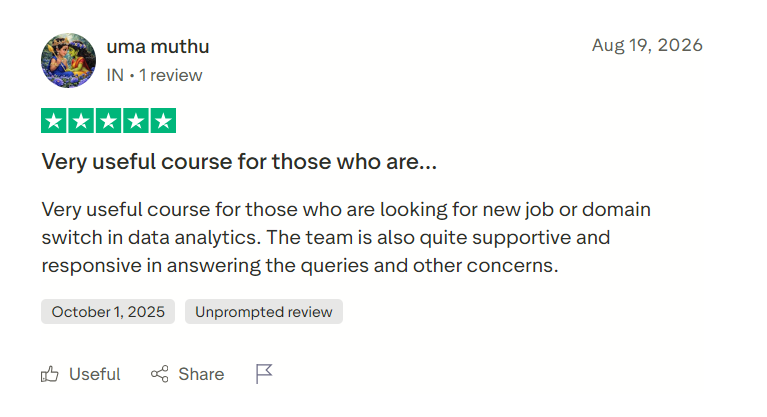
    Coding Ninjas Data Analytics with GenAI Review Uma Muthu Enrolled in Data Analytics Bootcamp
    “Very useful course for those who are looking for new job domain switch in data analytics. The team is also quite supportive and responsive in answering the queries and other concerns.”
    Reddit
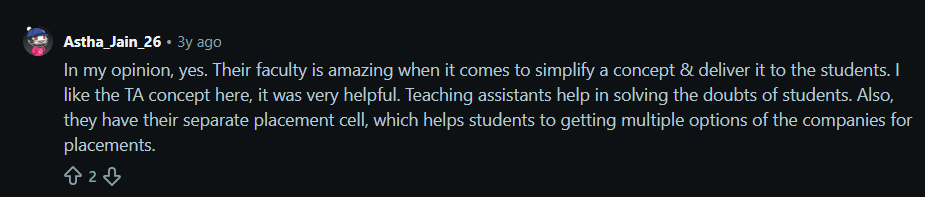
    Coding Ninjas DSA Course Review on Reddit Astha Jain Enrolled in DSA Course
    “In my opinion, yes. Their faculty is amazing when it comes to simplify a concept & deliver it to the students. I like the TA concept here, it was very helpful. Teaching assistants help in solving the doubts of students. Also, they have their separate placement cell, which helps students to getting multiple options of the companies for placements.”
    Google Reviews
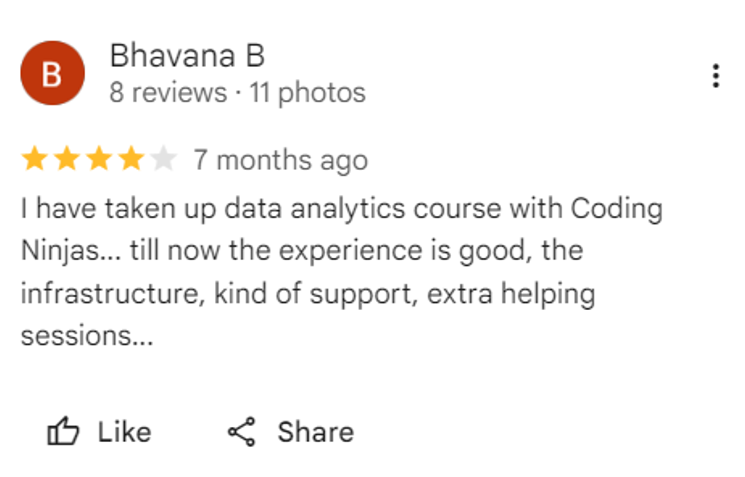
    Coding Ninjas Data Analytics with GenAI Course Review Bhavana B Enrolled in Data Analytics Bootcamp
    “I have taken up data analytics course with Coding Ninjas… till now the experience is good, the infrastructure, kind of support, extra helping sessions…”
    Course Report
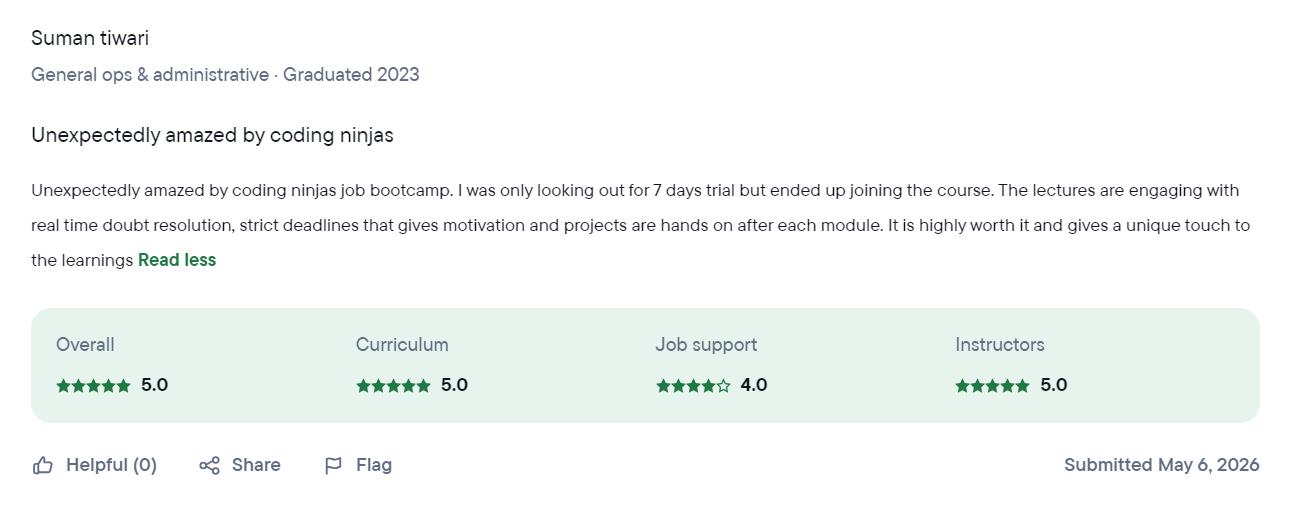
    Coding Ninjas Review Suman Tiwari Enrolled in Data Analytics Bootcamp
    “Unexpectedly amazed by coding ninjas job bootcamp. I was only looking out for 7 days trial but ended up joining the course. The lectures are engaging with real time doubt resolution, strict deadlines that gives motivation and projects are hands on after each module. It is highly worth it and give a unique touch to the learnings”
    Trustpilot
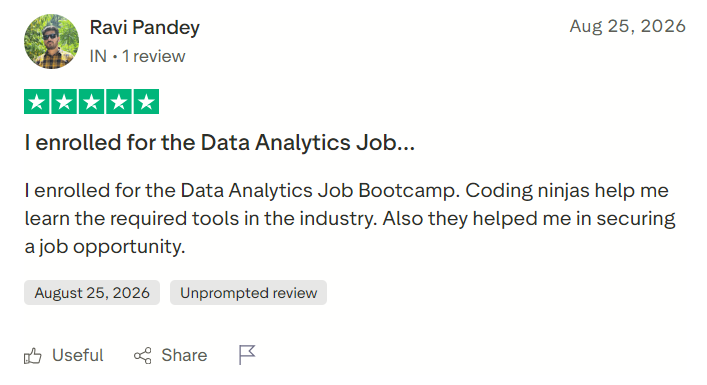
    Coding Ninjas Data Analytics Real Course Review Ravi Pandey Enrolled in Data Analytics Bootcamp
    “I enrolled for the Data Analytics Job Bootcamp. Coding ninjas helped me learn the required tools in the industry. Also they helped me in securing a job opportunity.”
    Trustpilot
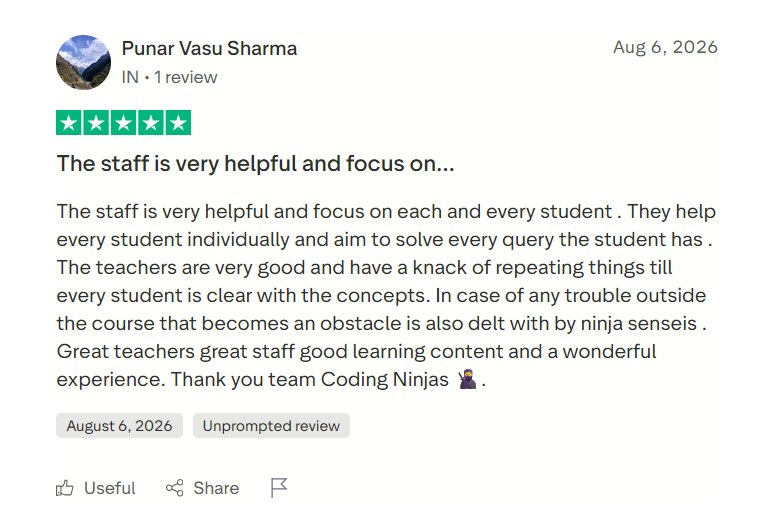
    Coding Ninjas GenAI Course Review Punar Vasu Sharma Enrolled in GenAI and Multi-Agent Systems
    “The staff is very helpful and focus on each and every student. They help every student individually and aim to solve every query the student has . The teachers are very good and have a knack of repeating things till every student is clear with concepts. In case of any trouble outside the course that becomes an obstacle is also delt with by ninja senseis . Great teachers great staff good learning content and a wonderful experience. Thank you team Coding Ninjas 🥷.”
    Reddit
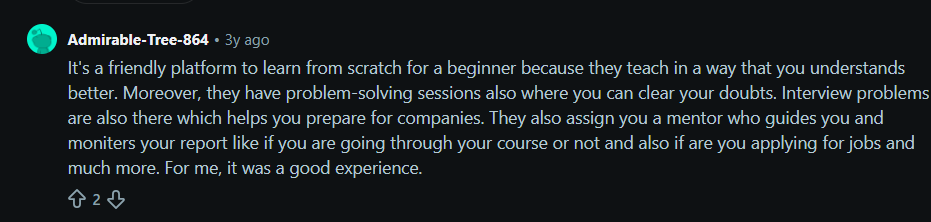
    Coding Ninjas DSA Course Review on Reddit Admirable-Tree-864 Enrolled in DSA Course
    “It’s a friendly platform to learn from scratch for a beginner because they teach in a way that you understands better. Moreover, they have problem-solving sessions also where you can clear your doubts. Interview problems are also there which helps you prepare for compnanies. They also assign you a mentor who guides you and moniters your report like if you are going through your course or not and also if you are applying for jobs and much more. For me, it was a good experience.”
    Google Reviews
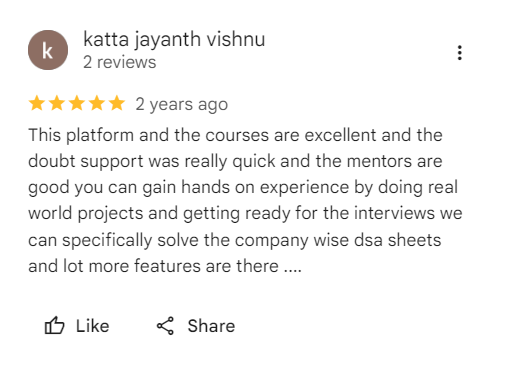
    Coding Ninjas DSA Course Review Katta Jayanth Vishnu Enrolled in DSA Course
    “This platform and the courses are excellent and the doubt support was really quick and the mentors are good you can gain hands on experience by doing real world projects and getting ready for the interviews we can specifically solve the company wise dsa sheets and lot more features are there ….”
    Course Report
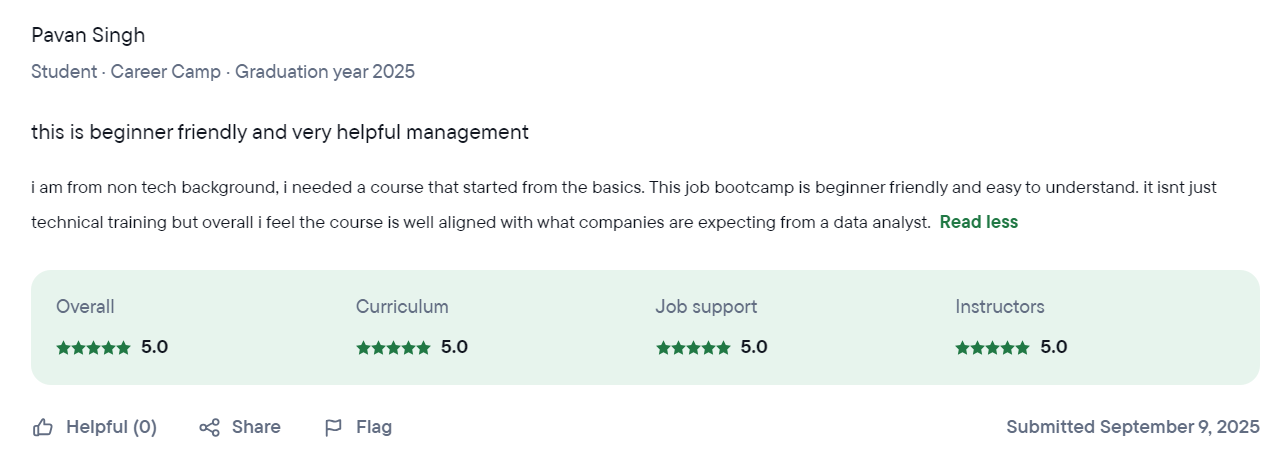
    Coding Ninjas Review Pavan Singh Enrolled in Data Analytics Bootcamp
    “i am from non tech background, i needed a course that started from the basics. This job bootcamp is beginner friendly and easy to understand. it isnt just technical training but overall i feel the course is well aligned with what companies are expecting from a data analyst.”
    Trustpilot
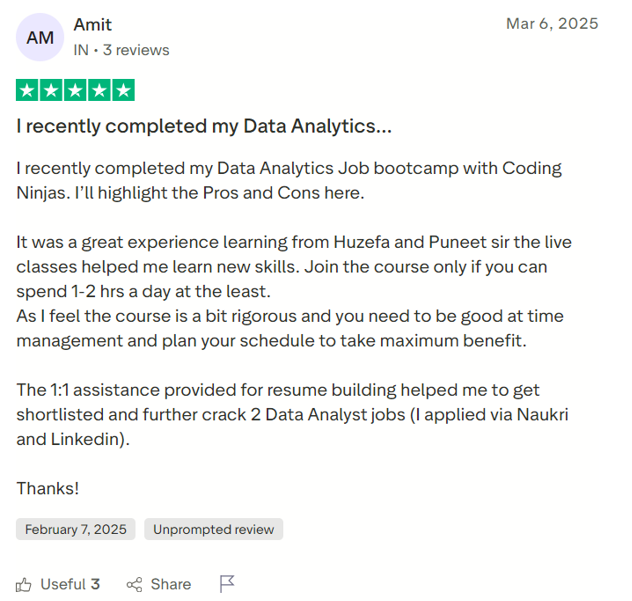
    Coding Ninjas Data Analytics Real Course Review Amit Enrolled in Data Analytics Bootcamp
    “I recently completed my Data Analytics Job bootcamp with Coding Ninjas. I’ll highlight the Pros and Cons here.
    It was a great experience learning from Huzefa and Puneet sir the live classes helped me learn new skills. Join the course only if you can spend 1-2 hrs a day at the least.
    As I feel the course is a bit rigorous and you need to be good at time management and plan your schedule to take maximum benefit.
    The 1:1 assistance provided for resume building helped me to get shortlisted and further crack 2 Data Analyst jobs (I applied via Naukri and Linkedin).
    Thanks!”
    Google Reviews
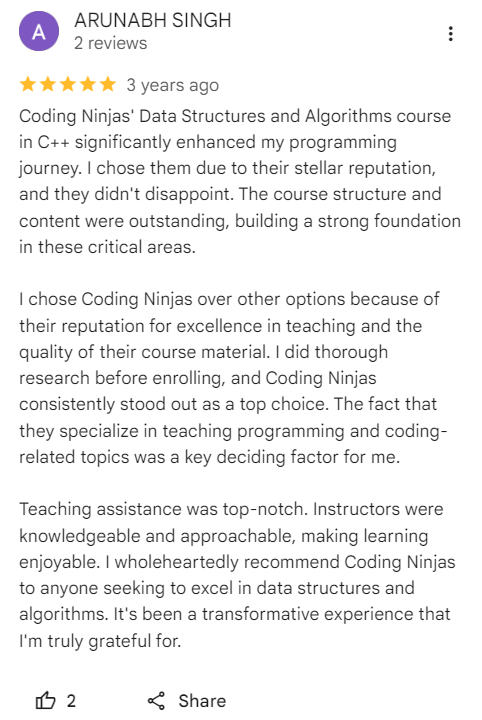
    Coding Ninjas DSA Course Review Arunabh Singh Enrolled in DSA Course
    “Coding Ninjas’ Data Structures and Algorithms course in C++ significantly enhanced my programming journey. I chose them due to their stellar reputation, and they didn’t disappoint. The course structure and content were outstanding, building a strong foundation in these critical areas.
    I chose Coding Ninjas over other options because of their reputation for excellence in teaching and the quality of their course material. I did thorough research before enrolling, and Coding Ninjas consistently stood out as a top choice. The fact that they specialize in teaching programming and coding-related topics was a key deciding factor for me.
    Teaching assistance was top-notch. Instructors were knowledgeable and approachable, making learning enjoyable. I wholeheartedly recommend Coding Ninjas to anyone seeking to excel in data structures and algorithms. It’s been a transformative experience that I’m truly grateful for.”
    Reddit
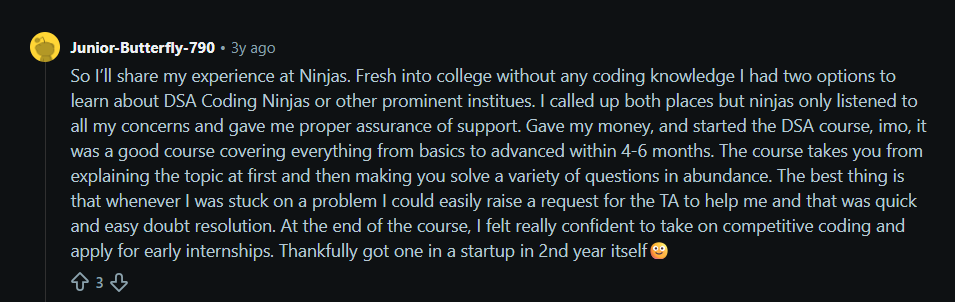
    Coding Ninjas DSA Course Review on Reddit Junior-Butterfly-790 Enrolled in DSA Course
    “So I’ll share my experience at Ninjas. Fresh into college without any coding knowledge I had two options to learn about DSA Coding Ninjas or other prominent institues. I called up both places but ninjas only listened to all my concerns and gave me proper assurance of support. Gave my money, and started the DSA course, imo, it was a good course covering everything from basics to advanced within 4-6 months. The course takes you from explaining the topic at first and then making you solve a variety of questions in abundance. The best thing is that whenever I was stuck on a problem I could easily raise a request for the TA to help me and that was quick and easy doubt resolution. At the end of the course, I felt really confident to take on competitive coding and apply for early internships. Thankfully got one in a startup in 2nd year itself🙂”
    Course Report
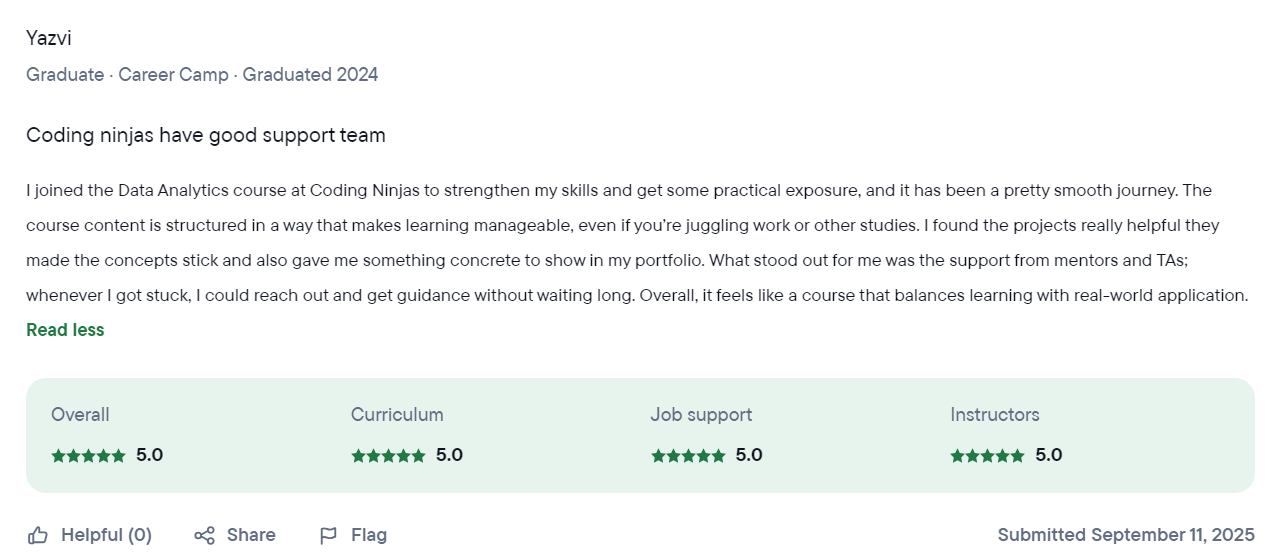
    Coding Ninjas Data Analytics Course Review Yazvi Enrolled in Data Analytics Bootcamp
    “I joined the Data Analytics course at Coding Ninjas to strengthen my skills and get some practical exposure, and it has been a pretty smooth journey. The course content is structured in a way that makes learning manageable, even if you’re juggling work or other studies. I found the projects really helpful they made the concepts stick and also gave me something concrete to show in my portfolio. What stood out for me was the support from mentors and TAs; whenever I got stuck, I could reach out and get guidance without waiting long. Overall, it feels like a course that balances learning with real-world application.”
    Course Report
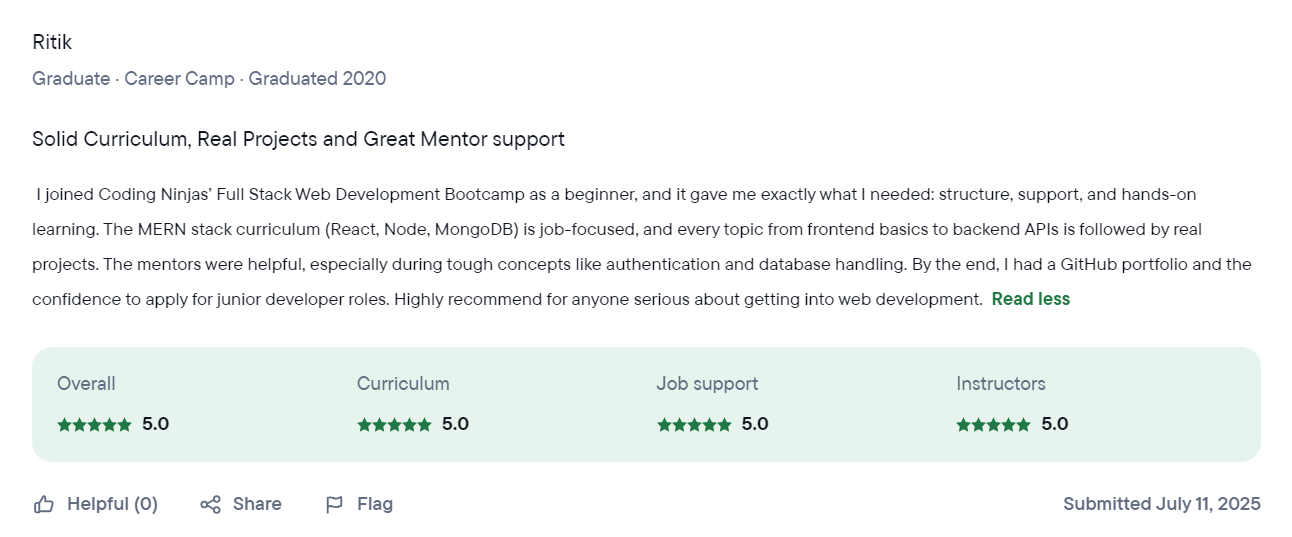
    Coding Ninjas Software Development Review Ritik Enrolled in Software Development Bootcamp
    “I joined Coding Ninjas’ Full Stack Web Development Bootcamp as a beginner, and it gave me exactly what I needed: structure, support, and hands-on learning. The MERN stack curriculum (React, Node, MongoDB) is job-focused, and every topic from frontend basics to backend APIs is followed by real projects. The mentors were helpful, especially during tough concepts like authentication and database handling. By the end, I had a GitHub portfolio and the confidence to apply for junior developer roles. Highly recommend for anyone serious about getting into web development.”
    Reddit
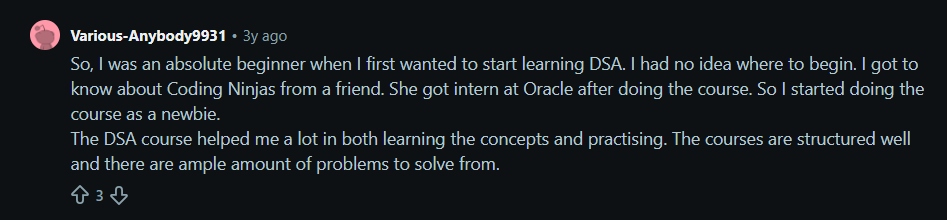
    Coding Ninjas DSA Course Review on Reddit Various-Anybody9931 Enrolled in DSA Course
    “So, I was an absolute beginner when I first wanted to start learning DSA. I had not idea where to begin. I got to know about Coding Ninjas from a friend. She got intern at Oracle after doing the course. So I started doing the course as a newbie.
    The DSA course helped me a lot in both learning the concepts and practising. The courses are structured well and there are ample amount of problems to sovle from.”
    Trustpilot
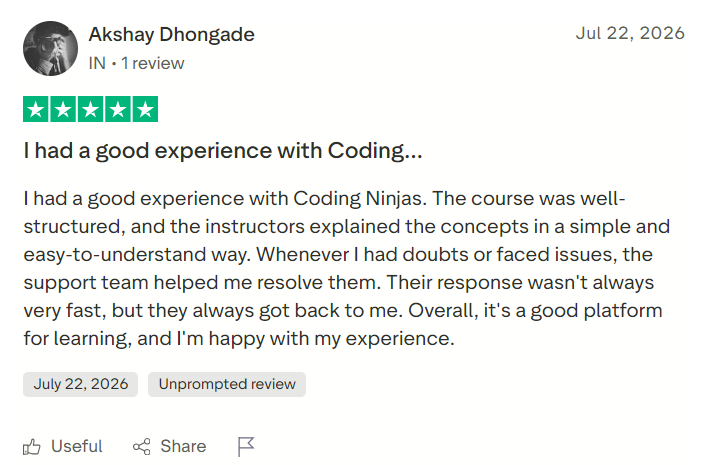
    Coding Ninjas Software Development Course Review Akshay Dhongade Enrolled in Software Development Bootcamp
    “I had a good experience with Coding Ninjas. The course was well-structured, and the instructors explained the concepts in a simple and easy-to-understand way. Whenever I had doubts or faced issues, the support team helped me resolve them. Their response wasn’t always very fast, but they always got back to me. Overall, it’s a good platform for learning, and I’m happy with my experience.”
    Course Report
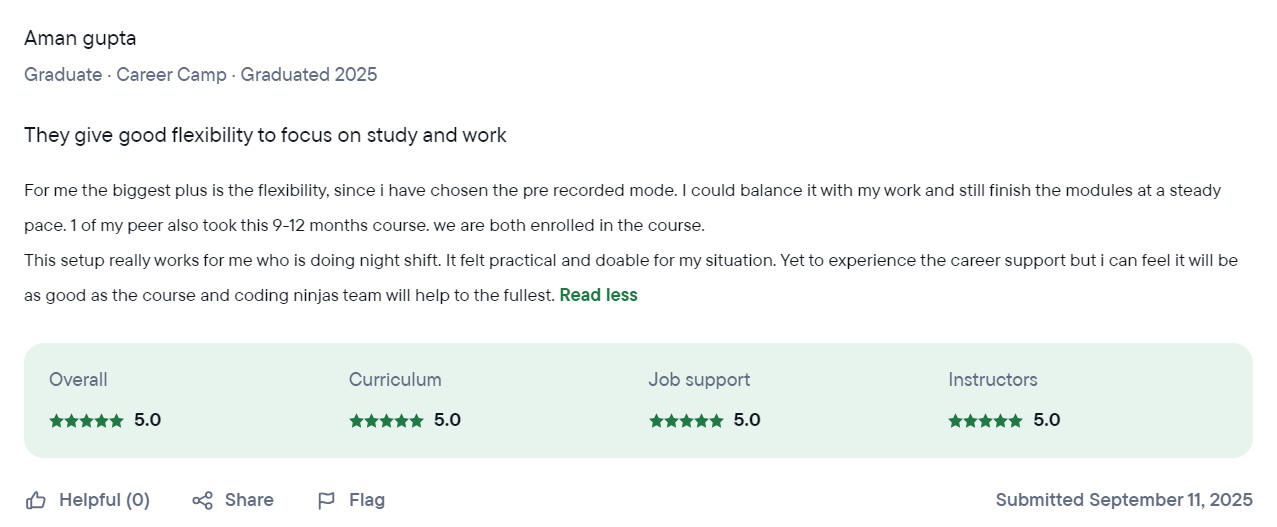
    Coding Ninjas Software Development Review Aman Gupta Enrolled in Software Development Bootcamp
    “For me the biggest plus is the flexibility, since i have chosen the pre recorded mode. I could balance it with my work and still finish the modules at a steady pace. 1 of my peer also took this 9-12 months course. we are both enrolled in the course.
    This setup really works for me who is doing night shift. It felt practical and doable for my situation. Yet to experience the career support but i can feel it will be as good as the course and coding ninjas team will help to the fullest.”
    Google Reviews
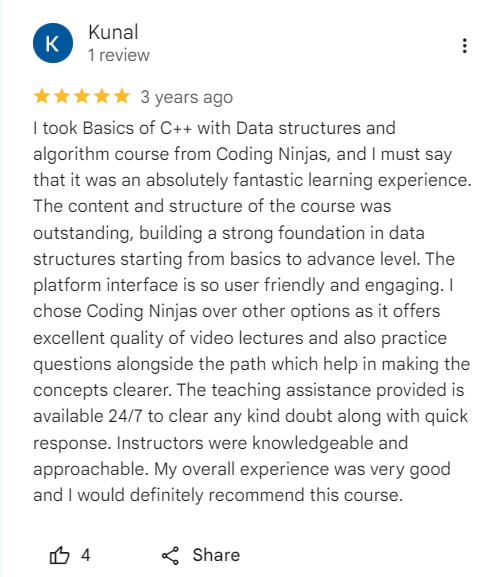
    Coding Ninjas DSA Course Review Kunal Enrolled in DSA Course
    “I took Basics of C++ with Data structures and algorithm course from Coding Ninjas, and I must say that it was an absolutely fantastic learning experience. The content and structure of the course was outstanding, building a strong foundation in data structures starting from basics to advance level. The platform interface is so user friendly and engaging. I chose Coding Ninjas over other options as it offers excellent quality of video lectures and also practice questions alongside the path which help in making the concepts clearer. The teaching assistance provided is available 24/7 to clear any kind doubt along with quick response. Instructors were knowledgeable and approachable. My overall experience was very good and I would definitely recommend this course.”
    Reddit

    Coding Ninjas DSA Course Review on Reddit Professional-You4841 Enrolled in DSA Course
    “My experience with Coding Ninjas was great, both as a student and as a TA later on. The lectures were quite friendly and the faculty( Ankush Sir Especially) here is amazing. It really helped me enhance my programming skills. I would highly recommend it.”
    Trustpilot
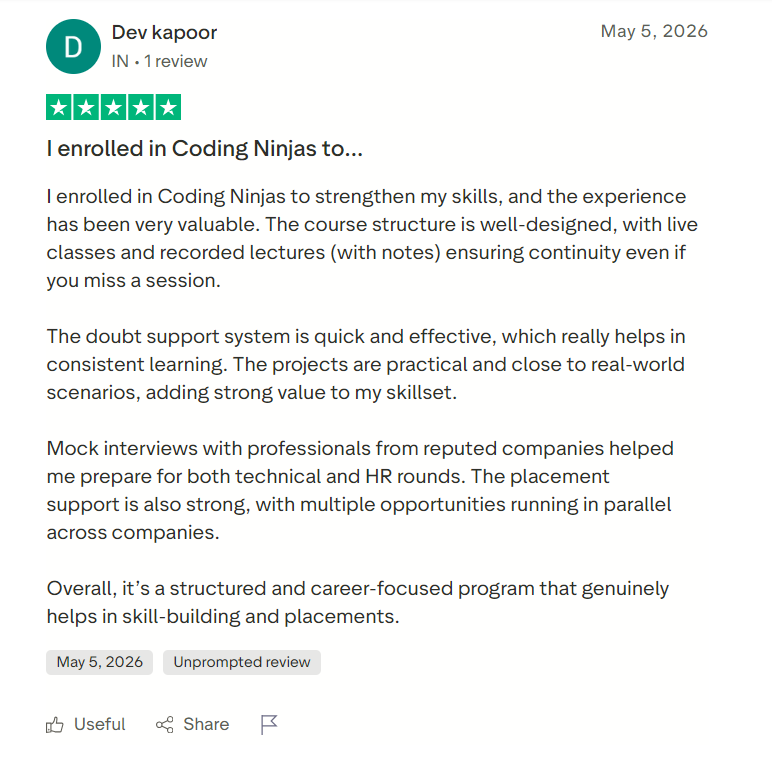
    Coding Ninjas Data Analytics Course Review Dev Kapoor Enrolled in Data Analytics Bootcamp
    “I enrolled in Coding Ninjas to strengthen my skills, and the experience has been very valuable. The course structure is well-designed, with live classes and recorded lectures (with notes) ensuring continuity even if you miss a session.
    The doubt support system is quick and effective, which really helps in consistent learning. The projects are practical and close to real-world scenarios, adding strong value to my skillset.
    Mock interviews with professionals from reputed companies helped me prepare for both technical and HR rounds. The placement support is also strong, with multiple opportunities running in parallel across companies.
    Overall, it’s a structured and career-focused program that genuinely helps in skill-building and placements.”
    Course Report
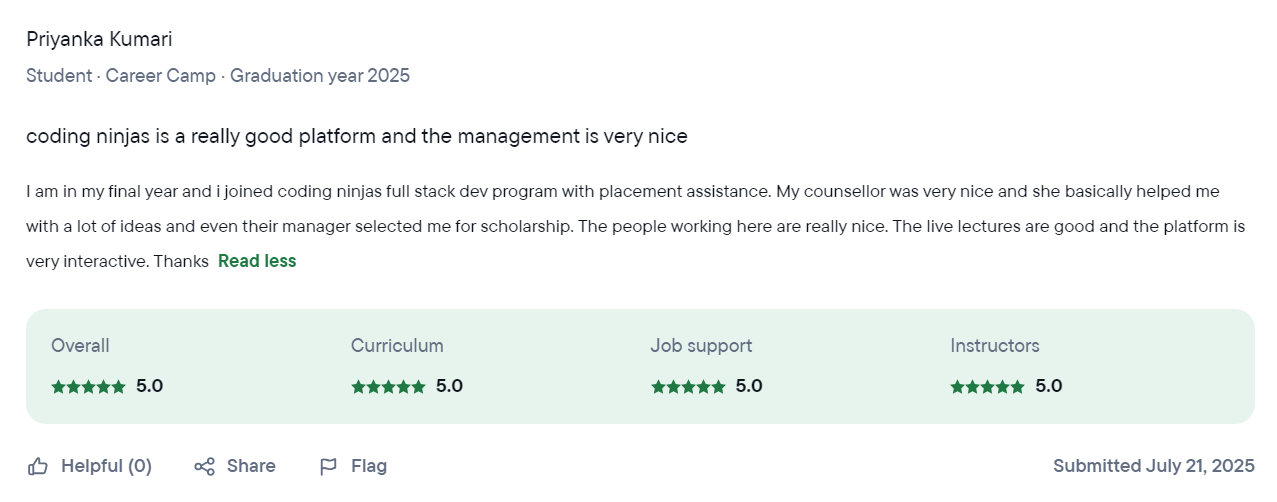
    Coding Ninjas Software Development Review Priyanka Kumari Enrolled in Software Development Bootcamp
    “I am in my final year and i joined coding ninjas full stack dev program with placement assistance. My counsellor was very nice and she basically helped me with a lot of ideas and even their manager selected me for scholarship. The people working here are really nice. The live lectures are good and the platform is very interactive. Thanks”
    Trustpilot
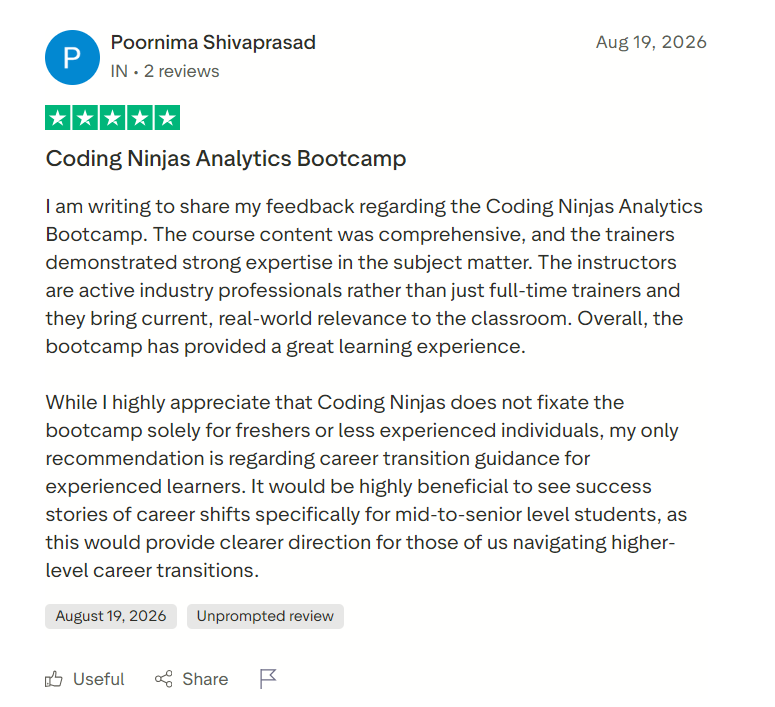
    Coding Ninjas Data Analytics Course Review Poornima Shivaprasad Enrolled in Data Analytics Bootcamp
    “I am writing to share my feedback regarding the Coding Ninjas Analytics Bootcamp. The course content was comprehensive, and the trainers demonstrated strong expertise in the subject matter. The instructors are active industry professionals rather than just full-time trainers and they bring current, real-world relevance to the classroom. Overall, the bootcamp has provided a great learning experience.
    While I highly appreciate that Coding Ninjas does not fixate the bootcamp solely for freshers or less experienced individuals, my only recommendation is regarding career transition guidance for experienced learners. It would be highly beneficial to see success stories of career shifts specifically for mid-to-senior level students, as this would provide clearer direction for those of us navigating higher-level career transitions.”
    Trustpilot
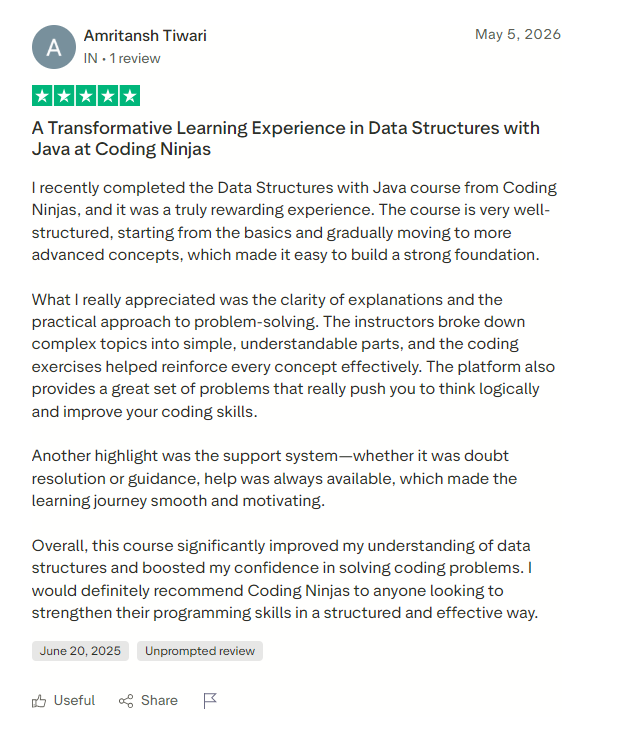
    Coding Ninjas DSA Course Review Amritansh Tiwari Enrolled in DSA Course
    “I recently completed the Data Structures with Java course from Coding Ninjas, and it was a truly rewarding experience. The course is very well-structured, starting from the basics and gradually moving to more advanced concepts, which made it easy to build a strong foundation.
    What I really appreciated was the clarity of explanations and the practical approach to problem-solving. The instructors broke down complex topics into simple, understandable parts, and the coding exercises helped reinforce every concept effectively. The platform also provides a great set of problems that really push you to think logically and improve your coding skills.
    Another highlight was the support system—whether it was doubt resolution or guidance, help was always available, which made the learning journey smooth and motivating.
    Overall, this course significantly improved my understanding of data structures and boosted my confidence in solving coding problems. I would definitely recommend Coding Ninjas to anyone looking to strengthen their programming skills in a structured and effective way.”
    Course Report
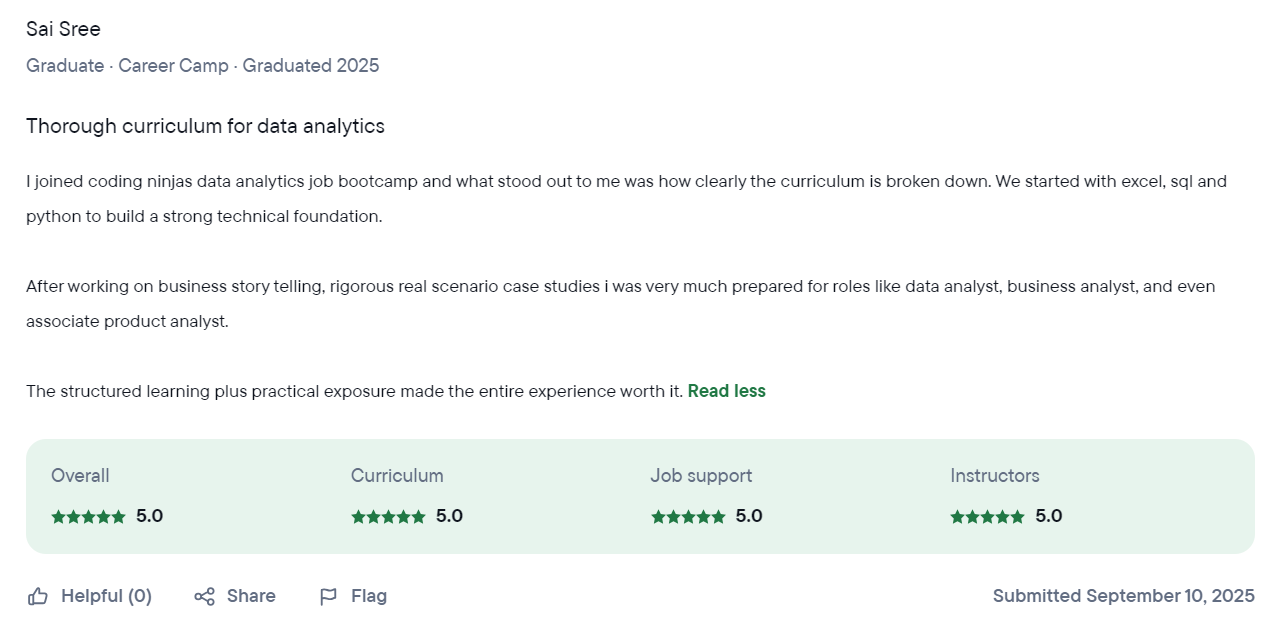
    Coding Ninjas Software Development Review Sai Sree Enrolled in Data Analytics Bootcamp
    “I joined coding ninjas data analytics job bootcamp and what stood out to me was how clearly the curriculum is broken down. We started with excel, sql and python to build a strong technical foundation.
    After working on business story telling, rigorous real scenario case studies i was very much prepared for roles like data analyst, business analyst, and even associate product analyst.
    The structured learning plus practical exposure made the entire experience worth it.”
    Course Report
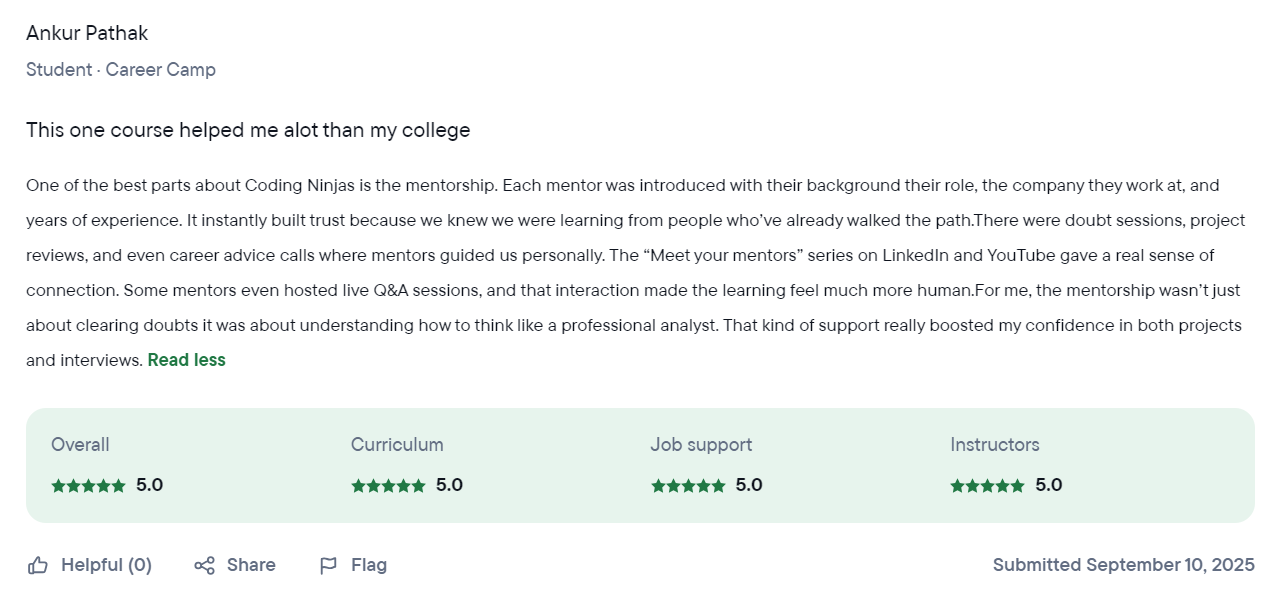
    Coding Ninjas Software Development Review Ankur Pathak Enrolled in Data Analytics Bootcamp
    “One of the best parts about Coding Ninjas is the mentorship. Each mentor was introduced with their background their role, the company they work at, and years of experience. It instantly built trust because we knew we were learning from people who’ve already walked the path.There were doubt sessions, project reviews, and even career advice calls where mentors guided us personally. The “Meet your mentors” series on LinkedIn and YouTube gave a real sense of connection. Some mentors even hosted live Q&A sessions, and that interaction made the learning feel much more human.For me, the mentorship wasn’t just about clearing doubts it was about understanding how to think like a professional analyst. That kind of support really boosted my confidence in both projects and interviews.”
    Trustpilot
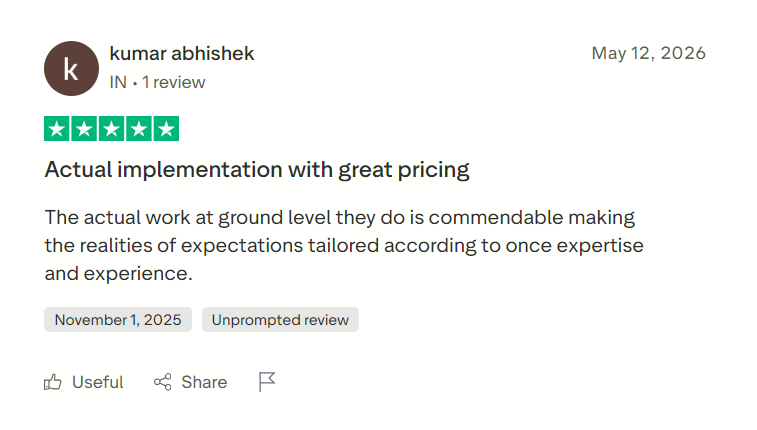
    Coding Ninjas Data Analytics Course Review Kumar Abhishek Enrolled in Data Analytics Bootcamp
    “The actual work at ground level they do is commendable making the realities of expectations tailored according to once expertise and experience.”
    Trustpilot
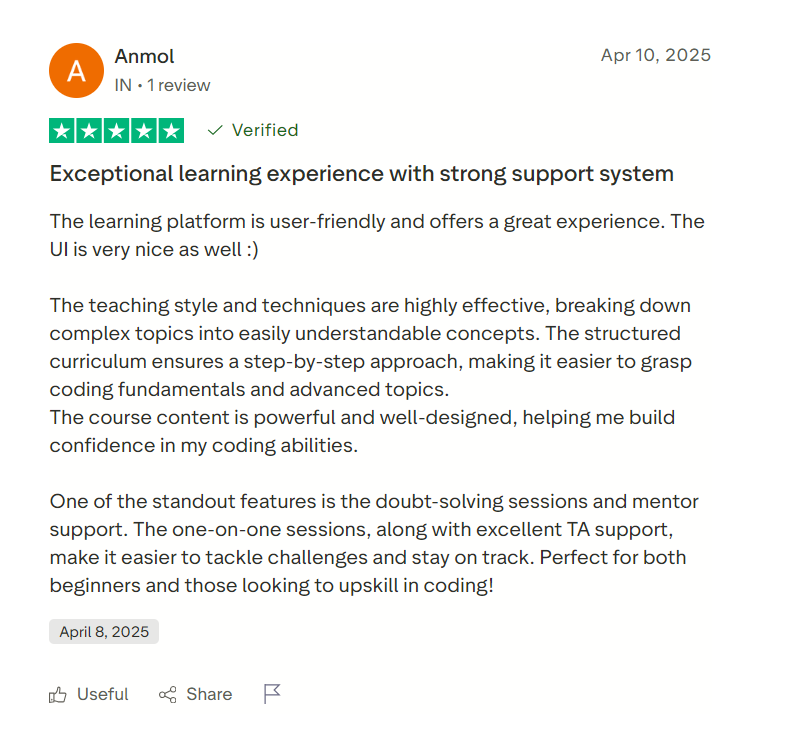
    Coding Ninjas Software Development Course Review Anmol Enrolled in Software Development Bootcamp
    “The learning platform is user-friendly and offers a great experience. The UI is very nice as well 🙂
    The teaching style and techniques are highly effective, breaking down complex topics into easily understandable concepts. The structured curriculum ensures a step-by-step approach, making it easier to grasp coding fundamentals and advanced topics.
    The course content is powerful and well-designed, helping me build confidence in my coding abilities.
    One of the standout features is the doubt-solving sessions and mentor support. The one-on-one sessions, along with excellent TA support, make it easier to tackle challenges and stay on track. Perfect for both beginners and those looking to upskill in coding!”
    Trustpilot
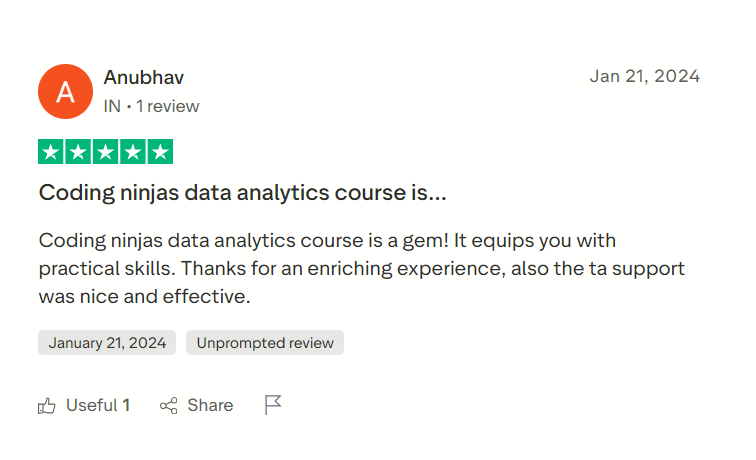
    Coding Ninjas Data Analytics Course Review Anubhav Enrolled in Data Analytics Bootcamp
    “Coding ninjas data analytics course is a gem! It equips you with practical skills. Thanks for an enriching experience, also the ta support was nice and effective.”
    Google Reviews
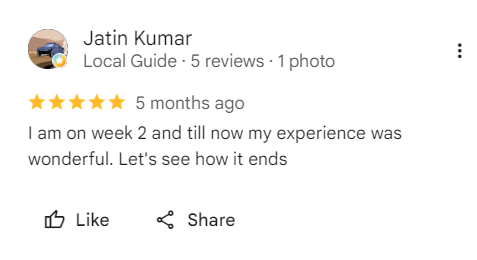
    Coding Ninjas DSA Course Review Jatin Kumar Enrolled in Data Analytics Bootcamp
    “I am on 2 weeks and till now my experience was wonderful. Let’s see how it ends”
    Google Reviews
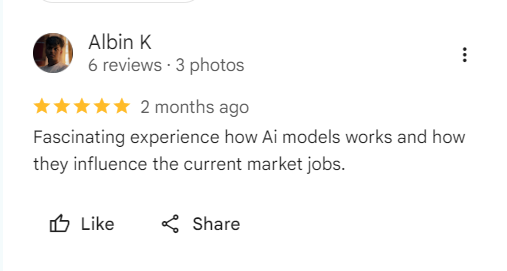
    Coding Ninjas DSA Course Review Albin K Enrolled in GenAI and Multi-Agent Systems
    “Fascinating experience how Ai models works and how they influence the current market jobs.”
    Trustpilot
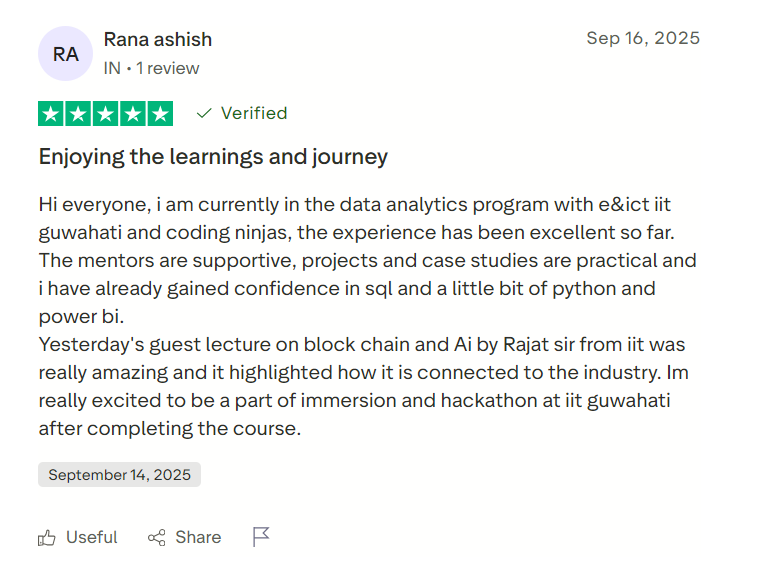
    Coding Ninjas Data Analytics Course Review Rana Ashish Enrolled in Data Analytics Bootcamp
    “Hi everyone, i am currently in the data analytics program with e&ict iit guwahati and coding ninjas, the experience has been excellent so far. The mentors are supportive, projects and case studies are practical and i have already gained confidence in sql and a little bit of python and power bi.
    Yesterday’s guest lecture on block chain and Ai by Rajat sir from iit was really amazing and it highlighted how it is connected to the industry. Im really excited to be a part of immersion and hackathon at iit guwahati after completing the course.”
    Trustpilot
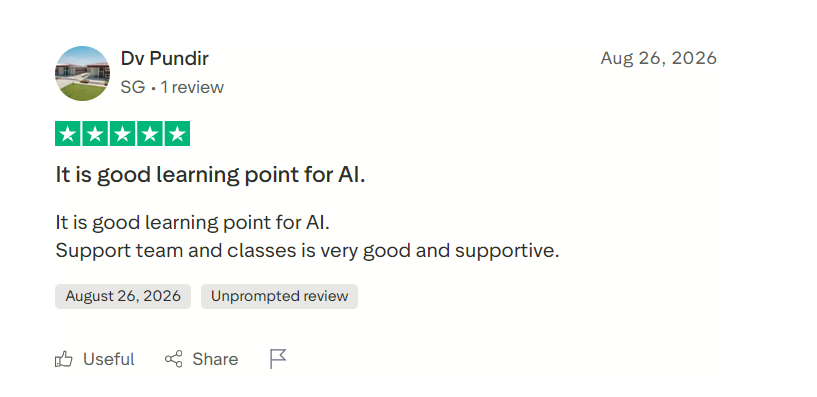
    Coding Ninjas GenAI Course Review Dv Pundir Enrolled in GenAI and Multi-Agent Systems
    “It is good learning point for AI.
    Support team and classes is very good and supportive.”
    Trustpilot
    Coding Ninjas GenAI Course Review Rak Sarvagna Vishnubotla Enrolled in GenAI and Multi-Agent Systems
    “The company is very productive and it’s a very good educational institute”
    Trustpilot
    Coding Ninjas GenAI Course Review Nilesh Kumar Enrolled in GenAI and Multi-Agent Systems
    “Before enrolling into coding ninjas I don’t have any skills , but when I enrolled in coding ninjas they have best mentors to teach us and their platform is very user friendly and their topic wise questions which clear all you concept or if you stuck in some questions they have provided you AI mentor tries to help me but in case you do not get my answers, they provide you a TA to help me out and clear me concepts used in that questions and will teach me some best skills and made me interview ready by providing mock interviews on real industry level questions. Their help and support functionary is also very friendly and help me out throughout my journey.”
    Trustpilot
    Coding Ninjas GenAI Course Review Radhe Sarda Enrolled in GenAI and Multi-Agent Systems
    “Excellent Training to accelerate the growth in career”
    Google Reviews
    Coding Ninjas Data Analytics Course Review Muddit Lal Enrolled in Data Analytics Bootcamp
    “I recently completed a coding course with Coding Ninjas, and I must say that it was an absolutely fantastic learning experience. From start to finish, the entire journey was filled with valuable knowledge, engaging content, and a supportive community.
    First and foremost, the course curriculum was exceptional. It covered a wide range of topics, starting from the basics and gradually progressing to more advanced concepts. Each module was well-structured and presented in a way that was easy to understand, even for someone like me who had limited coding experience. The instructors were highly knowledgeable and explained complex ideas in a clear and concise manner.”
    Google Reviews
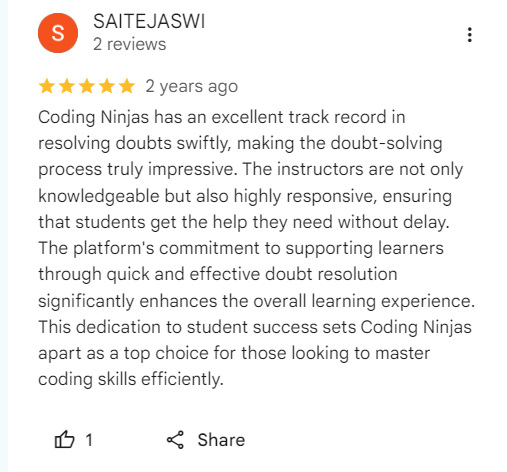
    Coding Ninjas DSA Course Review Saitejasvi Enrolled in DSA Course
    “Coding Ninjas has an excellent track record in resolving doubts swiftly, making the doubt-solving process truly impressive. The instructors are not only knowledgeable but also highly responsive, ensuring that students get the help they need without delay.
    The platform’s commitment to supporting learners through quick and effective doubt resolution significantly enhances the overall learning experience. This dedication to student success sets Coding Ninjas apart as a top choice for those looking to master coding skills efficiently.”
    Trustpilot
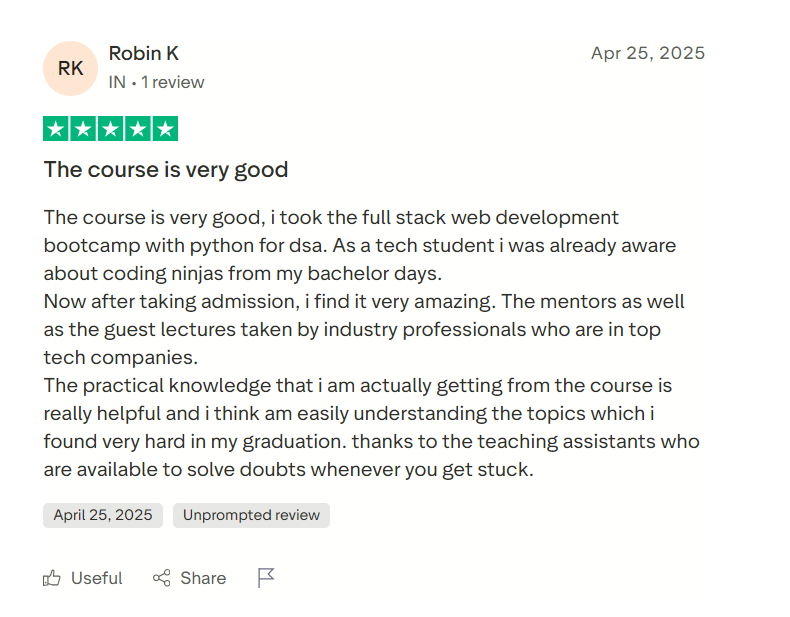
    Coding Ninjas Software Development Course Review Robin K Enrolled in Software Development Bootcamp
    “The course is very good, i took the full stack web development bootcamp with python for dsa. As a tech student i was already aware about coding ninjas from my bachelor days.
    Now after taking admission, i find it very amazing. The mentors as well as the guest lectures taken by industry professionals who are in top tech companies.
    The practical knowledge that i am actually getting from the course is really helpful and i think am easily understanding the topics which i found very hard in my graduation. thanks to the teaching assistants who are available to solve doubts whenever you get stuck.”
    Trustpilot
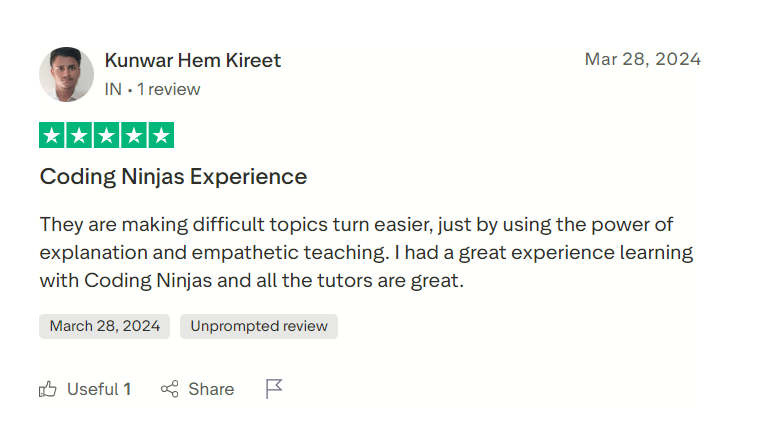
    Coding Ninjas Data Analytics Course Review Kunwar Hem Kireet Enrolled in Data Analytics Bootcamp
    “They are making difficult topics turn easier, just by using the power of explanation and empathetic teaching. I had a great experience learning with Coding Ninjas and all the tutors are great.”
    Trustpilot
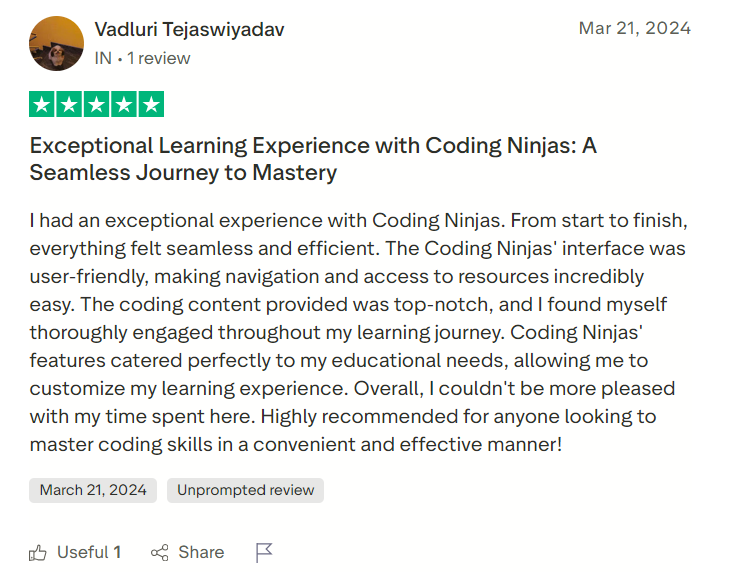
    Coding Ninjas Software Development Course Review Vadluri Tejaswiyadav Enrolled in Software Development Bootcamp
    “I had an exceptional experience with Coding Ninjas. From start to finish, everything felt seamless and efficient. The Coding Ninjas’ interface was user-friendly, making navigation and access to resources incredibly easy. The coding content provided was top-notch, and I found myself thoroughly engaged throughout my learning journey. Coding Ninjas’ features catered perfectly to my educational needs, allowing me to customize my learning experience. Overall, I couldn’t be more pleased with my time spent here. Highly recommended for anyone looking to master coding skills in a convenient and effective manner!”
    Loading more reviews…
    Full Review Screenshot
  • From Enrollment to Job Offer: Software Development Course Journey

    From Enrollment to Job Offer: Software Development Course Journey

    From Enrollment to Job Offer: Software Development Course Journey

    By Coding Ninjas • 8 mins read | Last updated: September 2026
    Summarize with AI:

    Table of Contents

    Choosing a software development course is not only about learning a programming language or framework. For many learners, the bigger challenge is understanding what to learn, how to practise consistently, where to get help and how to eventually prepare for software development roles.

    For Priyanka, this was exactly what she was looking for when she started exploring software development programs. She wanted a structured path that could take her from programming fundamentals to backend development while also helping her prepare for the job-search process.

    She enrolled in the Coding Ninjas Software Development with GenAI Program, choosing the Spring Boot track. The program combines structured learning, hands-on projects, doubt support, industry expert sessions and placement assistance.

    This is Priyanka’s journey from speaking with a career counsellor and enrolling in the program to learning Java and Spring Boot, building projects, preparing for interviews and eventually receiving a job offer through Coding Ninjas career support.

    Where My Journey Started

    I knew that I wanted to build a career in software development but I was not completely sure how to structure my learning. I wanted to understand how these technologies fit together and what I actually needed to learn to become job-ready.

    I was particularly interested in backend development. I wanted to understand what happens behind an application, how requests are processed, how databases are connected and how different services communicate with each other. I needed programming fundamentals, problem-solving skills, projects and interview preparation as well.

    That was when I started looking for a structured software development program rather than trying to create the entire learning roadmap myself.

    My Experience With the Career Counsellor

    Before enrolling, one of my first interactions was with the Coding Ninjas career counselling team. I wanted to understand what the Software Development with GenAI Job Bootcamp covered and whether the Spring Boot track went beyond simply teaching the framework.

    Pradeep explained the overall learning structure, the Spring Boot track, projects, doubt support and career assistance available through the program.

    The conversation also helped me understand my own responsibility. The program could provide the curriculum, support and career resources but I would still need to practise regularly, complete projects and prepare seriously for interviews.

    That gave me clearer expectations before I enrolled.

    Starting My Software Development Learning Journey

    The initial stage focused on building a strong programming foundation. Since Spring Boot is based on Java, understanding Java concepts was important before moving into backend development. I worked through programming fundamentals and object-oriented programming and gradually became more comfortable writing and understanding code.

    This progression helped me realise that frameworks are much easier to understand when the underlying programming concepts are clear.

    Instead of treating Spring Boot as a standalone technology, I started seeing it as one part of a larger software development journey.

    Strengthening My Problem-Solving With DSA

    Data Structures and Algorithms became another important part of my learning.

    Initially, I thought of DSA mainly as interview preparation. As I practised more problems, however, I started understanding how it also improves the way you approach programming problems.

    I worked with concepts such as arrays, linked lists, stacks, queues, trees, graphs, hashing, recursion and dynamic programming. The biggest change was learning to break a problem into smaller steps before thinking about the code.

    This became particularly useful later during interview preparation, where explaining the approach to a problem can be as important as arriving at the solution.

    Moving Into Backend Development With Spring Boot

    Once my programming foundation became stronger, I moved into backend development. This was one of the areas I was most interested in when I chose the Spring Boot track.

    Spring Boot helped me understand how Java can be used to build backend applications. I started learning how applications receive requests, process information, communicate with databases and return responses.

    The track covers technologies and concepts including Spring Boot, Spring MVC, REST APIs, Hibernate, JPA, Spring Security and microservices.

    This was an important transition for me because I was no longer thinking only about individual programming problems. I was beginning to understand how different components work together to form an application.

    Understanding APIs and Databases

    REST APIs became an important part of the backend learning journey.

    I started understanding how a frontend or another application can send a request to a backend, how the backend processes it and how the response is returned. I also learned how backend applications work with databases and how technologies such as Hibernate and JPA can be used for database interaction.

    This helped me connect the different parts of an application. A user action could result in an API request, the backend could process it, the application could retrieve or update information in a database and the result could then be returned to the user.

    Understanding this complete flow changed how I looked at software development.

    Building Projects Instead of Only Learning Concepts

    Projects became one of the most practical parts of my learning experience. There is a difference between understanding a concept in a lesson and actually using it while building an application.

    While working on projects, I had to think about backend logic, APIs, databases, authentication and how different components would work together. This made the learning more practical.

    Projects also became useful during interview preparation. Instead of simply saying that I had learned Java or Spring Boot, I could discuss applications I had worked on, the technologies I used and the problems I encountered while developing them.

    That gave me practical examples to use when discussing my technical experience.

    Learning to Use GenAI in Software Development

    Another part of the program was learning how GenAI can be used alongside software development. The program introduces learners to AI tools and workflows that can support development activities.

    For me, the important lesson was that AI does not replace the need to understand programming.

    I could use AI tools to explore coding approaches, understand errors, debug problems or improve development productivity but I still needed to understand the code and verify the output. This helped me see GenAI as another tool within a developer’s workflow rather than a replacement for technical fundamentals.

    Getting Help When I Got Stuck

    Software development also meant getting stuck. There were times when I understood a concept but could not identify why my code was not working. At other times, I needed someone to explain a topic from a different perspective.

    This was where the learning support became useful.

    Coding Ninjas provides Teaching Assistant support along with Ninja AI for doubt resolution 24/7. Teaching Assistants can provide one-on-one support through chat, audio calls and screen sharing. Having this support meant I did not always have to spend hours trying to solve the same problem alone.

    It was particularly useful while working on projects, where the problem was sometimes related to applying several concepts together rather than understanding a single lesson.

    Learning With Industry Experts

    As I progressed through the technical curriculum, I also started focusing more on the career side of software development. Knowing Java and Spring Boot was one thing. Being able to explain my knowledge and projects during an interview was another.

    The program provides industry expert sessions covering areas such as mock interviews, project guidance, resume reviews and career guidance. These sessions helped me think about my projects from an interviewer’s perspective.

    I had to be comfortable explaining the technologies I had used, the problems I had solved and the decisions I had made while developing an application.

    Preparing My Resume, LinkedIn and GitHub

    The next stage was preparing my professional profiles. My technical skills needed to be presented clearly when I started applying for jobs. The career support included assistance with resume, LinkedIn and GitHub profile building.

    I started looking at my projects differently. It was not enough for a project to work. I also needed to explain what I had built, what technologies I had used and what my contribution was.

    Improving these profiles helped me communicate my skills more clearly and made the transition from learning to job applications more structured.

    Preparing for Technical Interviews

    The next major stage was interview preparation.

    By this point, I had worked through Java, DSA, backend development, Spring Boot, databases and projects. I now needed to become comfortable discussing these concepts under interview conditions.

    I revised technical fundamentals and practised programming problems. I also prepared for topics that can be relevant to software development interviews, including OOP, SQL, DBMS, Operating Systems and system design, depending on the role.

    Mock interviews helped me practise explaining my thought process rather than simply trying to remember answers. I also became more comfortable discussing my projects and answering questions about the technical decisions I had made.

    Becoming Placement Ready

    The placement process was not something that started only after I completed the technical curriculum. Career preparation happened alongside the later stages of my learning.

    Coding Ninjas provides dedicated placement assistance covering areas such as career guidance, profile building, interview preparation and access to relevant job opportunities. Eligible learners can also receive Naukri Pro access.

    Once I met the relevant placement requirements, my focus shifted from simply learning another topic to demonstrating what I had learned to potential employers.

    By this stage, I had my resume and professional profiles prepared, projects to discuss and interview practice behind me.

    Working With the Placement Team

    The placement team’s support became particularly relevant once I started looking at actual opportunities. The team helped me understand relevant openings and navigate the recruitment process. The Spring Boot offering also includes placement coaching and job updates as part of its career support ecosystem.

    The support did not remove my responsibility from the process. I still had to apply, prepare, attend interviews and demonstrate my technical skills.

    However, having guidance around the job-search process made the transition from learning to applying more structured.

    From Applications to Interviews

    Applying for jobs was different from learning inside the course. During the learning phase, I could take time to understand a concept and practise it. During an interview, I had to demonstrate that understanding in real time.

    My preparation in Java, DSA and backend development became important during technical discussions. My projects gave me practical examples to explain. Not every interview resulted in an immediate outcome but each interaction helped me understand where I was confident and where I needed more preparation.

    The experience taught me that completing a course is only one part of becoming job-ready. I also needed to be able to demonstrate my knowledge clearly when an opportunity came along.

    Receiving a Job Offer Through Career Support

    Eventually, the preparation and placement support led to the outcome I had been working towards. I received a job offer through Coding Ninjas career support at a top company.

    For me, the offer represented the coming together of several stages of the journey.

    The technical curriculum gave me the foundation. Projects helped me apply what I learned. Doubt support helped me work through difficult concepts. Industry sessions helped me understand how to present my skills. Career preparation helped me improve my professional profiles, while the placement team supported me through the job-search and recruitment process.

    FAQs

    Is the Coding Ninjas Spring Boot Software Development course worth the fees?

    Yes, the program is designed for learners looking for a structured path covering Java, DSA, backend development, Spring Boot, projects, interview preparation and career support. Whether it is worth the fees depends on your existing skills, career goals, budget and how actively you use the resources provided.

    What does the Spring Boot track cover?

    The track covers Java-based programming and software development along with DSA, Spring Boot, Spring MVC, REST APIs, Hibernate, JPA, SQL, Spring Security, authentication and microservices. The broader program also includes software engineering concepts and GenAI-assisted development workflows.

    Can beginners learn Spring Boot through this program?

    Yes, the program is designed for working professionals, final-year college students and fresher graduates from different backgrounds. The learning path begins with programming fundamentals before progressing towards backend development and Spring Boot.

    How are doubts resolved during the course?

    Learners can use Teaching Assistant support and Ninja AI for doubt resolution 24/7. Teaching Assistants provide one-on-one support through chat, audio calls and screen sharing.

    Does the Spring Boot program provide placement assistance?

    Yes. Placement assistance includes career guidance, profile building, interview preparation and access to relevant job opportunities. Learners can also receive Naukri Pro access.

    What roles can I pursue after learning Spring Boot?

    Depending on their skills, projects and experience, learners can prepare for roles such as Java Developer, Spring Boot Developer, Backend Developer, Full Stack Developer and Software Engineer.

    How is GenAI integrated into the Spring Boot course?

    GenAI is integrated into the software development workflow through AI tools and workflows that can support coding, debugging and development productivity. Learners still need to understand the underlying programming and software development concepts.

    When can learners start applying for placements?

    Learners can begin applying for relevant opportunities after completing the required program milestones and meeting the applicable placement eligibility criteria.

    What kind of career preparation is provided?

    Career preparation can include resume and LinkedIn profile building, GitHub profile development, mock interviews, industry expert sessions, project guidance and career support.

  • IITM Pravartak DSA Course Review: Suraj’s Learning and Career Journey

    IITM Pravartak DSA Course Review: Suraj’s Learning and Career Journey

    IITM Pravartak DSA Course Review: Suraj’s Learning and Career Journey

    By Coding Ninjas • 8 mins read | Last updated: September 2026
    Summarize with AI:

    Table of Contents

    Starting a career in software development often begins with a simple question: what should you learn first?

    For Suraj, building strong programming and problem-solving skills was an important part of preparing for a career in technology. He wanted to understand Data Structures and Algorithms properly, work on practical coding problems and build a profile that could help him approach future opportunities with more confidence.

    But learning DSA on his own came with its own challenges. There were programming fundamentals to understand, concepts to practise and hundreds of problems that could potentially be solved. What he needed was a structured learning path along with someone to guide him when he got stuck.

    After exploring his options, Suraj enrolled in the Advanced Certification in Data Structures and Algorithms by IITM Pravartak.

    His journey went beyond completing a DSA curriculum. It included understanding the program before enrolment, getting guidance from a counsellor, learning programming fundamentals, progressing into advanced DSA, working on practical projects, getting doubts resolved, preparing his profile and eventually using Coding Ninjas’ career-support ecosystem.

    This is Suraj’s journey.

    IITM Pravartak DSA Course Overview

    The IITM Pravartak Advanced Certification in Data Structures and Algorithms is a structured four-month program designed to take learners from programming fundamentals to advanced problem-solving and DSA concepts.

    The current program is available in Java, C++ and Python and combines self-paced learning, assessments, expert support, IIT faculty interactions and practical coding work.

    FeatureDetails
    ProgramAdvanced Certification in Data Structures and Algorithms by IITM Pravartak
    Duration4 Months
    Programming LanguagesJava, C++ and Python
    Core SkillsProgramming fundamentals, DSA, OOP, problem solving and algorithms
    Advanced TopicsTrees, heaps, graphs, hash tables and Dynamic Programming
    Practical LearningTic Tac Toe, Snake and Ladder, 2048 and other coding projects
    Learning FormatBlended self-paced learning, assessments and expert-led sessions
    Learning Support1:1 doubt resolution through Teaching Assistants
    Expert InteractionMonthly IIT faculty guest lectures and masterclasses
    Campus ExperienceOrientation, graduation and an exclusive two-day hackathon at IITM Pravartak, as applicable
    Career SupportCoding Ninjas exclusive Job Cell access, resume reviews, profile building and mock interviews

    Before Enrolling in the Program

    For Suraj, choosing a DSA course was not simply about finding a list of topics.

    He wanted to understand how the learning process would work and whether he would have enough support while progressing from basic programming concepts to more advanced problem-solving.

    Some of the questions he had before enrolling were straightforward:

    • Where should I start if I want to build strong programming fundamentals?
    • How will I progress from programming basics to DSA?
    • Which programming language should I choose?
    • How will I practise the concepts I learn?
    • Who can help when I get stuck on a coding problem?
    • Will I get opportunities to work on practical projects?
    • How can I prepare my profile for internships and jobs?

    The structure of the IITM Pravartak DSA program gave him a defined learning path instead of leaving him to decide what to learn next.

    First Step Towards Joining Coding Ninjas

    Before making the final decision, Suraj interacted with a Coding Ninjas academic counsellor. For him, this conversation was important because it helped him understand what the program would actually involve after enrolment.

    The counsellor explained the course structure, duration, programming-language options, learning format and the different forms of support available during the program. He also got a clearer picture of how the curriculum progressed from programming fundamentals into Data Structures and Algorithms rather than beginning directly with advanced concepts.

    The conversation helped him understand that the program was designed as a structured journey. Once he was comfortable with what the learning experience would look like, he decided to enrol.

    Starting the IITM Pravartak DSA Journey

    Suraj’s learning journey began with Introduction to Programming.

    The current curriculum allows learners to choose between Java, C++ and Python. The initial modules focus on the fundamentals required to start solving programming problems, including variables, data types, input/output, loops, functions, arrays or lists, strings and 2D lists. Starting with these concepts created an important foundation.

    Before working with complex data structures, he first needed to understand how programs work, how logic is translated into code and how different programming constructs can be combined to solve a problem.

    This made the transition into DSA more structured.

    Moving From Programming Fundamentals to DSA

    Once the programming foundation was in place, Suraj moved into Data Structures and Algorithms.

    The curriculum introduces problem-solving techniques and Object-Oriented Programming before progressing through linear data structures, trees and advanced data structures.

    The topics include:

    • Problem-solving techniques
    • Object-Oriented Programming
    • Arrays and linked lists
    • Stacks and queues
    • Trees
    • Heaps
    • Graphs
    • Hash tables
    • Dynamic Programming

    The progression helped him understand that DSA is not simply about memorising algorithms.

    It is about understanding how a problem can be broken down, selecting an appropriate approach and thinking about how efficiently that approach works. As he progressed, concepts that initially seemed abstract started becoming connected to actual coding problems.

    Learning Through Practical Coding Projects

    Practising individual coding questions was one part of Suraj’s learning journey. Building projects provided another way to apply what he was learning.

    The program includes practical projects such as Tic Tac Toe, Snake and Ladder and 2048. These projects give learners opportunities to apply programming and problem-solving concepts beyond isolated coding exercises. Projects helped make the learning process more practical.

    Instead of only asking whether he understood a particular concept, he had to think about how multiple concepts could work together to build something. This also gave him examples of his work that he could discuss later when preparing for interviews and building his professional profile.

    Learning With Teaching Assistants and 1:1 Support

    DSA can become challenging when a learner gets stuck on a particular problem or cannot understand why a particular approach is not working. This was one area where Suraj found structured support useful.

    The program provides access to Teaching Assistants for 1:1 doubt resolution through chat, calls and screen sharing, seven days a week from 10 AM to midnight.

    Instead of spending hours trying to figure out every issue independently, he could seek help when he needed it. The support was particularly useful when he was working through programming problems, understanding an approach or trying to identify where his logic was going wrong.

    This meant that learning did not stop simply because he encountered a difficult problem.

    Learning From IIT Faculty

    The program also gives learners exposure to faculty from IITs through guest lectures and masterclasses.

    Exclusive monthly guest lectures from a pool of faculty from multiple IITs, giving learners an opportunity to hear from experts beyond the regular course content.

    For Suraj, these interactions added another dimension to the learning experience. The regular curriculum focused on building programming and DSA skills, while expert sessions provided opportunities to learn about broader technology concepts and perspectives.

    It also helped him see how the skills he was developing fit into the larger technology ecosystem.

    Building Skills That Go Beyond DSA

    As Suraj progressed through the program, he started looking at DSA as more than just another course to complete.

    The concepts he was learning were helping him develop broader programming skills.

    Understanding data structures encouraged him to think about how information is organised. Algorithms helped him approach problems systematically. Complexity and optimisation made him think about whether a solution was efficient rather than simply whether it worked.

    The combination of programming fundamentals, problem solving, projects and advanced DSA helped him build a stronger technical foundation. This became particularly relevant as he started thinking about software development opportunities.

    Preparing Profile for the Next Step

    Learning the technical concepts was only one part of Suraj’s journey.

    As he moved closer to the career stage, he also needed to think about how to present his skills professionally.

    Coding Ninjas’ career-support ecosystem includes profile-building assistance and resume reviews, helping learners work on how their skills, projects and learning experience are represented in their professional profiles.

    This helped connect his learning with the next stage. The projects he had worked on, the programming skills he had developed and the IITM Pravartak certification all needed to come together into a profile that clearly communicated his capabilities.

    Preparing for Interviews

    Technical knowledge needs to be communicated effectively during an interview.

    As part of the career-support process, Suraj had access to industry experts for mock interviews and career guidance. These sessions gave him an opportunity to practise how he approached technical questions and how he explained his thinking.

    Instead of only solving a problem privately, he had to explain his approach clearly and respond to follow-up questions. This was useful preparation for the interview environment, where communication and problem-solving often happen together.

    The current program page lists 1:1 mock interviews and domain-expert sessions as part of Coding Ninjas Career Services.

    From Learning to Career Support

    After building his technical foundation and preparing his profile, Suraj moved into the career-support stage.

    Coding Ninjas provides eligible learners with access to its exclusive Job Cell, along with resume reviews, profile-building support and interview preparation. The purpose of these services is to support learners as they explore relevant opportunities and prepare for recruitment processes.

    The support became another part of the journey rather than a separate process.

    The technical learning helped him build the skills.

    The projects gave him practical examples to discuss.

    The resume and profile support helped him present those skills.

    The mock interviews helped him practise communicating his approach.

    And the Job Cell provided access to relevant job opportunities.

    Eventually, he secured a job offer through the Coding Ninjas career-support process and moved from learning DSA to beginning the next stage of his professional journey. The job offer was an outcome of the broader journey rather than the only purpose of the program.

    Final Thoughts on the IITM Pravartak DSA Course Experience

    Suraj’s journey shows how a structured DSA learning experience can bring together different stages of career preparation.

    The programming foundation helped him build the basics required for problem solving. The up-to-date DSA curriculum then took him towards more advanced concepts such as trees, graphs and Dynamic Programming.

    The practical projects gave him opportunities to apply what he learned, while 1:1 Teaching Assistant support helped him continue learning when he encountered difficult problems.

    The opportunity to interact with IIT faculty, participate in expert sessions and experience the IITM Pravartak ecosystem added another dimension to the program.

    As he approached the career stage, resume support, profile building, mock interviews and access to the Coding Ninjas Job Cell helped him prepare for professional opportunities.

    Eventually, he secured a job offer through the career-support process.

    For learners considering a similar path, his experience highlights that building a software career is not only about completing a DSA course. It involves developing programming fundamentals, solving problems consistently, building practical projects, seeking help when needed and learning how to present those skills professionally.

    The IITM Pravartak DSA program brought these stages together into a structured learning journey.

    Frequently Asked Questions

    What does the IITM Pravartak DSA course cover?

    The current curriculum covers programming fundamentals, problem-solving techniques, Object-Oriented Programming, linear data structures, trees, advanced data structures and Dynamic Programming.

    Which programming languages are available?

    The program is currently available in Java, C++ and Python.

    How long is the IITM Pravartak DSA program?

    The program duration is four months, with online learning and a weekly effort of approximately 14–15 hours.

    What kind of projects are included?

    The program includes practical projects such as Tic Tac Toe, Snake and Ladder and 2048, allowing learners to apply programming and problem-solving concepts.

    What learning support is available?

    Learners can access 24/7 Ninja AI doubt support, 1:1 doubt resolution through Teaching Assistants via chat, calls and screen sharing. The current course page states that this support is available seven days a week from 10 AM to midnight.

    Does the program include IIT faculty interaction?

    Yes. The program includes guest lectures from a pool of faculty from multiple IITs.

    What career support is available after the course?

    Coding Ninjas Career Services includes access to the Job Cell, resume reviews, profile-building support and mock interviews or domain-expert sessions.

  • Chandan’s Journey with the IITM Pravartak Data Analytics Certification

    Chandan’s Journey with the IITM Pravartak Data Analytics Certification

    Chandan’s Journey with the IITM Pravartak Data Analytics Certification

    By Coding Ninjas • 8 mins read | Last updated: September 2026
    Summarize with AI:

    Table of Contents

    Starting a career in Data Analytics can be confusing when there are dozens of tools, courses and learning resources to choose from. The bigger challenge is often figuring out how these individual skills fit together and how to practise them in a structured way.

    For Chandan, the goal was to build practical Data Analytics skills while following a defined learning path. He wanted to understand the tools used in analytics, work on projects and have access to people who could help when he got stuck. At the same time, earning a certification associated with an established academic institution was an important part of his decision.

    After exploring his options, Chandan enrolled in the Professional Certification in Data Analytics with GenAI by IITM Pravartak – TIH.

    His experience went beyond completing individual lessons. It involved understanding the program before enrolling, progressing through the curriculum, working on projects, using doubt support, interacting with mentors and experts, attending IIT faculty sessions and understanding how the certification fit into his overall learning journey.

    This is Chandan’s experience with the program, with a focus on what he learned, how the support system worked and what he found useful about the overall structure.

    Why Chandan Started Learning Data Analytics

    Before joining the program, Chandan knew that learning Data Analytics would require more than becoming familiar with individual software tools. Excel, SQL, Power BI and data analysis each involve different concepts, and he wanted to understand how they worked together as part of a larger analytics process.

    He also wanted to understand the growing role of Generative AI in analytics. AI tools are increasingly becoming part of how professionals work with information, automate repetitive tasks and explore data. For Chandan, learning these capabilities alongside core analytics skills was more useful than treating them as completely separate subjects.

    His main questions were practical: What should he learn first? Which tools should he prioritise? How could he practise what he learned? Who could help when he faced a difficult concept? And how could he turn his learning into projects that demonstrated his skills?

    “I wanted a structured path where I could learn the fundamentals, practise them through projects and get guidance whenever I needed it.”

    What Chandan Looked for Before Enrolling

    Chandan did not want to choose a program based only on its name or certification. He wanted to understand what the actual learning experience would look like after joining.

    The curriculum was one of the first things he looked at. He wanted the program to cover the foundational skills required in Data Analytics while also introducing newer AI-based tools and workflows.

    The learning format was another consideration. Having live learning, assignments, tests, practical projects and access to support meant that he would not have to design the entire learning process himself.

    The certification also mattered to him. The Professional Certification from IITM Pravartak – TIH gave the program an academic and institutional component alongside the practical learning experience.

    He also wanted to know what would happen when he had doubts. The availability of Teaching Assistants, Ninja AI, a Relationship Manager and industry expert sessions made the support structure an important part of his evaluation.

    His First Step Towards Joining Coding Ninjas

    Before making the final decision, Chandan spoke with a Coding Ninjas academic counsellor. The conversation helped him understand the curriculum, learning format, support system and certification structure.

    This stage was useful because he wanted clarity about what would happen after enrolment rather than relying only on the information available while comparing programs.

    Once he had a better understanding of how the different components fit together, he decided to join the program and begin the six-month learning journey.

    IITM Pravartak Data Analytics Course Overview

    The Professional Certification in Data Analytics with GenAI by IITM Pravartak is structured as a six-month program combining core Data Analytics skills, Generative AI, practical projects and guided learning support.

    The current curriculum begins with an introduction to Data Analytics, the Data Analysis Lifecycle and MS Excel. It then progresses into Power BI, data transformations, Power Query and data modelling, followed by SQL and database operations. The program also incorporates Generative AI tools, practical workflows and projects.

    The current course information also highlights 20+ tools and technologies, 10+ projects and AI-based projects and workflows. The program provides ongoing doubt support through Teaching Assistants and Ninja AI, along with a Relationship Manager and opportunities for expert interaction.

    • Program: Professional Certification in Data Analytics with GenAI by IITM Pravartak – TIH
    • Duration: 6 months
    • Core learning: Data Analytics, Excel, Power BI, SQL and Generative AI
    • Practical learning: Projects, assignments, tests and AI-based workflows
    • Support: Teaching Assistants, Ninja AI and Relationship Manager
    • Expert interaction: IIT faculty guest lectures and industry expert sessions
    • Certification: Professional Certificate from IITM Pravartak – TIH, along with Coding Ninjas module-wise certification

    Learning Through the Structured Curriculum

    One of the most important parts of Chandan’s experience was having a defined sequence to follow. Instead of trying to learn Excel, Power BI, SQL and AI tools independently, the curriculum provided a progression through different stages of Data Analytics.

    The initial modules introduced Data Analytics and the Data Analysis Lifecycle before moving into MS Excel. This created a foundation for understanding how data can be organised, cleaned and analysed.

    The next stage moved into Power BI. Chandan worked through concepts around data transformations, Power Query and data modelling. This helped him understand that dashboard creation is not simply about creating charts. The underlying data needs to be prepared and structured before useful insights can be presented.

    SQL introduced another important part of the analytics workflow. Working with databases and understanding operations on data gave him another way of approaching analytical problems.

    The value of this structure was that each topic did not remain isolated. As Chandan progressed, the relationship between data preparation, analysis and visualisation became clearer.

    Applying Concepts Through Projects

    Projects became an important part of the learning experience because they gave Chandan an opportunity to move from understanding a concept to actually applying it.

    The current program highlights AI-based projects and workflows across use cases such as US healthcare, credit risk analysis, meal plan analysis and Pro Kabaddi analysis. The course information also states that 10+ projects are reviewed by certified experts for feedback and guidance.

    Working on projects required him to think beyond individual commands or features. He had to understand the data, determine what needed to be analysed and consider how the output could be communicated.

    This practical component also gave context to the theoretical concepts. For example, learning about data transformations becomes more meaningful when the learner has to prepare an actual dataset before analysing it.

    For Chandan, this was one of the more useful aspects of having a structured program. The projects provided a reason to revisit concepts and understand how different tools could work together.

    Understanding Generative AI in Data Analytics

    Another important part of the program was its AI-infused approach to Data Analytics.

    Chandan was not learning traditional analytics in isolation. The program introduces Generative AI tools and workflows alongside the core analytics curriculum, helping learners understand where AI can fit into modern data-related work.

    The current program information highlights 20+ tools and technologies and a range of AI-based projects and workflows.

    For Chandan, this helped put AI into context. Instead of treating Generative AI as a completely separate subject, he could think about it as an additional capability that can support parts of an analytics workflow while the underlying Data Analytics concepts remain important.

    Learning Support, Mentors and Teaching Assistants

    Learning independently can become difficult when a concept is unclear or a project is not working as expected. Having access to support was therefore an important part of Chandan’s experience.

    The current program provides 24/7 doubt support through Teaching Assistants and Ninja AI. This gives learners multiple ways to seek help while working through concepts, assignments and projects.

    Ninja AI can be useful for quick technical questions, while Teaching Assistants can provide human guidance when a learner needs additional explanation or context.

    Chandan also had access to a dedicated Relationship Manager. This provided a non-technical point of contact throughout the learning journey and helped make the overall experience more structured.

    Beyond day-to-day doubt support, the program also provides 1:1 industry expert sessions. These sessions can help learners understand their projects, professional profile and preparation for the next stage of their journey.

    Learning Through IIT Faculty Guest Lectures

    The opportunity to attend IIT faculty guest lectures was another part of the program that stood out to Chandan.

    The current program includes a monthly guest lecture series featuring faculty from a pool of IITs. The purpose is to give learners exposure to emerging technology and industry trends beyond the regular curriculum.

    These sessions added another layer to the learning experience. While the core curriculum provided the structured technical foundation, guest lectures offered an opportunity to hear different perspectives from academic experts.

    For Chandan, this interaction contributed to the broader value of the program because the learning experience was not limited to recorded lessons or assignments.

    Understanding the IITM Pravartak Certification

    The certification was one of the factors Chandan considered while evaluating the program.

    The program is offered in collaboration with IITM Pravartak – Technology Innovation Hub, and successful learners receive a Professional Certificate from IITM Pravartak – TIH. The learning journey also includes Coding Ninjas module-wise certificates.

    For Chandan, the value of the certification was connected to the overall learning experience rather than being viewed in isolation. The certificate was accompanied by a structured curriculum, practical projects, expert interaction and learner support.

    This distinction mattered to him. A certificate can document that a learner completed a program, but the learning experience around that certificate determines how much practical value the learner takes away from the program.

    In his case, the combination of the IITM Pravartak certification, Data Analytics curriculum, project work, mentorship and expert interaction made the program feel like a complete learning journey rather than simply a certification course.

    Career Preparation and Support

    Although Chandan’s primary focus was learning Data Analytics, he also wanted to understand how his new skills could be presented professionally.

    The program’s career-support ecosystem includes resume reviews, profile-building assistance, mock interviews, 1:1 industry expert sessions and access to the Coding Ninjas Job Cell.

    This support was useful as Chandan began connecting his curriculum with professional expectations. His projects, technical skills and certification needed to be presented clearly when he discussed his background.

    Mock interviews also provided an opportunity to practise explaining technical concepts and projects. This helped him think about not just what he had learned but how clearly he could communicate that learning.

    The career-support component remained one part of the larger experience. The main foundation of the journey was still the curriculum, practical work, mentorship and support that helped him build his skills.

    Eventually, Chandan secured a job offer through the career-support process. For him, this became an outcome of the broader learning and preparation journey rather than the only measure of the program.

    Chandan’s Overall Experience With the IITM Pravartak Program

    Looking back at the experience, Chandan’s journey was shaped by several components working together.

    The structured curriculum gave him a defined path through Data Analytics, beginning with fundamentals and progressing through Excel, Power BI and SQL while incorporating Generative AI. The projects gave him opportunities to apply what he learned instead of limiting the experience to theoretical lessons.

    The support ecosystem was another important part of the journey. Teaching Assistants and Ninja AI helped with doubts, while the Relationship Manager provided an additional point of contact. Industry expert sessions offered another layer of guidance as he started thinking about professional development.

    The monthly IIT faculty guest lectures added academic and industry context to the learning experience. These sessions complemented the regular curriculum by exposing learners to perspectives beyond their individual modules.

    Finally, the IITM Pravartak Professional Certificate gave the learning journey an institutional credential. For Chandan, the certificate was most meaningful when considered alongside the curriculum, projects, expert interaction and support system that came with it.

    His eventual job offer was an important outcome, but his overall experience was built around learning and preparation. For learners evaluating an IITM Pravartak Data Analytics course, his journey highlights several factors worth examining beyond placement claims: how current the curriculum is, what projects are included, what kind of mentorship is available, how doubts are handled, how learners interact with experts and what certification they receive.

    These elements together provide a more complete picture of what the learning experience can look like for someone considering a structured Data Analytics and GenAI program.

    Frequently Asked Questions

    What does the IITM Pravartak Data Analytics curriculum cover?

    The curriculum currently covers data analytics fundamentals, Excel, Power BI, SQL and Generative AI, with practical projects and AI-based workflows.

    Is the program suitable for learners from non-technical backgrounds?

    Yes. The current eligibility requirement is a bachelor’s degree in any discipline; a Computer Science-specific degree is not required.

    What kind of learning support is available?

    Learners have access to Teaching Assistants, 24/7 doubts support with Ninja AI and a dedicated Relationship Manager.

    Does the program include IIT faculty interaction?

    Yes. The program includes a monthly guest lecture series featuring faculty from a pool of IITs.

    What certificate will I receive?

    Learners receive a Professional Certificate from IITM Pravartak – TIH, along with module-wise Coding Ninjas certificates.

    Are projects included in the program?

    Yes. The current course page states that the curriculum includes 10+ projects reviewed by certified experts and also highlights 30+ AI-based projects and workflows.

    Does the program provide career support?

    Yes. Career services include resume reviews, profile-building support, mock interviews, 1:1 industry expert sessions and access to the Coding Ninjas Job Cell.

  • How Raghav Started His Data Science Journey and Got Placed

    From Enrollment to Placement: Raghav’s Data Science Course Journey

    How Raghav Started His Data Science Journey and Got Placed

    By Coding Ninjas • 8 mins read | Last updated: September 2026
    Summarize with AI:

    From Enrollment to Placement: Raghav’s Data Science Course Journey

    Starting a career in data science can be challenging when you are not sure what skills to learn, which tools to focus on or how to prepare for interviews. For Raghav, the challenge was not just learning data science. He wanted to understand how the skills he was developing could translate into an actual career opportunity.

    After exploring different learning options, he decided to join the Data Science with GenAI Job Bootcamp by Coding Ninjas. What started with a conversation with a counsellor eventually became a structured learning and career preparation journey.

    From the initial counselling session and enrollment to learning, project building, interview preparation and placement support, every stage played a role in helping Raghav become more confident about applying for data science opportunities.

    This is Raghav’s journey.

    Data Science with GenAI Program Overview

    Feature Details
    Best For Working professionals, final-year students and fresh graduates looking to build careers in Data Science and related AI/ML roles
    Duration 9 Months Intensive Job Bootcamp
    Skills Covered Python, SQL, Data Cleaning, EDA, Statistics, Machine Learning, Deep Learning, Generative AI and related Data Science technologies
    Projects Hands-on projects and real-world case studies
    AI Tools & Technologies ChatGPT, Replit, Notion AI and other AI tools and workflows
    Learning Support Live classes, Teaching Assistants, Ninja AI, mentors and industry experts
    Career Support Resume, LinkedIn and GitHub profile building, mock interviews, project reviews and interview preparation
    Placement Support Dedicated placement team, job opportunities, placement coaching and career guidance

    The current Coding Ninjas program describes the Data Science with GenAI bootcamp as a 9-month learning program with placement support after the learning phase. It includes live classes, 1:1 doubt support, a relationship manager, industry expert sessions, hands-on projects and personalised placement assistance.

    Before and After Enrolling into Coding Ninjas

    Before After
    Unsure about which Data Science skills to learn A structured learning roadmap
    Limited exposure to Machine Learning and AI Hands-on experience with Data Science and AI concepts
    Learning from different online resources One structured curriculum
    Unsure how to build a Data Science portfolio Projects and case studies to demonstrate practical skills
    Limited interview preparation Resume reviews, mock interviews and expert guidance
    Unclear about the job search process Dedicated placement and career support

    Why I Decided to Learn Data Science

    Before enrolling, I knew that Data Science was becoming an important field but I was not completely sure how to build a career in it. I had explored different online resources but the experience was fragmented. I could find tutorials for Python, Machine Learning or statistics but I wasn’t sure how these skills connected or what I should learn first.

    Another challenge was practical experience.

    I didn’t want to simply complete courses and collect certificates. I wanted to work on projects, understand how Data Science is used to solve real problems and eventually become confident enough to discuss my work during interviews.

    That’s when I started looking for a more structured learning path.

    My Experience With the Coding Ninjas Counsellor

    My first interaction with Coding Ninjas was through the counselling process. Instead of immediately making the conversation about enrolling, the counsellor helped me understand what the program covered, how the learning journey was structured and what kind of support would be available throughout the program.

    We discussed my existing background, my career goals and what I expected from a Data Science program.

    One thing that helped me was understanding that learning Data Science would require consistent effort. The program could provide the roadmap, mentors and support but I would still have to practise regularly and work on the projects myself. The counselling conversation helped me understand what I was signing up for before making the decision to enroll.

    Why I Chose Coding Ninjas

    I was looking for more than a collection of recorded courses.

    A few things stood out to me:

    • A structured curriculum covering Data Science fundamentals and advanced concepts
    • Live learning and access to mentors
    • 1:1 doubt support
    • Practical projects and case studies
    • Exposure to Generative AI and modern AI workflows
    • Resume and profile-building support
    • Mock interviews and career preparation
    • Dedicated placement assistance

    The combination of technical learning and career support was important to me because my goal was not simply to learn Data Science. I wanted to eventually use those skills to transition into a relevant job role.

    Starting My Coding Ninjas Journey

    After enrolling, the journey became more structured. The initial phase focused on building the fundamentals required for Data Science. Instead of jumping directly into complex Machine Learning concepts, I had to understand the basics first.

    The curriculum covered areas such as Python, data cleaning and preprocessing, exploratory data analysis, statistics and Machine Learning.

    As the learning progressed, the concepts became more practical. I started understanding how different skills fit together rather than treating Python, statistics, SQL and Machine Learning as separate subjects.

    Getting Help Whenever I Got Stuck

    Data Science has a steep learning curve and there were times when I got stuck while working through concepts or projects. This is where the support system became important.

    Instead of spending hours trying to solve every problem independently, I could reach out to Teaching Assistants for help. Ninja AI also became another resource for resolving doubts and getting help while learning.

    Having multiple ways to get support made the learning process less frustrating. When I couldn’t understand something, I could ask questions, discuss the problem and continue working instead of remaining stuck for too long.

    Learning Through Projects and Real-World Problems

    One of the most useful parts of the journey was applying concepts through projects. Data Science becomes much easier to understand when you actually work with data instead of only studying definitions.

    The program includes practical projects based on different business and analytical scenarios.

    For example, projects can involve areas such as:

    • Credit risk analysis
    • Healthcare data analysis
    • Retail analytics
    • Meal plan analysis
    • Sports analytics
    • Predictive modelling

    These projects required me to work with data, analyse patterns and think about how the results could be used to solve a practical problem. Working on these projects also changed the way I looked at interviews. Instead of saying that I had learned Python or Machine Learning, I could explain where I had actually used those skills.

    Understanding Generative AI in Data Science

    Another part of the program that stood out was the focus on Generative AI.

    Data Science is changing as AI tools become part of everyday workflows. I wanted to understand not only traditional Data Science techniques but also how AI could be used to improve productivity. The program introduces AI tools and workflows alongside Data Science concepts.

    This helped me explore how AI can assist with activities such as data preparation, analysis, documentation, model development and other parts of the Data Science workflow. For me, this was useful because I could see how traditional Data Science knowledge and newer AI capabilities could work together.

    Preparing My Resume and Online Profiles

    Once I started thinking seriously about job applications, I realised that technical skills alone were not enough. My resume needed to communicate my skills and projects clearly.

    The career support team helped me work on my professional profile, including my resume, LinkedIn profile and GitHub presence. This was particularly useful because I initially focused heavily on learning and didn’t pay enough attention to how I was presenting my work.

    The profile-building process helped me organise my projects and experience in a way that was easier for recruiters and interviewers to understand.

    Preparing for Data Science Interviews

    The next stage was interview preparation. This was one of the areas where I felt my confidence improved significantly.

    The placement preparation included mock interviews, project discussions and guidance from industry experts. Instead of only revising technical concepts, I started practising how to explain my projects and answer questions under interview conditions.

    The mock interviews also helped identify gaps in my preparation. Sometimes I knew the answer but struggled to explain it clearly. Other times, I realised that I understood a concept only at a surface level. Practising these situations before actual interviews helped me become more comfortable with the process.

    Placement Team Became Part of My Journey

    After completing the required learning and meeting the relevant placement eligibility criteria, the placement team became an important part of my job search. The team helped me understand relevant opportunities and guided me through the application process.

    The biggest difference for me was that I wasn’t trying to figure out the entire job-search process alone. There was someone I could approach when I had questions about my profile, interviews or applications.

    The Interview That Changed Everything

    Eventually, I received an interview opportunity through the career support process. By this point, the preparation felt very different from when I had started the program.

    I had projects that I could discuss, a more structured resume and experience with mock interviews. During the interview process, I was asked about my technical understanding as well as the projects I had worked on.

    The project discussions were particularly important because I could explain the reasoning behind my approach rather than simply listing technologies on my resume. After completing the interview rounds, I received the news I had been working towards.

    I had secured a job offer from a top company.

    Frequently Asked Questions

    What is the duration of the Coding Ninjas Data Science program?

    The Data Science with GenAI Job Bootcamp has a 9-month learning phase. Coding Ninjas also provides placement support after the learning phase, with extended access to learning content.

    Is the Data Science program suitable for beginners?

    Yes. The program is designed for working professionals, final-year college students and fresher graduates from different backgrounds. The curriculum starts with foundational Data Science concepts before progressing to Machine Learning and advanced topics.

    What kind of support is available during the learning journey?

    Learners can access live classes, Teaching Assistants, Ninja AI, relationship managers and industry experts. The learning journey also includes doubt support and guidance throughout the program.

    Does the program include practical projects?

    Yes. The program includes hands-on projects and real-world case studies covering areas such as healthcare, credit risk, retail, sports and other analytical use cases.

    Does Coding Ninjas provide placement assistance?

    Yes. The program includes dedicated placement assistance, job opportunities, resume and profile support, mock interviews, project reviews and career guidance.

    How does the placement process work?

    After completing the required learning and meeting the applicable placement eligibility criteria, learners can apply for relevant job opportunities. The placement team supports learners with profile building, resume preparation, interview practice and career guidance.

    Will I get help with my resume and LinkedIn profile?

    Yes. Resume, LinkedIn and GitHub profile building are part of the career support offered through the Data Science program.

    Are mock interviews included?

    Yes. The program includes interview preparation and industry expert sessions that can cover mock interviews, project guidance, resume reviews and career guidance.

    Does the program teach Generative AI?

    Yes. The Data Science with GenAI program includes Generative AI alongside Data Science concepts and introduces modern AI tools and workflows.

  • IBM GenAI Course Journey: Atul’s Honest Experience in 2026

    IBM GenAI Course Journey: Atul’s Honest Experience in 2026

    IBM GenAI Course Journey: Atul’s Honest Experience in 2026

    By Coding Ninjas • 10 mins read | Last updated: September 2026
    Summarize with AI:

    Table of Contents

    From Enrolling in a GenAI Program to Securing a Job with Coding Ninjas

    Generative AI is becoming an important part of modern software development but learning how to use AI tools is different from understanding how AI-powered applications are built. For professionals looking to move into GenAI-focused roles, the challenge is often finding a structured path that combines technical learning, practical projects and career preparation.

    Atul faced a similar situation. He wanted to build stronger skills in Generative AI and move beyond basic AI tools into areas such as Large Language Models, Retrieval-Augmented Generation, AI agents and Multi-Agent Systems. At the same time, he wanted guidance on projects, resume preparation and technical interviews.

    After exploring his options, Atul enrolled in the Advanced Certification in GenAI & Multi Agent Systems in collaboration with IBM.

    His journey involved much more than completing course modules. From his first conversation with the counsellor and learning with mentors to building projects, preparing for interviews and eventually receiving a job offer through Coding Ninjas career support, each stage contributed to his transition.

    IBM GenAI and Multi-Agent Systems Program Overview

    Feature Details
    Program Advanced Certification in GenAI and Multi-Agent Systems in collaboration with IBM
    Duration 6 Months
    Learning Format Live online learning
    Focus Areas Generative AI, LLMs, RAG, Vector Databases, AI Agents and Multi-Agent Systems
    Projects 30+ AI-based projects and practical applications
    AI Tools & Workflows 20+ AI tools and workflows
    Learning Support Live classes, Ninja AI, Relationship Manager and industry expert sessions
    Career Support Resume reviews, mock interviews, career guidance and job opportunities
    IBM Learning IBM LMS access after completing the required modules
    Certification 3+1 IBM certificates after meeting the qualifying requirements

    Before and After Enrolling in Coding Ninjas

    Before After
    Wanted to build stronger GenAI skills Followed a structured GenAI learning path
    Learning concepts from different resources Learned through a structured curriculum
    Limited practical experience with AI systems Built hands-on GenAI and agent-based projects
    Unsure how to present AI skills Improved his resume and project portfolio
    Limited interview preparation Practised technical and mock interviews
    Looking for opportunities in AI-focused roles Started applying with career-team support

    Why He Wanted to Learn Generative AI

    Atul had realised that Generative AI was becoming increasingly relevant to software development. However, using an AI chatbot was very different from understanding how AI applications were designed and implemented.

    He wanted to understand what happened behind the interface.

    As he explored the field, concepts such as LLMs, embeddings, semantic search, RAG and AI agents became increasingly important. He realised that simply learning how to write prompts would not give him the technical depth he wanted.

    He was looking for a structured learning path that could help him understand how these technologies worked together to build practical applications.

    That became one of the main reasons he started exploring GenAI programs.

    Why Atul Chose Coding Ninjas

    Before enrolling, he wanted to understand exactly what the program offered and how it could support his career goals.

    A few things stood out to him:

    • A curriculum covering GenAI, LLMs, RAG, vector databases, AI agents and Multi-Agent Systems
    • Hands-on projects rather than only theoretical learning
    • Live classes and doubt support
    • IBM learning content and certifications
    • Mentor and industry expert guidance
    • Resume reviews and mock interviews
    • Career support during the job search

    He was particularly interested in having support throughout the learning process instead of trying to solve every technical or career-related problem independently.

    Understanding the Program Before Enrolling

    Atul’s first interaction with Coding Ninjas was with a counsellor. Rather than immediately making a decision, he wanted to understand the course structure, learning format, technical curriculum and career support.

    During the conversation, he discussed areas such as the GenAI curriculum, live learning, projects, IBM certifications, mentor support, resume preparation and the placement process. The conversation helped him understand that the program involved both technical learning and career preparation.

    For him, this was important because he was not simply looking for another collection of recorded videos. He wanted a structured roadmap and access to people who could guide him when he faced difficulties. After understanding the program and what would be expected from him as a learner, he decided to enrol.

    Starting GenAI Learning Journey

    Once enrolled, Atul’s focus shifted from deciding what to learn to following a structured roadmap.

    The program gradually introduces learners to Generative AI and then moves towards more advanced concepts. His learning journey covered areas including LLMs, API integration, embeddings, semantic search, Retrieval-Augmented Generation, vector databases, AI agents and Multi-Agent Systems.

    This progression helped him understand how individual concepts fit into a complete AI application. Instead of learning each technology separately, he could see how different components could work together to create an AI-powered system.

    Learning Support When I Got Stuck

    Learning GenAI can become challenging when theory turns into implementation. A project might involve APIs, embeddings, vector databases, retrieval pipelines or agent workflows and a problem in one component can affect the entire application. Atul found learning support useful during these situations.

    He could use the available doubt-resolution channels when he needed clarification, while mentors and industry experts provided additional guidance during his learning journey. The program also includes Ninja AI support, Relationship Manager assistance and 1:1 industry expert sessions.

    Having these support options meant that getting stuck on a concept did not necessarily mean stopping his progress for several days. He could ask questions, understand where he was going wrong and continue working on the problem.

    Building Hands-On GenAI Projects

    Projects became an important part of Atul’s learning experience. Instead of treating projects as assignments to complete after finishing the curriculum, he used them to understand how GenAI concepts could be applied to practical problems.

    The program includes 30+ AI projects and applications. These include examples such as a Scam Detection System, Smart Helpdesk Assistant and Custom Agentic AI Ecosystem.

    Working on such projects helped him think about practical questions:

    • How can an LLM interact with external information?
    • How do embeddings support semantic search?
    • When should RAG be used?
    • How can a vector database support an AI application?
    • How can multiple agents coordinate?
    • How can tools be integrated into an AI workflow?

    This practical experience later became useful during interviews because he could explain concepts using projects he had actually worked on.

    Understanding Multi-Agent Systems

    One of the areas he found particularly interesting was Multi-Agent Systems. Initially, concepts such as AI agents, agent orchestration and tool integration seemed like extensions of Generative AI. As he progressed, he began understanding how different agents could be designed to handle specific tasks and work together as part of a larger workflow.

    This changed how he thought about AI applications. Instead of only asking how to use an LLM, he started thinking about how an AI-powered system could be designed, how different components could communicate and how tasks could be distributed between agents.

    This was particularly relevant to his goal of building skills for AI-focused software roles.

    Building a Portfolio and Getting Project Feedback

    Atul also realised that completing projects was only one part of the process. He needed to present those projects effectively. Mentor feedback helped him understand how to improve his project explanations, documentation and overall portfolio.

    He focused on being able to explain:

    • The problem his project solved
    • The technologies used
    • How the system worked
    • Why particular AI components were selected
    • Challenges faced during development
    • How the final application could be improved

    This made it easier for him to discuss his projects during interviews. Rather than simply listing RAG or AI agents as skills on his resume, he could explain how he had applied those concepts.

    Preparing My Resume for AI Roles

    As Atul progressed through the technical curriculum, his attention also shifted towards his professional profile. He realised that learning new technologies would not automatically communicate his capabilities to recruiters.

    His resume needed to clearly show his technical skills, projects and relevant experience. The career-support process helped him work on areas such as:

    • Resume structure
    • Technical skills
    • Project descriptions
    • Portfolio presentation
    • Positioning his existing experience
    • Highlighting relevant GenAI work

    This was an important transition because he was moving from learning technologies to presenting himself as a candidate for relevant roles.

    Preparing for Technical Interviews

    Interview preparation became another important stage of the journey. He knew that knowing definitions was not enough. He needed to explain concepts clearly, discuss his projects and communicate his approach while solving technical problems. Mock interviews gave him an opportunity to practise.

    He prepared around questions such as:

    • How does RAG work?
    • What are embeddings?
    • Why are vector databases used?
    • How would you evaluate a RAG system?
    • What is an AI agent?
    • How can multiple agents work together?
    • How would you design a GenAI application?
    • What challenges can arise when building AI applications?

    Practising these conversations helped Atul become more comfortable discussing the technologies he had learned.

    Starting the Placement Process

    Once Atul had strengthened his technical profile, resume and interview preparation, he started actively exploring job opportunities. This was where Coding Ninjas’ career support became an important part of his journey. The placement process was not simply about submitting applications. He had to identify suitable roles, apply, prepare for interviews and continuously improve based on feedback.

    The career team supported him through this process by providing guidance and helping him navigate relevant opportunities. This made the transition from learning to job searching more structured.

    From Applications to Interviews

    Atul eventually started receiving opportunities to participate in recruitment processes. His projects became particularly useful during technical discussions.

    When interviewers asked about his GenAI experience, he could discuss the applications he had built and explain the reasoning behind his technical decisions. He could talk about the problem, the architecture, the AI components involved and the challenges he encountered.

    The preparation he had done through project discussions, resume reviews and mock interviews helped him approach these conversations more confidently.

    How the Placement Team Supported Me

    The placement team’s role extended beyond simply sharing job opportunities. The support included several parts of the recruitment journey.

    Resume Preparation: His resume was reviewed to make his skills and projects clearer to recruiters.

    Career Guidance: He received guidance on the types of roles he could target based on his skills and experience.

    Interview Preparation: Mock interviews helped him practise technical and communication skills.

    Job Opportunities: The career team helped him discover and navigate relevant opportunities.

    Ongoing Support: Atul could seek guidance during different stages of the job-search process instead of handling every step independently.

    This support helped him connect his learning experience with the actual recruitment process.

    Finally Receiving the Job Offer

    After going through the recruitment process and interviews, Atul eventually secured a job offer from a top company through Coding Ninjas career support. For him, the offer represented the outcome of several stages rather than a single event.

    Learning → Projects → Portfolio → Resume → Mock Interviews → Applications → Interviews → Job Offer

    The technical curriculum gave him the foundation to discuss GenAI concepts. Projects provided practical examples. Career preparation helped him present those skills, while placement support helped him navigate the job-search and interview process.

    His experience also reinforced the importance of staying involved throughout the journey. Career support can provide guidance and opportunities but the learner still needs to practise, apply, attend interviews and continue improving.

    What I Learned From My Coding Ninjas Experience

    Atul’s journey highlighted several lessons for anyone considering a similar transition.

    GenAI Requires Consistent Practice

    Generative AI is a broad field and trying to learn everything simultaneously can become overwhelming. Following a structured roadmap helped him focus on one concept at a time.

    Projects Make Learning Practical

    Working on projects helped him move from theoretical understanding to implementation. They also gave him practical examples to discuss during interviews.

    Career Preparation Should Start Early

    Resume preparation and interview practice should not be left until the end of the program. Working on them alongside technical learning gave him more time to improve.

    Asking Questions Can Save Time

    Mentor guidance and doubt support helped him overcome technical challenges without spending excessive time trying to solve every problem alone.

    The Job Search Requires Active Participation

    Career support can provide guidance and opportunities but learners still need to apply consistently, prepare for interviews and take ownership of their job search.

    Frequently Asked Questions

    Is the IBM GenAI and Multi-Agent Systems program suitable for working professionals?

    Yes, the program is structured as a six-month learning journey and combines live learning, projects, doubt support, mentorship and career preparation. This makes it suitable for professionals looking to build GenAI skills alongside their existing commitments.

    What does the program teach?

    The curriculum covers Generative AI, LLMs, API integration, embeddings, semantic search, Retrieval-Augmented Generation, vector databases, AI agents, Multi-Agent Systems and related workflows.

    What kind of projects can learners build?

    The program includes 30+ AI-based projects and applications. Examples include a Scam Detection System, Smart Helpdesk Assistant and Custom Agentic AI Ecosystem.

    What kind of learning support is available?

    Learners have access to live classes, 24/7 Ninja AI doubt support solving 93% of the doubts, Relationship Manager assistance and 1:1 industry expert sessions.

    Does the program include career and placement support?

    Yes. The program includes career services such as resume reviews, career guidance, mentorship, mock interviews and access to job opportunities.

    Does the program include IBM learning content?

    Yes. Learners can access IBM learning content through the IBM LMS after completing the required core modules. The program also provides opportunities to earn 3+1 IBM certificates after meeting the qualifying requirements.

  • Honest IBM Data Analytics Course Journey in 2026

    Honest IBM Data Analytics Course Journey in 2026

    Honest IBM Data Analytics Course Journey in 2026

    By Coding Ninjas • 8 mins read | Last updated: September 2026
    Summarize with AI:
    “`
    “`

    Table of Contents

    From Enrolling in an IBM Data Analytics Program to Getting a Job: Navjot’s Journey

    Choosing a Data Analytics course is not only about finding a curriculum that covers Excel, SQL, Python or Power BI. For many learners, the bigger challenge is understanding where to start, how to stay consistent, how to build practical skills and, eventually, how to prepare for the job market.

    He was looking for exactly this kind of structured learning path. He wanted a program that could take him through the complete journey, from understanding the fundamentals to working on projects and preparing for interviews.

    After exploring different options, he enrolled in the Coding Ninjas Data Analytics with GenAI Program in Collaboration with IBM.

    The program combines the Coding Ninjas learning experience with IBM learning content, IBM certifications, hands-on projects and Microsoft PL-300 exam voucher.

    This is Navjot’s journey, from his first interaction with the career counsellor to learning Data Analytics, building his profile, preparing for interviews and eventually securing a job offer through Coding Ninjas career support.

    Data Analytics with GenAI Program with IBM and Microsoft Overview

    “`
    Feature Details
    Program Data Analytics with GenAI Program with IBM and Microsoft
    Duration 6-month intensive job bootcamp
    Core Skills Excel, SQL, Python, Statistics, EDA, Data Visualization and Power BI
    AI Learning Generative AI and 20+ AI/analytics tools
    IBM Learning 34 hours of IBM pre-recorded learning through IBM LMS
    IBM Certifications Up to 4 IBM certifications, subject to applicable requirements
    Microsoft Certification Power BI learning aligned with Microsoft PL-300 exam voucher
    Projects Coding Ninjas projects, business case studies and IBM hands-on projects
    Learning Support Live classes, teaching assistants, Ninja AI and industry experts
    Career Support Resume, LinkedIn and GitHub profile building, mock interviews and placement assistance
    Additional Support Relationship manager and Naukri Pro access for eligible learners
    “`

    The program is structured as a six-month learning journey and also provides placement support after the learning phase. Learners continue to have access to course content for 21 months from their batch start date.

    What Navjot Was Looking For

    Before joining Coding Ninjas, he had an interest in building a career in Data Analytics but needed more structure around the learning process.

    There are plenty of resources available online for learning SQL, Python, Excel and Power BI. However, moving between different YouTube videos, courses and tutorials can make it difficult to understand what should be learned first and how each skill connects to an actual Data Analyst role. The goal was not simply to complete another online course.

    He wanted to build a foundation that could eventually help him apply for Data Analytics roles with greater confidence.

    That meant finding a learning path that included:

    • A structured curriculum
    • Practical projects
    • Regular doubt support
    • Mentorship
    • Interview preparation
    • Resume and profile guidance
    • Career support during the job search

    This became one of the main reasons he started considering a structured Data Analytics bootcamp.

    Navjot’s First Interaction With the Coding Ninjas Counsellor

    The enrollment journey started with a conversation with a Coding Ninjas career counsellor.

    For a learner considering a career transition, the first counselling conversation can be important because there are usually several questions before making a decision.

    What does the curriculum cover? How long will the learning journey take? Will the program work alongside existing commitments? What kind of projects will be included? What happens after the course? And perhaps most importantly, how does the placement support actually work?

    He used this stage to understand the program beyond just its IBM association.

    The discussion helped him look at the complete learning journey rather than focusing only on the certification component. The combination of a structured Data Analytics curriculum, IBM learning content, practical projects, career preparation and placement assistance made the program relevant to what he was looking for.

    Once he decided to enrol, the focus shifted from deciding what to learn to actually following a structured learning path.

    Learning With Live Classes and Doubt Support

    One of the challenges of learning technical subjects independently is getting stuck on a problem without knowing how to move forward.

    A SQL query may not return the expected result. A Python program may produce an error. A Power BI dashboard may not behave as expected. Or a learner may understand a concept theoretically but struggle when applying it to a project.

    Navjot’s learning experience included access to live classes and dedicated doubt support. Coding Ninjas currently provides Teaching Assistant support along with Ninja AI for doubt resolution. The course page also states that learners can connect with teaching assistants through chat, audio calls and screen sharing.

    This support became part of the learning process rather than something reserved only for major problems. Instead of spending too much time trying to solve every issue alone, He could use the available support to understand where he was going wrong and continue with the learning journey.

    Working on Practical Data Analytics Projects

    Learning Data Analytics becomes more meaningful when concepts are applied to practical problems. The program includes multiple projects and case studies covering areas such as retail analytics, healthcare, banking, YouTube trends, credit risk and other business scenarios.

    For example, an analytics project can involve taking a dataset, cleaning and analysing the information, writing SQL queries or Python code and eventually presenting the findings through visualisations. The IBM component adds another practical layer.

    The program currently provides access to three IBM courses through the IBM LMS, with 34 hours of IBM pre-recorded learning and dedicated hands-on projects. These include projects around spreadsheet analysis with Python, YouTube trends and banking data analysis with Pandas. These projects were important because they provided something concrete to work with.

    Instead of simply saying that he had learned SQL, Python or Power BI, he could discuss how he had applied those skills while working on projects.

    What Made the IBM Version Different

    One of the things Navjot noticed during the learning journey was that the program was not limited to the standard Data Analytics curriculum.

    Alongside Excel, SQL, Python, statistics, EDA and Power BI, the program included a dedicated IBM learning component.

    The IBM learning currently includes three courses:

    • Data Visualization with Python
    • ETL & Data Pipelines with Bash, Airflow and Kafka
    • Generative AI Skills for Business Intelligence

    Together, these provide 34 hours of IBM pre-recorded learning through the IBM LMS. Learners can work towards individual IBM certificates and an additional consolidated Foundations of Data Analytics certificate after completing the applicable requirements. This gave him an opportunity to learn from two parts of the program: the broader Coding Ninjas bootcamp curriculum and the IBM-specific learning experience.

    Learning Power BI and Preparing for PL-300

    Power BI became another important part of Navjot’s Data Analytics learning journey.

    For many Data Analyst roles, knowing how to turn analysed data into understandable dashboards and visual reports is an important practical skill. The program includes more than 15 hours of Power BI learning aligned with the Microsoft PL-300 certification syllabus.

    Eligible learners can also receive a Microsoft PL-300 exam voucher after meeting the applicable internal requirements. The current course criteria state that learners need to complete at least 80% of the Power BI module and clear internal assessments to receive the exam voucher without any extra fees.

    This meant that Power BI was not treated simply as another tool to add to his resume. It became part of the practical analytics workflow he was learning.

    Working On Generative AI

    Another part of the program was learning how Generative AI can fit into modern Data Analytics workflows. The curriculum introduces multiple AI tools, including ChatGPT, Replit and Notion AI, among others.

    The important part was understanding that AI could support analytics work without replacing the need to understand the underlying concepts. Generative AI can help with tasks such as explaining SQL queries, assisting with Python code, exploring possible approaches to a problem and improving productivity. At the same time, the output still needs to be checked.

    Understanding SQL remains important even if AI can generate a query. Understanding Python remains important even if AI can suggest code. And understanding the data remains essential even if AI can help summarise it. This approach helped him think about Generative AI as an additional productivity tool rather than a substitute for learning Data Analytics fundamentals.

    Building a Resume and Professional Profile

    Learning the technical skills was only one part of his journey. The next challenge was communicating those skills to potential employers. A resume needs to explain what a learner knows but it also needs to show how those skills have been applied.

    This is where project experience became useful. Instead of listing SQL, Python and Power BI as isolated skills, He could use his project work to demonstrate practical application.

    The career support process also included guidance around professional profiles.Coding Ninjas currently provides support for building and improving resumes, LinkedIn profiles and GitHub profiles. This stage helped connect the learning journey with the job-search process.

    Preparing for Data Analytics Interviews

    Once the technical learning was progressing, Navjot had another important question:

    “`

    Could he explain what he had learned in an interview?

    “`

    Knowing how to solve a SQL problem is different from explaining the logic behind the solution. Building a dashboard is different from explaining why a particular visualisation was selected. Completing a project is different from confidently discussing the business problem, approach, challenges and insights during an interview.

    The program includes interview preparation, mock interviews, resume reviews and industry expert sessions. The current program details mention 10 one-to-one industry expert sessions covering areas such as mock interviews, mentorship, resume reviews and career guidance.

    This gave him an opportunity to practise before facing actual interviews. The preparation was not only about technical questions. It also involved becoming more comfortable explaining projects, discussing his experience and presenting himself professionally.

    How the Placement Support Worked for Navjot

    After completing the relevant learning requirements and becoming eligible for placements, He moved into the career-support stage. This was where the learning journey started translating into an actual job search. The placement support included several components.

    Resume and Profile Preparation

    The first step was making sure his professional profile represented the skills he had developed. His resume and online profiles were reviewed with attention to his Data Analytics skills and project experience.

    Interview Practice

    Mock interviews gave him opportunities to practise answering technical and general interview questions. This helped him identify areas where he needed more preparation before appearing for actual opportunities.

    Job Opportunities

    Coding Ninjas provides curated job opportunities through its career-support ecosystem. The current program page states that its job board includes hundreds of live opportunities and new jobs being added regularly. The objective was not simply to send applications randomly.

    He could focus on opportunities relevant to the skills he had developed during the program.

    Continued Career Guidance

    The program also provides a personal Relationship Manager and industry expert support. This gave him another layer of guidance while he was navigating the job-search process.

    The current program also includes Naukri Pro access for eligible learners, providing additional tools for job discovery and profile improvement.

    From Interviews to a Job Offer

    The final stage of Navjot’s journey was securing a job offer from a top company through Coding Ninjas career support. After preparing his profile, practising interviews and applying to relevant opportunities, he reached this milestone through a combination of learning, practical work and career preparation.

    “`

    Structured Learning → Practical Projects → Mentorship → Resume Preparation → Mock Interviews → Job Applications → Interview Preparation → Job Offer

    “`

    The placement process gave him access to career guidance and relevant opportunities, while his consistency and preparation helped him make the most of the support.

    Is the IBM Data Analytics Course Worth Considering in 2026?

    Considering the Coding Ninjas IBM Data Analytics with GenAI Program, the key things to evaluate are the overall learning structure, practical work, IBM component, Power BI exposure, career preparation and the amount of support available during the journey.

    Navjot’s experience shows how these different stages can come together.

    The program combines a six-month Data Analytics learning path with IBM learning content, hands-on projects, Generative AI exposure, Power BI learning aligned with PL-300 and career support.

    For learners who prefer having a structured roadmap instead of building their own curriculum from multiple sources, this type of learning model can provide a clearer path from the fundamentals to interview preparation. At the same time, the outcome still depends on the learner’s consistency, project work, interview preparation and active participation in the placement process.

    Frequently Asked Questions

    What is the Coding Ninjas IBM Data Analytics course?

    The Coding Ninjas Data Analytics with GenAI Program with IBM and Microsoft is a six-month intensive job bootcamp covering areas such as Excel, SQL, Python, statistics, EDA, data visualization, Power BI and Generative AI. It also includes IBM learning content, IBM projects and certification pathways along with Power BI aligned learning including free exam voucher for Microsoft PL-300 for eligible candidates.

    Does the program include IBM certifications?

    Yes. The program provides access to three IBM courses through the IBM LMS and a pathway towards up to 4 IBM certifications, subject to the applicable completion and certification requirements.

    Does the program include Microsoft PL-300 preparation?

    Yes. The program includes Power BI learning aligned with the Microsoft PL-300 certification. Eligible learners can receive an exam voucher after meeting the applicable internal requirements without any extra fees.

    What kind of projects are included?

    The curriculum includes practical projects and case studies across areas such as retail, healthcare, banking, YouTube trends, credit risk and other analytics scenarios. IBM-specific projects are also included as part of the IBM LMS learning component.

    How does Coding Ninjas provide learning support?

    Learners have access to live classes, Teaching Assistants and Ninja AI for doubt resolution 24/7. The program also provides access to industry experts and a personal Relationship Manager.

    Does Coding Ninjas provide placement support?

    Yes. The program includes dedicated placement assistance covering areas such as resume and profile building, mock interviews, career guidance and access to curated job opportunities.

    Is the IBM Data Analytics program suitable for beginners?

    Yes, the program starts with foundational Data Analytics topics such as Excel and SQL before progressing to Python, EDA, data visualization and Power BI. It is therefore structured for learners who prefer a guided learning path rather than having to assemble the curriculum themselves.

  • Software Development MERN Course Journey (2026)

    Software Development MERN Course Journey (2026)

    Software Development MERN Course Journey (2026)

    By Coding Ninjas • 7 mins read | Last updated: September 2026
    Summarize with AI:

    Table of Contents

    Choosing a software development course is not only about finding a curriculum that teaches programming languages and frameworks. For many learners, the bigger challenge is understanding what to learn, how to stay consistent, where to get help when stuck and how to eventually prepare for a software development job.

    For Yogesh, this was exactly what he was looking for when he started exploring software development programs. He wanted to learn full-stack development through a structured path rather than trying to figure out different technologies independently.

    He enrolled in the Coding Ninjas Software Development with GenAI Program MERN Track. The program combines self-paced learning, hands-on projects, doubt support, industry expert sessions and placement assistance. The MERN journey covers technologies such as HTML, CSS, JavaScript, React, Node.js, Express.js and MongoDB, while also introducing learners to GenAI tools and workflows used in modern software development.

    This is Yogesh’s journey from speaking to a career counsellor and enrolling in the program to learning the MERN stack, preparing for interviews and eventually receiving a job offer as an Associate Software Developer at a top company.

    Where Yogesh’s Journey Started

    I knew that I wanted to build a career in software development but I was not sure how to structure my learning.

    There are so many technologies to choose from. You can start with JavaScript, React, Python, Java, Node.js or any number of other technologies. The bigger problem was understanding how these technologies fit together and what I actually needed to learn to become job-ready. I started looking for a structured software development program that could take me through the fundamentals and gradually move towards full-stack application development.

    I wanted the learning journey to include practical projects as well because simply watching coding lessons was not going to be enough for me. I needed opportunities to actually build things and understand how different parts of a web application work together.

    My Experience With the Career Counsellor

    Before enrolling, one of the first interactions I had was with the Coding Ninjas career counselling team. The conversation helped me understand what the Software Development with GenAI Job Bootcamp was designed for and what the MERN track covered. The program is open to working professionals, final-year college students and fresher graduates from different backgrounds, which also made the program feel accessible to learners coming from different starting points.

    I was particularly interested in understanding whether the program would simply teach individual technologies or whether there would be a proper progression towards building applications and preparing for jobs. The counsellor explained the overall learning structure, the MERN track, the project-based approach and the career support available as part of the program.

    That conversation helped me set clearer expectations before enrolling. That was important for me because I wanted to understand what my own responsibility would be throughout the process.

    Starting My Learning Journey With the MERN Stack

    Once I enrolled, I started with the fundamentals. The initial part of the journey focused on getting comfortable with the basics of web development. The curriculum starts with concepts such as HTML and gradually moves towards technologies used in full-stack development. The MERN track includes JavaScript, React, Node.js, Express.js and MongoDB.

    At first, the focus was on understanding individual concepts. As I progressed, I started seeing how these concepts connect with each other.

    HTML and CSS helped me understand the structure and presentation of web pages. JavaScript introduced programming logic and interaction. React then helped me understand how modern frontend applications can be structured.

    The learning journey eventually moved towards backend development with Node.js and Express.js, along with database concepts using MongoDB.

    That progression made it easier for me to understand full-stack development as a complete system rather than as a collection of unrelated technologies.

    Moving From JavaScript to React

    Learning JavaScript was an important step because it became the foundation for understanding the frontend side of the MERN stack.

    As I moved towards React, I started thinking differently about how web applications are built. React helped me understand concepts such as components and JSX and how different parts of an application’s interface can be organised.

    The shift from basic web development to building more interactive interfaces was one of the areas where project-based learning became important. Instead of only learning what a particular React concept meant, I could think about where it would actually be used inside an application.

    Understanding Node.js and Backend Development

    The next important part of my journey was moving from the frontend to the backend. Node.js introduced me to server-side JavaScript and helped me understand what happens behind the interface of a web application.

    I started looking at how a backend receives requests, processes information and communicates with other parts of an application. The program also introduces Express.js as part of the MERN stack, which helped me understand how backend applications and APIs can be structured.

    This was an important transition because I was no longer thinking only about what the user sees on a screen. I was beginning to understand the systems working behind that interface.

    Learning MongoDB and Working With Data

    A full-stack application also needs a way to store and manage data. MongoDB became an important part of the MERN learning journey because it helped me understand how application data can be stored and accessed. As I worked through backend concepts, I started connecting databases with APIs and the frontend.

    For example, instead of thinking about a web page as something static, I could understand how a user’s action could trigger a request, how the backend could process it, how the database could be involved and how the response could eventually be displayed on the frontend.

    That connection between frontend, backend and database was one of the biggest changes in the way I understood software development.

    Building Projects Instead of Only Learning Concepts

    Projects became one of the most important parts of my learning experience. The program includes hands-on software development projects such as a stock market analyser, flight booking application, quick-commerce application, movie booking application and a secure authentication project.

    Working on projects made the learning process more practical. When you build an application, you cannot look at technologies individually anymore. You have to think about how the frontend communicates with the backend, how APIs work, how data is stored and how different features fit together.

    For me, this helped turn theoretical concepts into something more tangible. The projects also gave me something concrete to discuss when I started preparing for interviews. Instead of simply saying that I had learned React or Node.js, I could talk about applications I had actually worked on and the problems I encountered while building them.

    Learning to Use GenAI Alongside Development

    Another part of the program that stood out to me was the integration of GenAI into the software development workflow. The program introduces learners to 20+ AI tools and workflows, including tools such as Replit, Notion AI and ChatGPT.

    For me, the important part was understanding that using AI effectively still requires a strong foundation in software development.

    I could use AI tools to explore coding approaches, understand errors, debug issues, improve code and work through development problems but I still needed to understand what the code was doing. That became especially useful while working on projects.

    Instead of treating GenAI as a separate topic, I started seeing it as another tool that could be used as part of the development workflow.

    Getting Help When I Got Stuck

    Software development involves getting stuck. There were times when a problem that looked simple could take much longer than expected. Sometimes the issue was with the code, while at other times I simply needed another perspective to understand what I was doing wrong.

    This is where the learning support became useful. Coding Ninjas provides Teaching Assistant support along with Ninja AI for doubt resolution. The program page states that learners can get support from Teaching Assistants and Ninja AI, while the FAQ specifies one-on-one TA support through chat, audio calls or screen sharing.

    Having access to this support meant I did not always have to remain stuck on one problem for too long. The program also provides a Relationship Manager and access to industry expert sessions, so the support was not limited only to technical doubts. That made the overall learning experience feel more structured.

    Learning With Industry Guidance

    As I got closer to the career preparation stage, industry guidance became increasingly important. Knowing how to code is one thing. Understanding what companies expect from a software developer during interviews is another.

    The program includes 1:1 industry expert sessions covering areas such as mock interviews, project guidance, resume reviews and career guidance. These sessions helped me think about my preparation from an interviewer’s perspective.

    I started looking at my projects differently. Instead of only asking whether a project worked, I also had to think about whether I could explain the architecture, the technologies I used, the problems I faced and the decisions I made. That changed the way I approached my preparation.

    Preparing My Resume, LinkedIn and GitHub

    Another major step was preparing my professional profiles. The placement support includes assistance with resume, LinkedIn and GitHub profile building, with tailored feedback intended to improve these profiles.

    This was important because my technical skills needed to be presented clearly. A project might be useful but if it is not explained properly on a resume or GitHub profile, a recruiter may not understand what I actually worked on.

    I started focusing on communicating my skills through the projects I had built and making my profiles more aligned with software development roles.

    Preparing for Technical Interviews

    The next stage was interview preparation. By this point, I had already spent considerable time learning the MERN stack and working on projects. The focus now shifted towards explaining what I knew under interview conditions.

    Mock interviews and industry expert sessions helped me practise answering technical questions and discussing my projects. I had to become comfortable explaining topics such as frontend development, React, JavaScript, APIs, backend development, databases and the decisions I had made while building projects.

    This was different from simply studying for an exam. In an interview, I had to explain my thinking, communicate clearly and demonstrate that I understood the concepts behind the code.

    Becoming Placement Ready

    The placement process was not something that started only after I finished learning. Career preparation happened alongside the later stages of my learning journey.

    The program provides dedicated placement assistance, curated job opportunities, profile-building support and interview preparation. It also provides access to job boards with live opportunities and Naukri Pro access for eligible learners.

    Once I met the relevant program and placement eligibility requirements, I could start applying for suitable opportunities. At this stage, my focus became much more specific. Instead of simply learning another technology, I was preparing for actual software development roles.

    I had my projects, resume, LinkedIn and GitHub profile ready and I had also started practising how to approach technical interviews.

    From Applications to Interviews

    Applying for jobs was a different experience from learning inside the course. When I started receiving opportunities, I had to put everything I had learned into practice.

    My understanding of the MERN stack mattered during technical discussions, while my projects gave me examples to talk about. The interview preparation helped me structure my answers and explain my work more clearly.

    There were different stages to navigate and not every opportunity necessarily worked out. But with every interview, I became more comfortable discussing my technical skills and project experience.

    The process helped me understand that getting job-ready is not just about completing a course. It is about being able to demonstrate what you have learned.

    Receiving an Associate Software Developer Offer

    Eventually, the preparation led to the outcome I had been working towards. I received a job offer as an Associate Software Developer at a top company.

    For me, the important part was not just receiving the offer. It was seeing how the different parts of the journey had come together.

    The learning phase gave me the technical foundation. The projects gave me practical experience. The doubt support helped me move through difficult topics. The industry sessions helped me understand how to present my skills. The career preparation helped me improve my resume, LinkedIn and GitHub profiles. And the placement team helped me navigate the job search and recruitment process.

    What My Enrollment to Placement Journey Taught Me

    Looking back, the biggest change was the structure of my learning journey. Before enrolling, I knew I wanted to get into software development but I was not completely sure how to move from learning individual technologies to becoming job-ready.

    The MERN track gave me a structured path through frontend and backend development, covering technologies such as HTML, JavaScript, React, Node.js, Express.js and MongoDB. The program also combines hands-on projects, GenAI workflows, doubt support and career assistance.

    The placement stage taught me another important lesson. A course can provide resources, guidance and opportunities but the learner still has to put in the work. I had to complete the learning, build projects, practise technical concepts, improve my profiles, attend interviews and keep applying.

    For me, the journey from enrollment to receiving an Associate Software Developer offer was therefore not one single step. It was a series of smaller stages, with each stage preparing me for the next one.

    The biggest value of the experience was having a structured path that connected learning, projects, support, career preparation and placement assistance into one journey.

    Frequently Asked Questions

    Is the Coding Ninjas MERN Software Development course worth the fees?

    Yes, the program is worth considering for learners who want a structured path to learn full-stack development through the MERN stack, along with hands-on projects, doubt support, industry expert sessions and placement assistance. Whether it is worth the fees ultimately depends on your current skills, learning goals and how actively you use the resources provided.

    What does the MERN track cover?

    The MERN track covers core web development and technologies including HTML, CSS, JavaScript, React, Node.js, Express.js and MongoDB. The program also integrates GenAI tools and workflows into the software development learning experience.

    Can beginners learn MERN through this program?

    Yes, the Software Development with GenAI Job Bootcamp is open to working professionals, final-year college students and fresher graduates from different backgrounds. The learning path starts with fundamentals before moving towards technologies used in full-stack development.

    How are doubts resolved during the course?

    Learners can use Teaching Assistant support and Ninja AI for doubt resolution. The program’s FAQ states that Teaching Assistants provide one-on-one support through chat, audio calls and screen sharing.

    Does the program provide placement assistance?

    Yes. The program provides dedicated placement assistance that includes curated job opportunities, resume, LinkedIn and GitHub profile building, interview preparation and career support. Eligible learners can also receive access to Naukri Pro.

    What roles can I pursue after learning MERN?

    Depending on their skills, projects and experience, learners can prepare for roles such as MERN Stack Developer, Frontend Developer, React Developer, Backend Developer and other software development roles.

    How is GenAI integrated into the MERN course?

    GenAI is integrated into the software development workflow. Learners use AI tools to support activities such as coding, debugging, API development, frontend development and improving development productivity. The program also introduces learners to 20+ AI tools and workflows.

  • Enrollment to Placement Journey – GenAI and Multi-Agent Systems Experience (2026)

    Enrollment to Placement Journey – GenAI and Multi-Agent Systems Experience (2026)

    Enrollment to Placement Journey – GenAI and Multi-Agent Systems Experience (2026)

    By Coding Ninjas • 8 mins read | Last updated: September 2026
    Summarize with AI:

    Table of Contents

    From Enrolling in a GenAI Program to Getting a Software Engineer Job: Gaurav’s Journey

    Building a career in software development is becoming increasingly connected with Generative AI, large language models and AI-powered applications. For Gaurav, the challenge was not simply learning another technology. He wanted to understand how GenAI and Multi-Agent Systems were being used in real-world software development and how he could build the skills required for a software engineering career.

    Before enrolling, Gaurav had several questions. Was a specialised GenAI program the right next step? Would he get enough practical exposure? How would he build projects for his portfolio? And once the learning was complete, how would he prepare for interviews and find relevant opportunities?

    After exploring his options, he decided to enrol in the Advanced Certification in GenAI and Multi-Agent Systems by Coding Ninjas .

    His journey took him from the initial counselling and enrollment process through structured learning, project building, career preparation and interviews, eventually helping him secure a Software Engineer job offer.

    This is Gaurav’s journey.

    Advanced Certification in GenAI and Multi-Agent Systems Overview

    Feature Details
    Program Advanced Certification in GenAI and Multi-Agent Systems
    Duration 6 Months
    Learning Format Live Online Program
    Best For Working professionals from technical backgrounds looking to upskill in GenAI and autonomous agent systems
    Core Skills Generative AI, LLMs, API Integration, Embeddings, Vector Databases, RAG, AI Agents and Multi-Agent Systems
    Projects 30+ AI-based projects
    AI Tools & Workflows 20+ AI tools and workflows
    Learning Support Live classes, 24×7 Ninja AI doubt support and Relationship Manager
    Career Support Resume reviews, profile building, career guidance and 1:1 industry expert sessions
    Listed Fee ₹1,00,000 with EMI options available

    Before and After Enrolling in Coding Ninjas

    Before After
    Wanted to build stronger GenAI skills Developed a structured GenAI learning path
    Limited exposure to advanced AI applications Hands-on exposure to LLMs, RAG and AI agents
    Unsure how to build an AI-focused portfolio Worked on multiple AI-based projects
    Needed guidance on career preparation Received resume and interview guidance
    Looking for relevant software engineering opportunities Prepared for software engineering interviews

    Why I Decided to Learn GenAI and Multi-Agent Systems

    I decided to learn GenAI after seeing how quickly AI was becoming part of software development.

    I understood that traditional software development skills were still important but I also wanted to learn how modern applications were being built using large language models, APIs, retrieval systems and AI agents.

    The challenge for me was figuring out how all these technologies connected.

    I found separate tutorials about LLMs, RAG, APIs and AI agents but following disconnected resources made it difficult to understand what I should learn next or how to apply everything together.

    I realised that I needed a structured learning path rather than simply collecting more online resources.

    My Experience With the Coding Ninjas Counsellor

    Before enrolling, I spoke with a Coding Ninjas counsellor to understand whether the program matched my learning and career goals. I wanted clarity about the curriculum, learning format, practical projects and the kind of support available after enrollment.

    The conversation helped me understand how the six-month learning journey was structured and what I could expect from the learning and career-support ecosystem.

    This was an important part of my decision because I was not looking for a short-term course focused only on GenAI concepts. I wanted a structured program that connected technical learning with practical projects and career preparation.

    Why I Chose Coding Ninjas

    After comparing different learning options, I decided to go ahead with Coding Ninjas.

    A few things stood out to me:

    • A structured six-month GenAI and Multi-Agent Systems curriculum
    • Practical exposure to LLMs, RAG and AI agents
    • Multiple AI-based projects
    • 24×7 AI-powered doubt support through Ninja AI
    • Relationship Manager support
    • 1:1 industry expert sessions
    • Resume and profile-building support
    • Career guidance and job-search support

    The combination of technical learning and career support gave me more confidence that I could follow a structured path instead of trying to figure everything out independently.

    Starting the Learning Journey

    Once enrolled, Gaurav began following the structured learning path.

    The curriculum introduced the foundations of Generative AI and API integration before moving into concepts such as embeddings, vectorisation and semantic search.

    As he progressed, he explored Retrieval-Augmented Generation, vector databases, AI agents and Multi-Agent Systems.

    This progression helped him understand how individual technologies connected.

    Instead of viewing GenAI as simply a collection of AI tools, Gaurav started looking at it from a software development perspective:

    Model → API → Data → Retrieval → Application → Agent → Multi-Agent Workflow

    That change in perspective became one of the important parts of his learning journey.

    Getting Support When I Got Stuck

    Learning advanced AI concepts involved a lot of experimentation. There were situations where I understood the overall concept but needed help with implementation details or understanding why a particular approach was not working.

    This is where the learning support became useful.

    The program provides 24×7 AI-powered doubt support through Ninja AI, while I could also connect with my Relationship Manager for personalised guidance. Live classes provided opportunities to ask questions and clarify concepts.

    Being able to get help instead of remaining stuck for long periods made it easier for me to stay consistent with my learning.

    The support also encouraged me to ask questions rather than move ahead without fully understanding a concept.

    Building Practical GenAI Projects

    One of the biggest differences between learning concepts and becoming comfortable with them was project work.

    Gaurav worked on AI-based projects where concepts such as APIs, LLMs, retrieval and agents could be applied to practical use cases.

    The program includes 30+ AI-based projects, including projects such as a Scam Detection System, Smart Helpdesk Assistant and Custom Agentic AI Ecosystem.

    Working on these projects helped Gaurav move beyond simply knowing technical terminology.

    He had to think about how an AI application would work, how different components would interact and how the technology could be used to solve a specific problem.

    The projects also gave him practical examples that he could later discuss during interviews.

    Learning RAG, AI Agents and Multi-Agent Systems

    As Gaurav progressed through the curriculum, the learning became more advanced.

    He explored concepts such as:

    • Large Language Models
    • API integration
    • Embeddings
    • Vectorisation
    • Semantic search
    • Retrieval-Augmented Generation
    • Vector databases
    • AI agents
    • Multi-Agent Systems
    • Tool orchestration

    The progression helped him understand how these technologies could be combined to build more capable AI applications.

    This was particularly useful because his goal was not simply to learn how to use an AI chatbot. He wanted to understand the technology and workflows behind AI-powered applications.

    Building a Portfolio That Demonstrated Practical Skills

    As Gaurav completed projects, he also started thinking about how to present his work professionally.

    Completing a project was only one part of the process. He needed to be able to explain what problem the project solved, why specific technologies were used and how the application worked.

    The project experience gave him practical examples to discuss when preparing for interviews.

    It also helped him demonstrate that his understanding of GenAI extended beyond theoretical concepts.

    Preparing My Resume and Profile

    Once I had developed stronger technical skills and completed projects, I started working on my professional profile.

    The career-support process included resume reviews, profile building, career guidance and 1:1 industry expert sessions.

    This helped me present my technical skills and projects more clearly.

    Instead of simply listing technologies such as LLMs, RAG or AI agents, I focused on explaining what I had actually built and the skills I had applied.

    This became an important step before I started actively applying for software engineering opportunities.

    Preparing for Software Engineering Interviews

    Getting shortlisted was only one part of Gaurav’s goal. He also needed to become comfortable discussing his technical knowledge and projects during interviews.

    His preparation focused on explaining the projects he had built, understanding the technologies behind them and improving his communication during technical discussions.

    The industry expert sessions and career guidance helped him identify areas where he could improve his resume and interview preparation.

    As he practised more, Gaurav became more comfortable explaining how GenAI concepts could be applied within software development.

    After strengthening his profile and preparing for interviews, Gaurav started looking for relevant software engineering opportunities.

    The career-support ecosystem provides resources such as curated job opportunities, career guidance, resume reviews and industry expert sessions. This stage required consistency. He applied to relevant roles, prepared for interviews and continued improving his profile based on feedback.

    The learning journey had prepared him with technical projects but the job search required him to actively participate in the process.

    How the Placement Team Supported My Journey

    Once I began receiving opportunities, the placement and career support became an important part of my transition from learning to employment.

    The support focused on areas such as resume improvement, profile preparation, interview readiness and helping me make better use of available job-search resources.

    The broader career ecosystem also provided access to curated opportunities and guidance from industry experts.

    This meant that my journey did not end after completing the technical curriculum. I continued receiving guidance while preparing to enter the job market.

    The Interview Process

    When Gaurav started appearing for interviews, his project experience became particularly useful.

    He was able to discuss the applications he had built and explain the technical decisions behind them.

    Rather than simply saying that he had studied GenAI, he could talk about practical concepts involving LLMs, retrieval, AI agents and application workflows.

    The preparation also helped him become more comfortable discussing his approach to technical problems.

    With continued practice and feedback, Gaurav felt more confident during the interview process.

    Getting the Software Engineer Job Offer

    After going through the interview process, Gaurav eventually received the result he had been working toward. He secured a Software Engineer job offer.

    For him, the achievement was not the result of a single class or project. It was the outcome of a longer journey that started with understanding his goals, speaking with a counsellor, enrolling in a structured program, learning GenAI and Multi-Agent Systems, building projects, improving his profile and preparing for interviews.

    What Changed From Enrollment to Placement

    Stage Gaurav’s Journey
    Initial goal Wanted to build relevant GenAI skills and improve his software career prospects
    Counselling Understood the curriculum, learning process and career support
    Learning Followed a structured six-month GenAI and MAS curriculum
    Doubt support Used Ninja AI, live classes and Relationship Manager support
    Projects Built practical AI-based applications
    Portfolio Developed project examples to demonstrate his skills
    Career preparation Worked on his resume and professional profile
    Interview preparation Practised explaining projects and technical concepts
    Job search Applied for relevant software engineering opportunities
    Outcome Secured a Software Engineer job offer

    What I Took Away From the GenAI Learning Journey

    My biggest takeaway was that learning GenAI was not just about understanding new AI terminology. It was about learning how different technologies could work together to build applications.

    The structured curriculum helped me progress from GenAI fundamentals toward RAG, AI agents and Multi-Agent Systems. Project work gave me practical experience, while career guidance helped me prepare for the transition into the job market.

    The journey also showed me that completing a course is only one part of becoming job-ready.

    Consistent practice, project work, resume preparation, interview preparation and active participation in the job search all played a role in my journey.

    Tips for Learners Planning a GenAI Career

    Gaurav’s experience highlights a few things that can help learners approaching a similar journey.

    Start with a clear career goal.
    Understand how you want to use GenAI and which type of technical role you want to pursue.

    Don’t stop at watching lectures.
    Work on projects so that you can apply what you learn.

    Ask questions when you’re stuck.
    Using available doubt-support resources can help you maintain momentum.

    Build projects you can explain.
    Be prepared to discuss what you built, why you built it and how it works.

    Work on your resume early.
    A strong project portfolio becomes more useful when it is presented clearly on your professional profile.

    Treat interview preparation as a process.
    Regular practice can make technical discussions more comfortable.

    Stay consistent during the job search.
    Career support can provide resources and guidance but learners still need to apply, prepare and participate actively in the process.

    Frequently Asked Questions

    What is the Advanced Certification in GenAI and Multi-Agent Systems?

    The Advanced Certification in GenAI and Multi-Agent Systems is a six-month live online program covering Generative AI, LLMs, RAG, vector databases, AI agents and Multi-Agent Systems through structured learning and practical projects.

    What kind of projects can learners build?

    The program includes 30+ AI-based projects, including projects such as a Scam Detection System, Smart Helpdesk Assistant and Custom Agentic AI Ecosystem. These projects provide hands-on exposure to GenAI applications and agent-based systems.

    How does Coding Ninjas help learners with doubts?

    Learners have access to 24×7 Ninja AI doubt support. They can also connect with their Relationship Manager and ask questions during live classes.

    Does the program provide career and placement support?

    Yes. Career support includes resume reviews, profile building, career guidance and 1:1 industry expert sessions. Learners can also access job-search resources through the career ecosystem.

    Does the program include resume and interview guidance?

    Yes. The career services include resume reviews, profile building, career guidance and 1:1 industry expert sessions to help learners prepare for the job market.

    Would I recommend this learning path?

    Yes, if you are a technical professional looking for a structured way to learn Generative AI, LLMs, RAG, AI agents and Multi-Agent Systems while also preparing your profile for the job market, a structured learning path can be useful.
    However, the outcome ultimately depends on how consistently you learn, build projects, prepare for interviews and participate in the job-search process.

  • Most Asked Questions About Coding Ninjas Software Development Spring Boot Course in 2026

    Most Asked Questions About Coding Ninjas Software Development Spring Boot Course in 2026

    Most Asked Questions About Coding Ninjas Software Development Spring Boot Course in 2026

    By Coding Ninjas • 8 mins read | Last updated: September 2026
    Summarize with AI:

    Table of Contents

    The Coding Ninjas Software Development with GenAI Job Bootcamp with the Spring Boot track is designed to help learners build software development skills from programming fundamentals to backend development using Java and Spring Boot.

    The program combines programming fundamentals, Data Structures and Algorithms, frontend concepts, backend development, databases, system design and GenAI-assisted development workflows. Learners can choose the Spring Boot variant if they want to build their backend development skills around Java and the Spring ecosystem.

    If you are considering software development in 2026 and wondering whether a structured Spring Boot program is worth your time, this guide explains what the course covers, who it is for, what you can learn and how the career support works.

    You can also explore the official Coding Ninjas Software Development with GenAI Job Bootcamp for the latest course information, pricing and enrollment details.

    Is the Coding Ninjas Software Development with GenAI Spring Boot Job Bootcamp Right for You?

    Yes, the program can be a suitable option for learners who prefer a structured path into software development and want to build backend skills around Java and Spring Boot.

    The learning journey moves from programming fundamentals and problem-solving towards backend development, databases, system design, practical projects and modern GenAI-assisted workflows.

    At a Glance: Software Development with GenAI Spring Boot Job Bootcamp

    Feature Details
    Program Duration 6-Month Intensive Job Bootcamp
    Target Audience Working professionals, final-year college students and freshers
    Core Technical Stack Java, Data Structures & Algorithms, Spring Boot, Spring MVC, Hibernate, JPA, SQL and related software development technologies
    Learning Approach Self-paced learning, hands-on projects, assignments and live doubt support
    AI Integration GenAI tools and workflows integrated into software development learning
    Career Support Career guidance, profile building, interview preparation and industry expert sessions
    Key Support Features Ninja AI, Teaching Assistants, Relationship Manager and 1:1 industry expert sessions
    Additional Benefit Eligible learners can receive Naukri Pro access

    Can beginners from non-tech backgrounds actually learn software development with Spring Boot?

    Yes, beginners can start the Coding Ninjas Software Development with GenAI Job Bootcamp even if they do not come from a traditional computer science background.

    The learning journey does not begin directly with complex Spring Boot concepts. You first build your programming foundation and gradually move towards more advanced software development concepts.

    For the Spring Boot track, the learning journey can include areas such as:

    • Programming fundamentals using Java
    • Data Structures and Algorithms
    • Object-Oriented Programming
    • Frontend fundamentals
    • Database and SQL concepts
    • Spring Boot and Spring MVC
    • REST API development
    • Hibernate and JPA
    • Spring Security and authentication
    • Microservices and backend architecture
    • System design concepts

    This progression is useful because Spring Boot builds on a strong understanding of Java and programming fundamentals.

    Learners also have access to support when they get stuck. Coding Ninjas provides Teaching Assistant support and Ninja AI for doubt resolution, with Teaching Assistants available 7 days a week from 10 AM to 12 AM through chat, audio calls and screen sharing.

    For someone starting from a non-tech background, the important part is being prepared to learn consistently, practise regularly and apply concepts through projects.

    What exactly is taught in the Coding Ninjas Spring Boot bootcamp?

    The Spring Boot variant is part of a broader software development learning journey rather than a course focused only on the Spring framework.

    You begin with programming and problem-solving fundamentals before moving towards frontend development, Java backend development, databases, system design and GenAI-assisted development.

    Curriculum Breakdown

    The learning journey includes foundational and advanced areas such as:

    • Programming Fundamentals: Java programming, variables, conditions, loops, arrays, strings and fundamental programming concepts.
    • Data Structures & Algorithms: Recursion, linked lists, stacks, queues, trees, graphs, heaps, hashmaps and Dynamic Programming.
    • Frontend Development: HTML, CSS and JavaScript fundamentals, followed by React concepts.
    • Backend Development: Java-based backend development using Spring Boot and Spring MVC.
    • Database Development: SQL, database concepts, Hibernate and Spring Data JPA.
    • Security: Spring Security and authentication concepts.
    • Microservices: Understanding backend systems through microservice architecture and related components.
    • System Design: Concepts such as scalability, caching, load balancing, database scaling and architecture design.
    • GenAI Workflows: Using modern AI tools to support coding, debugging and software development workflows.

    The Spring Boot-specific learning path also covers areas such as JWT authentication and microservices architecture, alongside Spring Boot, Spring MVC, Hibernate/JPA and Spring Security.

    Interview Preparation

    The program also covers technical areas that are relevant to software development interviews, including:

    • Data Structures & Algorithms
    • Object-Oriented Programming
    • DBMS
    • Operating Systems
    • SQL
    • System Design
    • Problem-solving

    This is important because software development interviews typically go beyond framework-specific questions. Depending on the role, candidates may need to demonstrate their understanding of databases, programming concepts, system design and algorithmic problem-solving.

    Hands-On Projects

    One important part of learning backend development is getting beyond individual coding exercises and actually working on applications.

    The Spring Boot learning path includes hands-on software development projects that allow learners to apply concepts such as backend APIs, databases, authentication and application architecture.

    Working on applications alongside the curriculum can help connect individual concepts and provide practical experience with how different parts of a software system work together.

    Can this Spring Boot bootcamp help a working professional switch to a better software development role?

    Yes, it can be relevant for working professionals who want to move towards software development or strengthen their existing development skills.

    One advantage of a structured program is that learners do not have to independently piece together resources for Java, DSA, backend development, databases and system design.

    For example, someone who already knows basic Java may use the program to build stronger skills in:

    • Spring Boot
    • REST API development
    • Hibernate and JPA
    • Spring Security
    • Microservices
    • SQL and databases
    • System design
    • GenAI-assisted development

    The program is designed for learners at different stages, including working professionals, career switchers and students.

    However, completing a bootcamp alone does not guarantee a career switch. Learners still need to complete projects, practise DSA, understand the underlying concepts and prepare for interviews.

    The value of the program ultimately depends on how consistently you use the learning resources and apply what you learn.

    How is the Coding Ninjas Spring Boot bootcamp different from other platforms?

    The Spring Boot track is not positioned as an isolated framework course. It forms part of a larger software development curriculum covering programming, problem-solving, frontend concepts, backend development, databases, system design and GenAI-assisted workflows.

    The Core Differentiators:

    • Structured Learning: The program provides a guided learning path from programming fundamentals to advanced software development concepts.
    • Spring Boot Focus: Learners choosing this variant can develop backend skills around Java, Spring Boot, REST APIs, databases, Hibernate/JPA, security and microservices.
    • Doubt Support: Coding Ninjas provides Teaching Assistant support along with Ninja AI.
    • Industry Expert Sessions: Learners can attend live interactive sessions with industry experts covering areas such as mock interviews, project guidance and resume reviews.
    • GenAI Integration: AI tools and workflows are incorporated into the software development learning experience.

    This combination gives learners an opportunity to study Spring Boot while also developing the broader technical foundation needed for software development roles.

    How does Coding Ninjas career support work?

    Career support is an important part of the Coding Ninjas Software Development with GenAI Job Bootcamp, especially for learners preparing for their first software development role or planning a career transition.

    Rather than focusing only on job opportunities, the career support process covers different stages of becoming more prepared for the hiring process. This includes building a stronger professional profile, preparing for interviews and learning how to present your skills and projects.

    Learners can receive support in areas such as:

    • Resume building: Guidance on creating and improving a resume based on skills and projects.
    • LinkedIn and GitHub profile building: Support in presenting technical work and professional profiles.
    • Interview preparation: Practice and guidance for technical and other aspects of the hiring process.
    • Mock interviews: Opportunities to practise interview scenarios and identify areas that need improvement.
    • Industry expert sessions: Live sessions that can include mock interviews, project guidance and resume reviews.
    • Job opportunities: Access to curated opportunities that may be relevant to skills and career goals.
    • Career guidance: Support in understanding the job-search process and preparing for software development roles.
    • Naukri Pro access: Eligible learners can receive Naukri Pro access as part of the program.

    The purpose of this support is to help learners move from learning technical concepts to becoming better prepared for the hiring process. However, career support should not be confused with a job guarantee. Getting a role ultimately depends on factors such as the learner’s skills, projects, preparation, experience and performance during the hiring process.

    For someone considering the Spring Boot variant, this support can be particularly useful because the technical preparation goes beyond learning Java and Spring Boot. Learners also need to be comfortable with DSA, databases, problem-solving, projects and explaining their technical decisions during interviews.

    Frequently Asked Questions

    Is the Coding Ninjas Spring Boot course worth it?

    Yes, the Coding Ninjas Software Development with GenAI Spring Boot track is suitable for learners who prefer a structured learning path covering Java, Data Structures and Algorithms, Spring Boot, backend development, databases, projects, interview preparation and career support. Whether it is worth it depends on your career goals, existing skills, available time, budget and preference for structured learning.

    Is the Coding Ninjas Spring Boot course suitable for beginners?

    Yes. The program is designed to build programming fundamentals before moving into more advanced software development concepts. Learners can progress through Java, Data Structures and Algorithms, databases and backend development before working with Spring Boot.

    Does Coding Ninjas provide placement assistance for the Spring Boot course?

    Yes. The program includes career-oriented support such as resume and profile building, interview preparation, mock interviews, industry expert sessions, career guidance and access to relevant job opportunities.

    Can the Coding Ninjas Spring Boot course help working professionals switch careers?

    Yes, the Spring Boot track is relevant for working professionals who want to strengthen their software development skills or move towards Java, backend or full-stack development. The program provides a structured path across Java, DSA, Spring Boot, databases, system design, projects and interview preparation, but a career switch depends on the learner’s skills, preparation and hiring performance.

    Does Coding Ninjas provide doubt support for the Spring Boot course?

    Yes. Coding Ninjas provides Teaching Assistant support along with Ninja AI 24/7 doubt support. Teaching Assistants are available 7 days a week from 10 AM to 12 AM through chat, audio calls and screen sharing.