The Data Analyst Hiring Paradox: Why a Career Gap Isn’t a Dealbreaker
The Data Analyst Hiring Paradox: Why a Career Gap Isn’t a Dealbreaker
By Coding Ninjas • 5 mins read | Last updated: September 2026
Every company claims it wants candidate depth over surface-level resume polish, yet the hiring process is built to do the exact opposite.
We sit in boardrooms complaining that good data talent is impossible to find. Teams are overwhelmed by raw data, backlogs are growing, and analytics leaders are desperate for thinkers who can actually connect SQL queries to business revenue. Yet, the moment a candidate’s timeline breaks for family, upskilling, relocation, or a reset, our automated screeners quietly push them into the reject pile.
This friction has become so severe that recent reporting from The Economic Times highlights how job seekers are pushed toward extreme measures just to bypass rigid HR algorithms that treat any gap over six months as an automatic dealbreaker. It exposes a fundamental flaw in modern recruitment: screening tools routinely penalize unemployment history over actual technical capability.
Should I hire a data analyst with a resume gap?
If you care about real-world capability over resume optics, the answer is an unqualified yes.
A career break isn’t an intellectual pause; it’s often where the real growth happens. It is during these periods that motivated analysts spend hundreds of hours mastering modern stacks, building complex portfolio projects, and sharpening their problem-solving edge away from administrative noise. When you evaluate an analyst on their SQL efficiency, dashboard storytelling, and business logic rather than an arbitrary, unbroken sequence of dates, you don’t just fill an open role. You tap into an undiscovered pool of resilient, fiercely committed talent that your competitors were too blind to notice.
Why Resume Gaps Don’t Equal Skill Gaps in Data
Let’s be real: career gaps happen for a hundred different reasons. Some people take time off for caregiving, others undergo career pivots, and many take a deliberate break to upskill. It’s fair to evaluate the context of a break, but treating a gap as an automatic disqualifier by default is fundamentally broken.
In data analytics, assuming a break equals a decline in capability fails to account for how modern technical skills are actually built:
The Gap Is Often Where Real Upskilling Happens: In a fast-moving field, active job roles don’t always leave time to master modern tech stacks. A break is frequently when motivated analysts step back to build real-world portfolios, work through open-source datasets, and strengthen their command of tools such as Python, SQL, Tableau, dbt, and advanced statistics without corporate distractions.
Diverse Backgrounds Bring Better Business Context: Data analytics isn’t just about syntax; it’s about business context. An analyst returning from a career break, whether from healthcare, sales, logistics, or caregiving, often brings nuanced, cross-industry knowledge that makes their technical insights more practical than those of someone who has spent their entire career inside a single corporate silo.
The High Cost of the “Safe” Bet: When organizations automatically filter out non-linear resumes, they end up competing in exhausting, expensive bidding wars for the narrow pool of candidates with perfectly unbroken CVs. Meanwhile, they leave project-ready, highly motivated talent untouched just outside their pipeline.
Evaluating a candidate’s career context is reasonable. Rejecting them without an evaluation because of a date range is simply missing the forest for the trees.
Context Matters: Balancing Risk Against Real Capability
At the end of the day, no business ever bought a dashboard powered by an uninterrupted employment history.
An analyst’s real value isn’t measured by a clean, consecutive timeline on a piece of paper. It’s measured in practice: their ability to clean messy data, ask the difficult questions business leaders miss, and translate raw figures into decisions that protect or grow revenue.
To be fair, context matters. It’s reasonable for hiring teams to pause at a multi-year gap when there is no evidence of upskilling or staying current with modern tools. Skill decline can be a genuine concern. However, the hesitation to hire candidates with a break usually isn’t about a lack of talent; it’s about verification friction. When busy teams don’t have time to review portfolios and check whether someone has maintained their skills, they rely on simple date filters to make a quick decision.
Industry analysis, including reporting from Gulf Business, points out that rigid, automated screening filters routinely remove highly qualified applicants before they reach an interview. Busy hiring managers don’t always have the bandwidth to audit unstructured GitHub repositories, review individual Tableau portfolios, or conduct repeated screening calls to establish genuine capability. Because manual verification is slow and demanding, automated HR filters rely on a familiar proxy: unbroken timelines equal lower perceived risk.
That trade-off is a major missed opportunity, leaving project-ready, highly motivated talent untouched just outside the hiring pipeline.
The Solution: Practical Verification Over CV Optics
The solution is straightforward. It starts by shifting the evaluation focus from chronological dates to verified technical output.
At Coding Ninjas, we bridge this gap for analytics teams. Through structured placement management and practical evaluation processes, we assess candidates on what actually affects your business: query performance, data quality, dashboard storytelling, and business logic.
By prioritizing verified skill alignment over resume optics, Coding Ninjas creates a direct match between project-ready analysts and high-impact job opportunities, helping companies secure capable talent while giving candidates returning from career breaks a fair opportunity to demonstrate their value.
Turning Perceived Risk into Your Competitive Advantage
A career gap on a resume isn’t a technical flaw; it’s an untapped talent opportunity. By looking beyond automated screening tools and prioritizing practical capability, forward-thinking organizations can build resilient, high-performing data teams.
Ready to scale your analytics team with verified, job-ready talent?
Why Technical Hiring Slows Down, and How a Coding Ninjas Placement Manager Can Speed It Up
Why Technical Hiring Slows Down, and How a Placement Manager at Coding Ninjas Can Speed It Up
By Coding Ninjas • 5 mins read | Last updated: September 2026
Every time a company opens a new role, recruiters go through the same grind: shortlisting, assessments, interviews, and offers. Each stage sounds simple on paper. In practice, it involves an overwhelming volume of calls, emails, and follow-ups that quickly stall hiring velocity.
Industry statistics highlight the operational tax of traditional recruitment:
Calendar Bottlenecks:Data from GoodTime’s 2026 Hiring Statistics Report reveals recruiters spend 38% of their working hours, nearly two full days a week, on interview coordination alone, citing availability alignment as the biggest operational friction point.
Missed Organizational Goals: GoodTime’s 2026 report also found that 60% of organizations saw time-to-hire increase in 2025, only 1 in 9 companies managed to reduce it, and 90% of companies missed their hiring goals altogether, a third of them by a wide margin.
The core issue comes down to recruiter bandwidth. Internal recruiters usually balance five or six open searches at once, constantly context-switching between sourcing candidates, chasing interviewer availability, and handling follow-ups.
Why Do Technical and Data Roles Take Longer to Hire?
Technical positions introduce multi-stage evaluation loops, take-home projects, live coding assessments, system design evaluations, and multi-engineer panel interviews. Each stage requires additional synchronization across candidates, interviewers, and engineering leads.
Technical Hires: Require an average of 23.3 hours of collective interview time, compared with 12.2 hours for standard business roles.
Data Roles: Top all studied categories with an average of 24.9 interview hours.
Coordinating these multi-hour evaluation cycles across busy engineering calendars is precisely where internal recruiter workflows encounter major delays.
How Coding Ninjas Accelerates Technical Role Shortlisting
Coding Ninjas addresses this through a dedicated Placement Manager model, a single point of contact who compresses tech shortlisting and takes coordination friction off your plate.
The process, in three steps:
1Job opening rolled out
→
2Placement Manager delivers a pre-vetted shortlist in an average of 24–48 hours
→
3You select candidates; the Placement Manager coordinates the rest
Once you make your selection, the Placement Manager takes over assessment coordination and all candidate follow-ups and communications.
In practical terms, here’s what actually changes for you: you get a matched, pre-screened shortlist without doing manual resume screening yourself; your Placement Manager follows up with candidates, so you’re not managing five open threads at once; and you deal with one point of contact from shortlist to offer instead of separate conversations with every candidate and interviewer.
Traditional Recruitment vs. Coding Ninjas Placement Model
Hiring Metric
Traditional Internal Recruitment
Coding Ninjas Placement Model
Shortlist Turnaround
8–9 days of manual resume screening
On average, a pre-vetted shortlist in 24–48 hours
Interview Coordination
Recruiter manages individual calls (38% time sink)
Single Placement Manager handles end-to-end coordination
Technical Role Velocity
23.3+ collective interview hours, unmanaged
Structured coordination across all engineering stakeholders
Communication Point
Separate threads for candidates and hiring managers
One dedicated point of contact
Whether you’re filling one critical role or scaling out an entire engineering team, the principle holds: the more coordination you hand off, the faster your pipeline moves. Our Placement Managers work as an extension of your team, not a replacement for your judgment, you still make every hiring call; we just clear the noise around it.
Spend less time chasing calendars and more time meeting top tech talent. Let Coding Ninjas handle sourcing and scheduling so your team can focus purely on making the final hire.
Get Started by sharing your role requirements today to receive your first pre-vetted shortlist this week.
Choosing a career-focused learning program is not just about the curriculum. Having the right guidance while learning can make a difference, especially when working through difficult concepts, building projects or preparing for a career.
Coding Ninjas combines structured learning with different forms of learner support, including experienced mentors, Teaching Assistants, doubt resolution, industry expert sessions and career guidance. The overall approach is designed to give learners multiple ways to get help throughout their learning journey.
The key distinction is simple: learners do not have to navigate the learning process entirely on their own. They can use the available support to clarify doubts, learn from experienced professionals, get guidance on projects and strengthen their technical and career preparation.
How Does Coding Ninjas Maintain Mentor Quality?
Coding Ninjas works with skilled mentors who are working professionals, giving learners practical guidance from people who understand how technical skills are used in real-world roles.
After every lecture, learners are required to review their mentor and share feedback. Coding Ninjas follows a 4.5-star mentor rating benchmark; if a mentor’s rating falls below this benchmark, the mentor is reviewed and may be changed where required.
There is also an additional layer of AI-assisted lecture review from the management side. AI reviews session content to check whether it remains relevant to the topic being taught, providing an additional quality check beyond learner feedback.
Together, learner reviews, mentor ratings and AI-based lecture reviews help Coding Ninjas continuously monitor teaching quality and maintain a consistent learning experience.
What Kind of Support Does Coding Ninjas Provide?
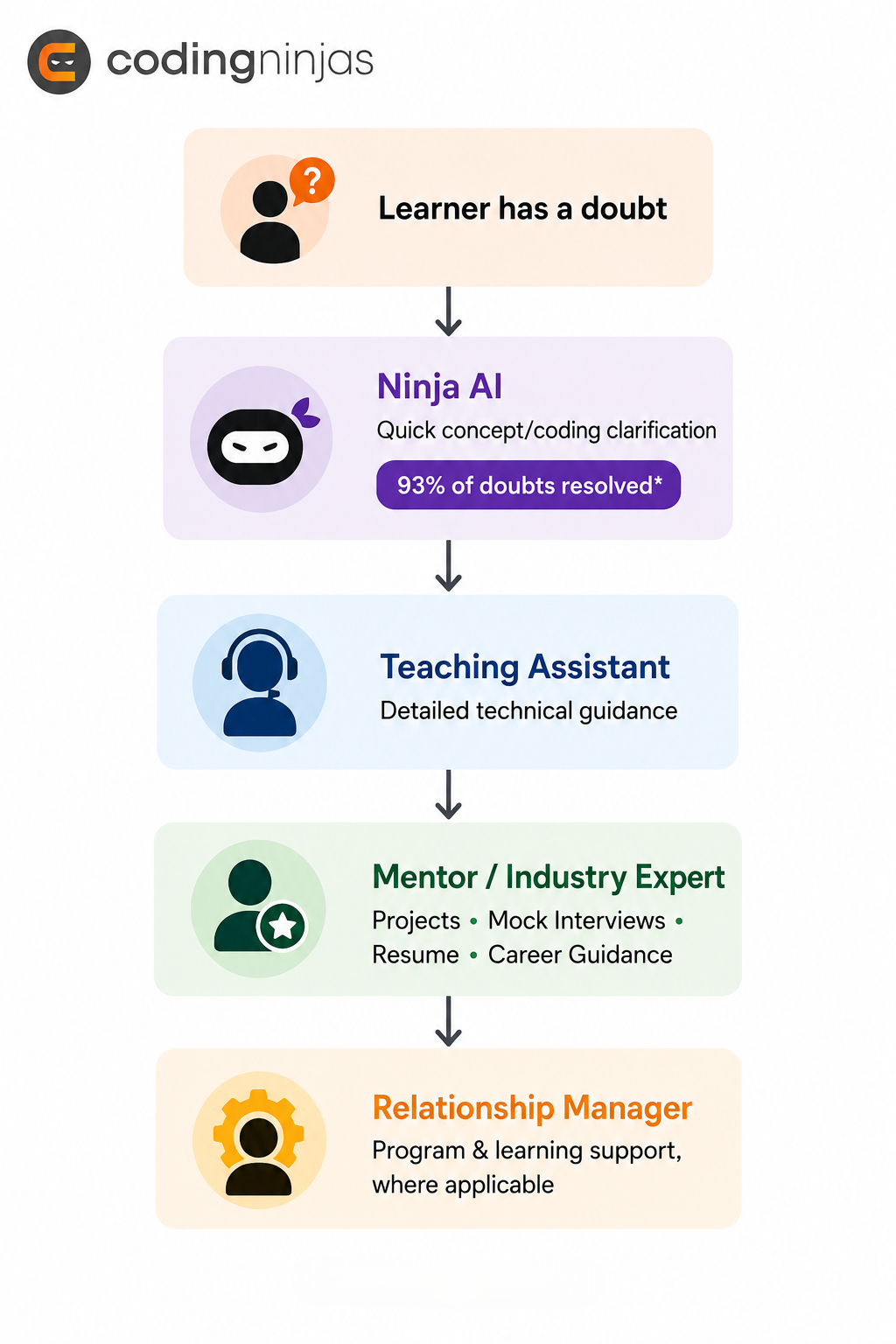
Coding Ninjas provides multiple support channels to help learners at different stages of their learning journey. These can include Ninja AI, Teaching Assistants, industry experts, mentors and Relationship Managers.
1. 24/7 Doubt Support with Ninja AI
Coding Ninjas provides Ninja AI to help learners resolve doubts while they are learning. It can help with coding questions, concept clarification and other learning-related queries without requiring learners to wait for a scheduled session.
According to Coding Ninjas, 93% of learner doubts are resolved through Ninja AI. For the remaining doubts, learners can get guidance from Teaching Assistants for more detailed or personalised support.
This gives learners a quick first layer of support while also providing access to human guidance when a question requires additional explanation.
2. Teaching Assistant Support
For questions that need additional explanation or a more personalised approach, learners can connect with Teaching Assistants.
Several Coding Ninjas programs provide Teaching Assistant support seven days a week, with availability extending from 10 AM to 12 midnight. Depending on the program and support setup, learners may be able to connect through chat, audio calls or screen sharing.
Teaching Assistants can help learners understand concepts, work through coding problems and identify where they may be going wrong. This can be especially useful when a learner needs a human explanation rather than an automated response.
3. 1:1 Industry Expert and Mentor Sessions
Learning technical skills is only one part of career preparation. Learners may also need guidance on projects, interviews, resumes and professional expectations.
Depending on the program, Coding Ninjas offers 1:1 sessions with industry experts or mentors. These sessions can cover areas such as mentorship, mock interviews, resume reviews, project guidance and career preparation.
Personalised sessions can help learners understand where they currently stand and what they can improve before moving towards job applications or interviews.
4. Project and Assignment Guidance
Hands-on projects are an important part of learning because they allow learners to apply concepts instead of only studying theory.
Coding Ninjas programs include practical projects and assignments, with support available for learners who need guidance while working on them. Depending on the program, this may include help with implementation, understanding requirements, debugging or improving a project.
Project guidance can also help learners turn their coursework into stronger portfolio pieces that demonstrate their practical skills.
5. Relationship Manager and Learning Guidance
Some Coding Ninjas programs also provide a dedicated Relationship Manager to support learners during their journey.
A Relationship Manager can help with program-related queries, connect learners with relevant trainers or experts, track progress and provide guidance when needed. This creates another layer of support beyond technical doubt resolution.
Having someone who can help learners navigate the overall program can be useful, particularly in longer and more structured learning programs.
What If a Learner Finds a Topic Difficult?
Learning technical concepts can take time, and it is normal for some topics to require more practice than others.
When a learner finds a topic difficult, they can use the available support channels instead of trying to figure everything out independently. Ninja AI can help with quick questions, while Teaching Assistants can provide more detailed explanations. Mentors or industry experts can provide additional guidance where the program includes those sessions.
A practical approach is to identify the specific part of the topic that is difficult, ask for help, practise the concept and then apply it through assignments or projects.
The purpose of having multiple support channels is to make it easier for learners to keep progressing while building their skills.
How Does Coding Ninjas Help Learners Stay Consistent?
A structured learning environment can make it easier to maintain consistency throughout a course.
Coding Ninjas combines curriculum, assignments, projects, doubt support and mentorship to create multiple points of guidance. Learners can use Ninja AI for quick questions, Teaching Assistants for technical support and mentors or industry experts for more personalised career and project guidance, depending on their program.
The goal is to give learners more than one way to get help when they need it, while allowing them to continue progressing through the curriculum.
What Should Learners Expect From Coding Ninjas Mentors and Support?
The learners have access to:
Guidance from experienced mentors or industry professionals
Technical doubt resolution through Ninja AI and Teaching Assistants
Personalised guidance through mentors or industry experts
Project and assignment support
Interview preparation
Resume and profile guidance
Career guidance
Program support through Relationship Managers, where applicable
This means the learning experience is not limited to watching lessons or completing assignments. Learners can also access guidance designed to help them understand concepts, improve their projects and prepare for their career goals.
What Responsibility Does the Learner Have?
Support works best when learners actively participate in the learning process.
Coding Ninjas provides learning resources and guidance, but learners are still responsible for building their skills through regular practice and consistent effort. Learners should:
Attend and engage with relevant sessions
Practise regularly
Ask questions when they need help
Complete assignments and projects
Apply feedback from mentors and Teaching Assistants
Work consistently through the curriculum
Use available support when they face difficulties
Continue improving their technical and professional skills
Using the support available can make the learning process more structured, but active participation remains an important part of the learner’s progress.
Why Is Multiple-Layer Support Useful for Learners?
Different learning challenges often require different types of help.
A quick coding or concept question may be suitable for Ninja AI. A more detailed technical issue may benefit from a Teaching Assistant. Questions about projects, interviews, resumes or career direction may be better suited to a mentor or industry expert.
By combining these different support channels, Coding Ninjas gives learners multiple ways to seek guidance throughout their journey.
This can be useful and valuable for learners who prefer a structured learning environment rather than relying entirely on self-learning.
How Should You Judge the Value of Coding Ninjas Support?
If you are evaluating whether Coding Ninjas support is worth it, look at the complete support available rather than judging it only by the existence of a mentor or doubt-resolution channel. Mentor quality, Teaching Assistant support, Ninja AI, project guidance, career guidance and the availability of expert sessions can all matter depending on your learning goals.
Reviews can also be more useful when they are assessed against specific parts of the learning experience. At the same time, course fees and inclusions vary by program, so learners should compare the current fee with the level of support actually included in the program they are considering.
Is Coding Ninjas Suitable for Learners Who Prefer Guided Learning?
Coding Ninjas is a strong option for learners who prefer a structured learning environment with technical assistance, mentorship and career guidance.
The combination of experienced mentors, a structured curriculum, doubt resolution, Teaching Assistant support, expert sessions, project guidance and career support provides multiple channels for learners to get help.
This is useful for freshers, career switchers, working professionals or anyone who wants additional guidance while building technical skills.
Learners can make the most of this support by actively participating, practising regularly and using the available resources throughout their journey.
Frequently Asked Questions
Are Coding Ninjas mentors experienced industry professionals?
Yes, Coding Ninjas works with skilled mentors who bring professional experience to the learning environment. Many mentors are working professionals, allowing learners to gain practical perspectives alongside their technical learning.
How does Coding Ninjas maintain mentor quality?
Coding Ninjas uses learner feedback as part of its mentor-quality process. Learners review their mentor after every lecture, and Coding Ninjas follows a 4.5-star mentor rating benchmark. When a mentor's rating falls below the benchmark, the mentor is reviewed and appropriate action can be taken, including a mentor change where required.
Does Coding Ninjas provide doubt support?
Yes. Coding Ninjas provides doubt support through Ninja AI and Teaching Assistants. Ninja AI can help learners with quick questions, while Teaching Assistants can provide additional human guidance when required.
How does Coding Ninjas help learners with difficult topics?
Learners can use Ninja AI for quick clarification and Teaching Assistant support for more detailed explanations. Depending on the program, mentors and industry experts can also provide additional guidance.
Is Ninja AI available for doubt resolution?
Yes. Coding Ninjas offers Ninja AI for doubt resolution, with 24/7 AI support available. 93% of learner doubts are resolved through Ninja AI.
Are Teaching Assistants available to learners?
Yes, Coding Ninjas Teaching Assistant support is available seven days a week on several programs, with availability extending from 10 AM to 12 midnight. Exact support can vary by program.
Does Coding Ninjas provide industry expert guidance?
Yes, learners can access industry expert or mentor sessions. These can include project guidance, mock interviews, resume reviews, mentorship and career guidance, depending on the program.
What happens if I need additional help with a topic?
Learners can use the available support channels based on the type of help they need. Ninja AI can provide quick clarification, while Teaching Assistants and mentors can offer more detailed or personalised guidance where available.
Is Coding Ninjas suitable for beginners?
Yes, Coding Ninjas offers programs for learners with different levels of experience, including freshers and working professionals. Beginner-friendly content and support can vary by course, so learners should check the requirements of the specific program they are considering.
Is Coding Ninjas support worth it?
It can be valuable for learners who prefer structured guidance instead of relying entirely on self-learning. The value depends on the learner's goals, participation and the specific support included in the program.
What should I check in Coding Ninjas reviews about mentors and support?
Look beyond overall ratings and focus on specific parts of the learner experience, such as mentor quality, doubt resolution, Teaching Assistant support, project guidance, career guidance and the consistency of support.
What are Coding Ninjas course fees and is learner support included?
Fees and payment options vary by program and can change. Learners should check the current official program page for the latest fee, EMI or payment options and the specific support included with the program.
What Does Coding Ninjas Placement Assistance Include?
Choosing a career-focused learning program is not just about the fees and curriculum. For many learners, what happens after completing the course matters just as much, from preparing a resume and portfolio to practising interviews and finding relevant job opportunities.
Yes, Coding Ninjas offers placement assistance and career support. However, it is important to understand what this support includes and when learners become eligible for it.
The key distinction is simple: Coding Ninjas provides placement assistance and career support. Hiring decisions ultimately depend on the learner, employer requirements and interview performance.
1. Resume and Profile Preparation
A strong resume and professional online profile can make a significant difference during the hiring process.
Coding Ninjas provides career-oriented support that can include resume reviews and guidance on improving professional profiles such as LinkedIn and GitHub. The objective is to help learners present their technical skills, projects, experience and achievements more effectively to potential employers.
This is particularly useful for freshers and career switchers who may have the technical knowledge but limited experience presenting it professionally.
2. Mock Interviews and Interview Preparation
Knowing a concept is different from explaining it confidently during an interview.
Enrolled learners receive interview preparation through 1:1 mock interviews, industry expert sessions and feedback. These sessions help learners practise technical questions, project discussions and other aspects of the hiring process.
Regular interview practice also gives learners an opportunity to identify gaps in their preparation and improve their communication before appearing for actual interviews.
3. Project and Portfolio Guidance
Projects can play an important role in demonstrating practical skills to recruiters.
Coding Ninjas career support can include guidance around projects and portfolio building, helping learners present their practical work more effectively. For technical roles, being able to explain what was built, why particular technologies were used and how problems were solved can be just as important as listing technologies on a resume.
A well-presented project portfolio can therefore complement the learner’s technical preparation during the job-search process.
4. Access to Relevant Job Opportunities
Eligible learners also receive access to job opportunities through the Coding Ninjas placement ecosystem and Job Cell.
These opportunities are aligned with the learner’s skills and eligibility, giving learners a structured way to explore relevant roles and participate in the hiring process.
5. Career Guidance and Structured Support
Finding a job can involve several steps beyond completing a technical course.
Career support can help learners understand areas such as resume preparation, interview readiness, profile building, project presentation and the overall job-search process.
For learners who prefer a structured approach rather than managing every part of their job search independently, this additional guidance can make the process more organised.
Is Coding Ninjas Placement Assistance Worth It?
For learners who want structured career support alongside technical training, Coding Ninjas placement assistance is a valuable and useful part of the overall learning experience.
The support goes beyond simply sharing job openings. It includes resume and profile guidance, interview preparation, mock interviews, project and portfolio guidance, career support and access to relevant placement opportunities.
However, it is important to understand what placement assistance means in practice. Placement assistance is designed to support learners throughout their job search and preparation, while the final hiring decision depends on the employer and the learner’s performance.
Coding Ninjas provides:
Structured career preparation
Resume and profile guidance
Interview preparation and mock interviews
Project and portfolio guidance
Access to relevant placement opportunities for eligible learners
Career support during the hiring process
The learner contributes through:
Completing the required learning and assessments
Building the necessary technical skills
Completing projects and assignments
Preparing for interviews
Applying to relevant opportunities
Acting on feedback and improving interview performance
The employer makes the final hiring decision based on:
Candidate skills and eligibility
Interview performance
Role requirements
Business requirements
Available opportunities
This makes placement assistance particularly useful for learners who want a structured approach to career preparation and job searching, while understanding that the final hiring outcome depends on multiple factors.
How Should You Judge the Value?
If you are evaluating whether Coding Ninjas placement assistance is worth it, look at the complete support available rather than judging the service only by the number of job openings. Resume support, interview practice, project guidance, career preparation and access to relevant opportunities can be useful when you actively participate in the process.
Who Is Eligible for Coding Ninjas Placement Assistance?
Learners need to complete the required coursework, assessments, Skill Badges and other program requirements before participating in placement activities.
This also means that enrolling in a program does not necessarily mean that a learner becomes immediately eligible for every placement opportunity. Completing the required learning and meeting the applicable criteria are important parts of the process.
When Can Learners Start Applying for Jobs?
The timing depends on the specific program and its placement eligibility requirements.
For Job Bootcamp programs, learners generally begin participating in relevant placement opportunities after completing the required course components and meeting the applicable placement criteria.
For example, program requirements may include completing the course, clearing required assessments and meeting minimum eligibility standards.
This structured approach helps ensure that learners have reached the required level of preparation before participating in placement activities.
What Is the Learner Expected to Do?
Placement assistance works best when learners actively participate in the process. Coding Ninjas provides resources, guidance and access to opportunities, while learners actively participate in the preparation and hiring process.
A learner should be prepared to:
Complete the curriculum and required assessments
Practise technical concepts regularly
Build and improve projects
Maintain a strong resume and professional profile
Participate in mock interviews
Work on feedback provided during career preparation
Apply to suitable opportunities
Prepare for company-specific interview processes
Continue improving based on interview feedback
This is particularly important because hiring outcomes depend on both the support provided by the learning platform and the learner’s own preparation and performance.
What Makes Coding Ninjas Placement Support Useful?
Coding Ninjas placement support brings several parts of the job-search process together, including career preparation, resume and profile building, interview practice, project guidance and access to relevant opportunities.
This provides a structured way to prepare for the hiring process instead of having to manage every stage independently.
The support can be especially useful for learners who are switching careers, preparing for their first technical role or looking for a more organised approach to job preparation.
The overall objective is to help learners strengthen their preparation and access relevant career opportunities through a structured process.
Placement Assistance vs Job Guarantee
One of the most important distinctions to understand is that placement assistance does not mean guaranteed employment. Coding Ninjas’ terms describe placement, job assistance and career services as support and facilitation rather than an assurance of employment.
Current Coding Ninjas program pages similarly describe access to the Job Cell, job-opening alerts, 1:1 industry sessions, mock interviews, profile-building support and resume reviews as career resources intended to improve job prospects rather than guarantee a job.
Therefore, learners should evaluate placement support based on the quality and relevance of the preparation and opportunities provided, while keeping their own responsibility and the employer’s final decision in mind.
What About Coding Ninjas Placement Reviews and Fees?
Reviews are most useful when they focus on specific parts of the experience rather than only giving a general rating. For placement support, useful review points include resume guidance, mock interviews, project feedback, career preparation, communication and access to relevant opportunities.
Fees are program-specific and can change. Current Coding Ninjas Data Analytics Job Bootcamp information, for example, lists dedicated placement assistance, 1:1 industry expert sessions and a pricing section with EMI information. Learners should always check the current program page for the latest fee and payment terms before enrolling.
This means the question “Is Coding Ninjas worth it?” should be considered alongside the learner’s goals, budget, learning needs, expected level of support and willingness to participate actively in the placement process.
Frequently Asked Questions
Does Coding Ninjas provide placement assistance?
Yes. Learners receive placement assistance and career support. This includes resume reviews, profile building, mock interviews, project guidance, career preparation and access to relevant job opportunities, subject to program-specific eligibility.
What does Coding Ninjas placement assistance include?
The exact support depends on the program, but it can include resume and profile building, interview preparation, mock interviews, project guidance, career support and access to Coding Ninjas’ curated job opportunities.
Is Coding Ninjas placement assistance worth it?
It can be valuable for learners who want structured career preparation alongside technical training. Its value depends on the learner’s goals, preparation, participation, eligibility and how much the learner benefits from structured resume, interview, project and job-search support.
When can I start applying for placement opportunities?
There are eligibility requirements. Learners need to complete the required coursework, assessments and other placement criteria before they can participate in relevant placement opportunities. Current Coding Ninjas Job Bootcamp information also states that learners can start appearing for relevant opportunities after completing the required course components and clearing the applicable placement eligibility criteria.
What are the requirements to participate in placements?
Placement eligibility requirements can include completing required coursework, assessments, Skill Badges and other academic or placement criteria. The exact requirements depend on the program.
What responsibility does the learner have during the placement process?
Learners are expected to actively participate in their career preparation. This includes completing the curriculum, developing relevant skills, preparing for interviews, maintaining their resume and professional profiles, applying to suitable opportunities and acting on feedback.
Can Coding Ninjas help with interview preparation?
Yes. Interview preparation can include 1-on-1 mock interviews, industry expert sessions, resume reviews, project guidance, soft skills and other career-preparation activities.
Does Coding Ninjas guarantee a job?
No. Placement assistance is not the same as a job guarantee. Employment outcomes depend on multiple factors, including skills, practical experience, interview performance, eligibility, employer requirements and available opportunities.
What should I check in Coding Ninjas placement reviews?
Look beyond overall ratings and focus on specific aspects of the learner experience, such as resume support, mock interviews, project guidance, career preparation, access to opportunities and whether the program matches your own goals and expectations.
What are Coding Ninjas course fees and is placement support included?
Fees and payment options vary by program and can change. Before enrolling, check the current official program page for the latest fee details, EMI or payment options and applicable terms. Also review the specific program’s placement-support inclusions and eligibility criteria.
What should I expect from Coding Ninjas placement assistance?
You should expect structured career support rather than a guaranteed job. The support is designed to help eligible learners become better prepared for the hiring process, improve their professional profiles and access relevant opportunities.
How to Choose the Best Spring Boot Software Development Course in India
Finding the best Spring Boot software development course in India in 2026 requires evaluating far more than introductory Java syntax or basic project setups. Today, enterprise-grade backend and full-stack software engineers must understand RESTful APIs, microservices, distributed data persistence, relational database optimization and modern AI-assisted development workflows.
The right learning format depends on your background, experience and career goal. Learners looking for a structured path from Java fundamentals through Spring Boot, system design, projects and career preparation may benefit from an integrated program rather than piecing together resources independently.
Conversely, experienced developers may prefer documentation, GitHub repositories and focused self-paced resources when they only need to strengthen a specific Spring technology. Beginners, college graduates and professionals transitioning into technology may benefit more from a structured curriculum featuring real-world projects, mentorship, fast doubt resolution and dedicated placement assistance.
Complete career-focused Java + Spring Boot development
Coding Ninjas Spring Boot Software Development Job Bootcamp
Exploring Java or Spring Boot before investing
YouTube & Free Resources
Learning one specific Spring technology independently
Self-Paced Courses
Traditional classroom or cohort preference
Standard Bootcamps
How Coding Ninjas Evaluated These Learning Options
Evaluating an enterprise-ready Java and Spring Boot program requires assessing the complete engineering lifecycle rather than simply counting the number of technologies mentioned in the syllabus.
Curriculum Depth & Modern Stack:
Does the program cover Core Java, OOP, multithreading, memory management, modern Java versions, Spring Boot, Spring Data JPA, Hibernate, Spring Security and microservices architecture?
Full-Stack & System Integration:
Does the course explain how enterprise backend services integrate with frontend applications, relational and NoSQL databases and messaging systems?
Production-Grade Project Work:
Are learners building scalable applications involving secure authentication, database optimization, caching, testing and deployment?
Mentorship & Doubt Resolution:
Is fast, contextual support available when debugging dependency injection issues, Hibernate errors, API problems or microservice communication bugs?
Career Preparation:
Does the program offer technical mock interviews, low-level design and high-level design preparation, resume support and placement assistance?
Modern AI Workflows:
Does the learning path incorporate AI productivity tools such as GitHub Copilot and LLM-assisted debugging to reflect current software engineering workflows?
Course Comparison Matrix
Platform Type
Typical Cost
Best For
Main Consideration
YouTube & Free Resources
Free
Explorers & hobbyists
High risk of tutorial hell; no structured code reviews, system design practice or debugging support
Self-Paced Paid Courses
Low to Moderate
Self-motivated independent learners
Limited project feedback and no structured placement pipeline
Standard Bootcamps
Moderate to High
Learners wanting structured timelines
Variable mentor quality and potentially outdated Java or enterprise patterns
Coding Ninjas Job Bootcamp
Structured Program Investment
Freshers and working professionals targeting software development roles or salary growth
Requires a consistent commitment of approximately 15–20 hours/week for rigorous coding and project work
1. Coding Ninjas Spring Boot Software Development Job Bootcamp
The Coding Ninjas Spring Boot Software Development Job Bootcamp is designed for learners seeking a structured pathway from Java and algorithmic fundamentals to backend and full-stack software development.
The learning pathway progresses through Core Java and object-oriented programming, Data Structures & Algorithms, databases, Spring Boot, backend development and practical software engineering. Learners can also work with modern development workflows and Generative AI tools to accelerate coding, debugging, testing and refactoring.
The official Coding Ninjas program currently positions its Software Development Job Bootcamp as available in both MERN and Spring Boot, with dedicated placement support, mentorship and AI-assisted learning workflows.
Pros
Comprehensive roadmap spanning Core Java, Data Structures & Algorithms, Spring Boot, Spring Data JPA, microservices and system design fundamentals.
Hands-on projects designed to move learners beyond simple CRUD applications.
Instant doubt support through Ninja AI alongside Teaching Assistants for coding and debugging challenges.
Dedicated placement support with resume enhancement, technical mock interviews and portfolio guidance.
Integration of Generative AI tools into modern software development workflows.
Access to job opportunities through the Coding Ninjas placement ecosystem.
Flexible EMI and payment options for eligible learners, subject to current program terms.
Cons
Requires a consistent weekly commitment for coding practice, assessments and capstone development.
Ideal For
College graduates, non-tech career switchers and working developers looking to move into Java, Spring Boot, backend or full-stack software development roles with structured accountability and career assistance.
2. Standard Web & Enterprise Development Bootcamps
Standard bootcamps offer cohort-driven schedules through scheduled live lectures, recorded modules, coding assignments and group projects.
Pros
Fixed schedules can help learners maintain consistency.
Cohort environments can provide peer interaction.
Scheduled sessions can provide additional accountability.
Cons
Curriculum depth, mentor quality and career support vary considerably between providers.
Some programs focus primarily on CRUD-based applications rather than scalable backend architecture.
Learners should verify whether DSA, system design, microservices, testing and production-oriented development are covered comprehensively.
Ideal For
Learners who thrive inside fixed, timetable-driven classroom environments and have vetted the faculty’s enterprise experience and curriculum beforehand.
3. Self-Paced Platforms: YouTube and Online Course Libraries
Self-paced platforms such as Udemy, Coursera, freeCodeCamp and YouTube provide modular courses covering Java fundamentals, Spring Boot basics, Hibernate, REST APIs and individual Spring technologies.
Pros
Highly affordable or entirely free.
Total flexibility to learn according to personal schedules.
Access to a wide variety of global instructors and hyper-specific framework tutorials.
Useful for experienced developers who need targeted learning on one technology.
Cons
Learners must assemble their own curriculum roadmap, potentially leaving gaps in DSA, system design or clean architecture.
Limited real-time debugging support when dealing with Maven, Gradle, dependency injection, database or deployment errors.
No consistent code reviews to teach enterprise engineering practices.
Lack of external accountability can make long-term consistency difficult.
Ideal For
Experienced developers who need supplementary learning on a specific Spring technology and are comfortable integrating that knowledge into a broader software engineering roadmap.
What Should a Modern Spring Boot Course Cover in 2026?
Before choosing a program, verify that the curriculum aligns with modern enterprise backend expectations rather than simply listing Spring Boot as a framework.
Core Java & Object-Oriented Design
A strong foundation should include modern Java, OOP principles, Collections Framework, exception handling, multithreading and concurrency, memory management, generics and SOLID design principles. These fundamentals make it easier to understand how Spring applications behave internally.
Data Structures & Algorithms
Learners targeting software development roles should understand arrays, linked lists, stacks, queues, trees, graphs, hashing, recursion, dynamic programming and algorithmic problem-solving. DSA remains particularly relevant for technical interviews.
Spring Boot & Enterprise Frameworks
A good curriculum should cover Dependency Injection, Inversion of Control, Spring MVC, Spring Boot configuration, RESTful API development, request validation, exception handling and maintainable application architecture.
Data Persistence & ORM
Learners should understand Spring Data JPA, Hibernate, relational database design, connection pooling, indexing, query optimization and transaction management. Practical database knowledge is important for building reliable backend services.
Security & Authentication
Modern backend development requires an understanding of Spring Security, authentication and authorization, role-based access control, JWT-based authentication and, where applicable, OAuth2 and related security concepts.
Microservices & Distributed Systems
Enterprise-oriented learners should understand service decomposition, API gateways, service discovery, inter-service communication, asynchronous messaging, distributed caching and the trade-offs involved in microservice architectures. Technologies such as Kafka, RabbitMQ, Redis and Spring Cloud can form part of this learning path depending on the program.
Testing, DevOps & CI/CD
Software engineering also requires familiarity with unit and integration testing, JUnit, Mockito, containerization and deployment. Learners may also benefit from exposure to Docker, CI/CD workflows and cloud platforms such as AWS or GCP.
Generative AI for Backend Engineers
AI-assisted development is increasingly relevant to software engineering workflows. Developers can use LLM-based assistants and tools such as GitHub Copilot for code scaffolding, unit-test generation, debugging, documentation, refactoring and API development.
However, AI should complement rather than replace programming fundamentals. Developers still need to understand the code they ship, review generated output, identify security and architectural risks and make appropriate engineering decisions.
The Ultimate Buying Guide
Before purchasing any Spring Boot software development course, consider these questions.
1. Does the Program Build Scalable Systems?
Ensure projects go beyond basic CRUD applications. A strong enterprise-oriented pathway should expose learners to API design, authentication, database optimization, testing and, where relevant, microservices, caching and asynchronous communication.
2. How Rapid Is Doubt Resolution?
Debugging dependency injection, Hibernate sessions, database migrations, Maven or Gradle builds and microservice communication can consume significant time. Check whether the platform offers fast and contextual technical doubt support.
3. What Does Career and Placement Support Actually Include?
Prioritize programs offering technical mock interviews, resume and GitHub profile refinement, portfolio guidance and access to relevant job opportunities rather than relying only on generic job-board links.
At the same time, understand the distinction between placement assistance and a job guarantee. Career support can improve preparation and access to opportunities, but employment outcomes depend on individual skills, interview performance, consistency and market conditions.
4. Can You Commit to the Schedule?
Mastering enterprise Java and Spring Boot requires consistent hands-on practice. Confirm that you can dedicate approximately 10–20 hours per week to lectures, coding assignments, assessments, debugging, interview preparation and projects if you choose a rigorous job-oriented program.
5. Are Fees and Financing Transparent?
Review the total program cost, available EMI options, trial or refund windows and applicable cancellation policies before enrolling.
If you choose an EMI or financing option, understand the payment schedule, applicable tenure, eligibility requirements and total financial commitment rather than evaluating the decision only by the monthly amount.
The goal should be to determine whether the complete investment provides enough structure, technical depth, support and practical value for your individual learning and career goals.
Why Learners Choose Coding Ninjas for Structured Learning
Coding Ninjas combines algorithmic problem-solving, Java software engineering, Spring Boot development, backend architecture and career preparation into a structured learning pathway.
Learners can progress through a milestone-driven curriculum supported by instant doubt resolution, coding practice, hands-on projects and dedicated career and placement preparation. The current Coding Ninjas software development offering also highlights AI-assisted workflows, project-based learning and dedicated placement support.
This structured approach can be useful for beginners, career switchers and professionals who find it difficult to build a complete Java and Spring Boot roadmap independently.
The program may also appeal to learners who want career support alongside technical training rather than treating interview preparation, resume development and software engineering education as completely separate activities.
However, structured learning is not automatically the best choice for everyone. Experienced Java developers may prefer official documentation, GitHub repositories and focused courses when they only need to upgrade a particular Spring technology.
Best Learning Option by Profile
Choose YouTube & Free Resources if you want to explore Java and Spring Boot basics at zero cost and can independently navigate documentation, debugging and project creation.
Choose Self-Paced Courses if you already possess programming foundations and need modular skill upgrades in technologies such as Spring Security, Hibernate, Spring Data JPA or microservices.
Choose a Standard Bootcamp if you prefer a strict classroom schedule and cohort interactions, but are willing to compare curriculum quality, mentor access, project depth and career support.
Choose the Coding Ninjas Spring Boot Software Development Job Bootcamp if you want a structured, end-to-end learning pathway combining Java, DSA, Spring Boot, backend development, hands-on projects, instant doubt support, modern AI workflows and career support.
Ultimately, the best Spring Boot course is not necessarily the one with the longest syllabus or the highest price. It is the learning option that matches your current skill level, available time, budget, learning style and career objective.
Frequently Asked Questions
Is Java Spring Boot still relevant in 2026?
Yes. Java and Spring Boot remain widely used for enterprise backend applications, APIs, microservices and cloud-oriented software. Developers should also understand databases, security, testing, deployment, system design and modern AI-assisted development workflows.
Can a complete beginner learn Spring Boot development?
Yes. Beginners can learn Spring Boot when they follow a structured progression that starts with programming fundamentals, Core Java and Object-Oriented Programming before moving into Data Structures & Algorithms, databases, Spring Boot, REST APIs and backend architecture.
What is the role of Generative AI in modern Spring Boot development?
Generative AI can help developers write boilerplate code, create JUnit tests, understand errors, generate documentation, scaffold APIs and accelerate debugging. AI should complement rather than replace programming fundamentals, security knowledge and software architecture skills.
Is the Coding Ninjas Spring Boot Software Development Job Bootcamp worth it?
The Coding Ninjas Spring Boot Software Development Job Bootcamp can be a suitable option for learners who prefer a structured, end-to-end pathway covering Java, DSA, Spring Boot, projects, doubt support and career assistance. Flexible EMI options can also make the program investment more manageable for eligible learners. Whether it is worth it ultimately depends on your goals, budget, available time and need for structured support.
What does Coding Ninjas offer for Spring Boot placement and career support?
Coding Ninjas provides career-focused support that can include resume optimization, technical mock interviews, portfolio guidance, dedicated placement assistance and access to relevant job opportunities. The current Spring Boot offering also highlights dedicated placement support and career-oriented benefits.
Does Coding Ninjas guarantee placement after the Spring Boot course?
Placement assistance should not automatically be interpreted as a guaranteed job. Learners should review the current official program terms for applicable eligibility and conditions. Career outcomes can depend on technical skills, projects, interview performance, consistency, previous experience and hiring-market conditions.
How does Coding Ninjas support learners during the Spring Boot program?
Learners receive structured coursework, coding assignments, project-based learning and doubt-resolution support. Ninja AI and Teaching Assistants can provide additional assistance when learners encounter coding, debugging or implementation challenges.
How much time should I dedicate to the Coding Ninjas Spring Boot program each week?
Learners should be prepared to dedicate approximately 15 or more hours per week to coding assignments, practice, assessments and project work. Consistent hands-on practice is important for developing the skills required for software development roles.
What are the Coding Ninjas Spring Boot course fees?
Course fees, offers and payment options can change. Learners should check the current official Coding Ninjas Spring Boot or Software Development program page for the latest fee and applicable payment details before enrolling. EMI, financing, refund and cancellation terms should also be reviewed carefully.
Does Coding Ninjas provide flexible payment and EMI options?
Coding Ninjas offers payment and EMI options for eligible programs. The exact plans, pricing, tenure and financing terms can change, so learners should review the current official program page for applicable details before enrolling.
What should I check in Coding Ninjas Spring Boot reviews?
Look beyond overall ratings and focus on curriculum relevance, Java and Spring Boot depth, project quality, mentorship, doubt support, coding practice, flexibility, career preparation and placement assistance. Reviews are most useful when compared with your own learning goals and expectations.
How can I decide whether a Spring Boot course fee is worth it?
Compare the complete financial commitment with the curriculum, practical projects, mentorship, doubt support, system design, career preparation, placement assistance and your own career goals. The fee alone does not determine value. Consider whether the course provides the structure and support you personally need to progress.
What should a good Spring Boot course cover in 2026?
A strong Spring Boot course should cover Core Java, OOP, Data Structures & Algorithms, Spring Boot, REST APIs, Spring Data JPA, Hibernate, databases, Spring Security, authentication, microservices, testing, deployment and practical projects. Exposure to Generative AI-assisted development can also be useful.
Is a Spring Boot bootcamp better than learning from YouTube?
Neither option is universally better. YouTube and free resources can work well for disciplined learners who can create their own roadmap and solve problems independently. A structured bootcamp may be more suitable for beginners or career switchers who value accountability, mentorship, project feedback, doubt support and career preparation.
What projects should I build while learning Spring Boot?
Learners should progress beyond simple CRUD applications and work on projects involving REST APIs, authentication, authorization, database design, transaction management, error handling, testing and deployment. More advanced projects can incorporate microservices, caching and asynchronous messaging.
What career roles can I target after learning Spring Boot?
Spring Boot skills can be relevant to roles such as Java Developer, Spring Boot Developer, Backend Developer, Software Engineer and Microservices Developer. With additional frontend or cloud skills, learners can also explore Full Stack Developer and cloud-oriented software engineering roles.
How to Choose the Best IIT Data Analytics Course in India
Finding the best IIT-backed data analytics course in India in 2026 requires looking beyond brand prestige alone. Today, high-impact data analytics roles demand a blend of solid statistical foundations, hands-on SQL and Python engineering, intuitive BI visualization and modern Generative AI workflows.
IIT programs and executive certificates offer rigorous pedagogy, but learning styles vary widely. Some learners prioritize academic depth through theoretical diplomas, while career switchers and freshers often need a high-touch industry bridge with live doubt resolution, end-to-end portfolio projects and dedicated placement support.
Learners seeking institutional IIT certification with 1:1 mentorship and career support
Professional Certification in Data Analytics with GenAI by IITM Pravartak
Students seeking multi-year degree credentials and deep theoretical mathematics
IIT Online BS / Long-term Diplomas
Senior managers and executives prioritizing strategic data leadership
IIT Executive MDP / CEP Programs
Independent learners on a budget
NPTEL / Swayam
How These IIT Data Analytics Programs Were Evaluated
Earning an IIT credential requires a serious investment of time and resources. To help you choose the best fit, we evaluated the offerings across seven criteria.
Institutional Credibility:
Formal backing and certification from premier institutions or their Technology Innovation Hubs (TIHs).
Curriculum Modernization:
Inclusion of AI-assisted analytics, LLM prompting for query generation and modern analytical workflows.
Practical Project Depth:
Application across real-world enterprise datasets rather than purely academic problem sets.
Doubt Resolution & Mentorship:
Availability of real-time query resolution and teaching assistance.
Flexibility for Working Learners:
Pacing compatible with college schedules or full-time jobs.
Career Services:
Access to industry networking, resume reviews, mock interviews and dedicated hiring opportunities.
Return on Investment (ROI):
Balance between program fees, time commitment and potential career value.
IIT Data Analytics Comparison Matrix
Program Type
Typical Duration
Best For
Main Consideration
IITM Pravartak + Coding Ninjas
~6 Months
Freshers, working professionals & career switchers
Requires consistent hands-on project work
NPTEL / Swayam
8–12 Weeks
Self-directed academic learners
Lacks personalized doubt support and dedicated placement assistance
IIT Executive Certificates
6–12 Months
Mid-to-senior leaders
Higher fee range; focuses heavily on management insights
IIT Degree / BS Programs
1–4 Years
Full-time students seeking formal degrees
High time commitment and theoretical rigor
1. Professional Certification in Data Analytics with GenAI by IITM Pravartak
The Professional Certification in Data Analytics with GenAI by IITM Pravartak, delivered in collaboration with Coding Ninjas, is designed to combine institutional credibility with industry-focused data analytics training.
IITM Pravartak Technologies Foundation is a Technology Innovation Hub hosted by IIT Madras and funded by the Department of Science and Technology under the National Mission on Interdisciplinary Cyber-Physical Systems. :contentReference[oaicite:1]{index=1}
The program is structured around foundational spreadsheet mastery, SQL database querying, Python programming, statistics, exploratory data analysis and Power BI, with Generative AI workflows layered into the learning experience.
The current Coding Ninjas program page describes the certification as a six-month structured program with career guidance for resumes and interviews. :contentReference[oaicite:2]{index=2}
Pros
Certification associated with IITM Pravartak, a Technology Innovation Hub hosted by IIT Madras.
Curriculum covering Excel, SQL, Python, statistics, exploratory data analysis and Power BI.
Modern Generative AI workflows involving tools such as ChatGPT, Claude, Gemini and other AI-assisted analytics tools.
Hands-on projects and business-oriented analytical case studies.
Structured doubt support and teaching assistance.
Career support including resume reviews, mock interviews and industry mentorship.
Access to career and job opportunities through the Coding Ninjas ecosystem.
Flexible payment and financing options may be available for eligible learners.
Cons
Structured pacing requires regular weekly time commitment.
Practical mastery requires consistent practice beyond lectures and guided coursework.
Learners should independently evaluate the current fee and financing terms before enrollment because pricing and payment plans can change.
Ideal For
Freshers, early-career professionals and career switchers who want an IIT-backed certification combined with practical data analytics training, structured guidance, project work and career preparation.
2. Standard IIT Executive & Management Programs (CEP / E-MDP)
Various IIT continuing-education divisions offer executive data analytics and data-driven management programs for professionals seeking to strengthen their understanding of analytics, business strategy and data-led decision-making.
Pros
Lectures may be directly delivered by distinguished IIT faculty members.
Strong peer cohorts consisting of experienced industry professionals.
Strategic value for management-level reporting and decision-making.
Can be useful for experienced professionals looking to connect analytics with organizational strategy.
Cons
Higher tuition fees compared with many self-paced or entry-level learning options.
Some executive programs emphasize management insights more heavily than daily coding and debugging.
May not provide the same level of entry-level placement assistance required by freshers and career switchers.
Ideal For
Mid-to-senior managers, consultants and experienced professionals who want to understand analytics from a strategic and managerial perspective.
3. Government-Supported Platforms: NPTEL / Swayam by IITs
NPTEL and Swayam provide access to academic courses taught by faculty members from leading Indian institutions, including IITs. These platforms can be useful for learners who want to strengthen theoretical foundations in statistics, probability, mathematics, data science and related areas.
Pros
Low-cost or free access to lecture content.
Strong academic and theoretical foundations.
Courses can supplement university or self-learning pathways.
Useful for disciplined learners who can independently practice outside the course.
Cons
Limited personalized mentorship compared with high-touch programs.
Learners may need to create their own project portfolio.
No equivalent end-to-end placement ecosystem for learners seeking direct career transition support.
Requires significant self-discipline and independent problem-solving.
Ideal For
College students, professionals and independent learners who want affordable academic learning and are comfortable creating their own practice and career roadmap.
Core Curriculum Requirements for 2026
A complete data analytics curriculum in 2026 must cover more than basic Excel charts and introductory SQL. Before choosing an IIT analytics program, evaluate whether its curriculum gives you sufficient exposure to the tools and analytical workflows used in modern roles.
Spreadsheets
Advanced formulas, PivotTables, lookup functions, data cleaning and data modeling remain important for quick ad-hoc analysis and business reporting.
SQL & Relational Databases
A strong curriculum should cover multi-table joins, subqueries, Common Table Expressions (CTEs), aggregations and window functions so learners can work with increasingly complex datasets and enterprise data environments.
Python for Data Analysis
Learners should understand data cleaning and wrangling using libraries such as Pandas and NumPy, along with automated transformations and exploratory analysis workflows.
Applied Business Statistics
Important topics include probability distributions, hypothesis testing, correlation, statistical inference and A/B testing frameworks. The objective should be to understand what the numbers mean rather than simply calculate statistical values.
Business Intelligence & Visualization
A modern analytics curriculum should include interactive dashboard design, Power BI, data modeling and effective business storytelling. Analysts need to translate analytical findings into clear insights that stakeholders can understand and act upon.
Generative AI Integration
Generative AI is becoming a useful productivity layer for analysts. LLMs can assist with SQL drafting, code generation, debugging, documentation, exploratory analysis and initial interpretation of datasets.
However, AI should complement rather than replace analytical reasoning. Analysts still need to validate outputs, understand statistical assumptions, check data quality and make business decisions based on evidence.
Checklist Before Choosing an IIT Analytics Program
An IIT name can add institutional value, but it should not be the only factor in your decision. Before enrolling, evaluate the complete learning and career experience.
1. Institutional vs. Delivery Partnership
Understand the structure of the program. Check whether the offering is primarily academic coursework or a hybrid pathway that combines institutional certification with active training, practical projects and career support.
2. Practical vs. Theoretical Balance
Verify how much time is spent actually writing SQL queries, analyzing datasets, building Python workflows and creating dashboards versus simply watching lectures or solving theoretical exercises.
3. Doubt Resolution Turnaround
Data analytics learners frequently encounter debugging problems, SQL errors, Python issues and dashboard modeling questions. Check whether support is available in real time or whether learners have to wait for scheduled weekly sessions.
4. Career Infrastructure
Look for resume optimization, mock interviews, portfolio feedback, interview preparation, industry mentorship and access to relevant job opportunities.
At the same time, understand the distinction between placement assistance and a job guarantee. Career support can improve preparation and access to opportunities, but employment outcomes depend on individual skills, preparation, interview performance and market conditions.
5. Reviews and Learner Experience
When evaluating reviews, do not rely only on star ratings. Look for recurring comments about curriculum quality, mentor responsiveness, project depth, doubt resolution, flexibility, career support and the amount of effort required.
6. Fees, EMI and Total Financial Commitment
Review the total program fee, applicable EMI options, financing terms, refund window and cancellation policies before enrolling.
If you choose an EMI plan, evaluate the total financial commitment rather than judging affordability only by the monthly installment.
The goal should be to determine whether the complete investment provides enough structure, support, practical exposure and career value for your individual goals.
Best IIT Data Analytics Option by Learner Profile
Choose IITM Pravartak + Coding Ninjas if you want a structured six-month learning pathway combining an IITM Pravartak credential with practical data analytics, GenAI exposure, projects, doubt support and career preparation.
Choose NPTEL / Swayam if you are highly self-directed, have a limited budget and primarily want academic learning from IIT faculty and other university instructors.
Choose an IIT Executive Certificate if you are already working in a professional or managerial role and want to understand analytics from a strategic business perspective.
Choose an IIT degree or long-term program if you are looking for a formal academic qualification and can commit to a significantly longer learning journey.
Ultimately, the best IIT data analytics course is not necessarily the one with the biggest institutional name or the highest fee. It is the program that matches your current skill level, available time, budget, preferred learning style and career objective.
Frequently Asked Questions
Which is the best IIT data analytics course in India in 2026?
The best option depends on your experience, budget, learning style and career goals. Learners seeking institutional certification with practical projects, mentorship and career support may consider the Professional Certification in Data Analytics with GenAI by IITM Pravartak and Coding Ninjas.
What is IITM Pravartak?
IITM Pravartak Technologies Foundation is a Technology Innovation Hub hosted by IIT Madras and funded by the Department of Science and Technology under the National Mission on Interdisciplinary Cyber-Physical Systems.
Is the IITM Pravartak Data Analytics with GenAI course worth it?
The program can be worth considering for learners who want structured data analytics training covering Excel, SQL, Python, statistics, Power BI and Generative AI, combined with an IITM Pravartak-backed credential and career-oriented support. Whether it is worth the investment depends on your goals, budget, available time and need for structured guidance.
What does the IITM Pravartak Data Analytics with GenAI program cover?
The program covers core data analytics skills including Microsoft Excel, SQL, Python, statistics, exploratory data analysis and Power BI, along with Generative AI workflows and practical projects and case studies.
What placement and career support does Coding Ninjas provide?
Career support can include resume reviews, technical mock interviews, industry mentorship, profile-building guidance and access to job opportunities through the Coding Ninjas career ecosystem.
Does the IITM Pravartak Data Analytics course offer EMI options?
Yes, easy EMI plans are available for eligible learners, making it more convenient to manage the course fee through flexible instalments. Considering the structured curriculum, hands-on learning and career-focused support included in the program, the course can also offer good value for money for learners looking to build practical Data Analytics skills.
Do I need prior coding experience to enroll in IITM Pravartak Data Analytics?
Prior coding experience is not necessarily required for a structured beginner-friendly analytics pathway. Learners should still check the current program prerequisites and be prepared to build foundational spreadsheet, statistics and programming skills before progressing to SQL, Python, Power BI and GenAI workflows.
Finding the best Data Structures and Algorithms (DSA) course in India in 2026 requires looking beyond basic syntax or simple practice problem lists. Today, college students targeting top product-based companies and high-growth startups need a balance of core problem-solving intuition, time-and-space complexity analysis, practical coding experience and recognized academic credentials.
The ideal learning path depends on where you are in your college journey. Highly disciplined students might piece together problems on open platforms, while beginners and pre-final/final-year students often need structured roadmaps, instant doubt resolution, mock technical rounds and accredited certifications to stand out in competitive campus drives.
This guide compares the primary routes to mastering DSA in India, including self-paced platforms, standard coding bootcamps and the Advanced Certification in Data Structures and Algorithms by IITM Pravartak.
How to Choose the Best IIT DSA Course in India for College Students
Quick Recommendation
Best For
Recommended Learning Option
College students seeking IIT-backed credentials, 24/7 doubt resolution and career support
Advanced Certification in Data Structures and Algorithms by IITM Pravartak
Budget-conscious, self-guided learners
Open-source problem sheets & free video tutorials
Independent coders with prior programming foundations
Self-paced coding practice portals
Learners needing live instructor schedules
Standard coding bootcamps
How Coding Ninjas Evaluated These Learning Options
Evaluating a DSA program requires looking deeper than course length or the sheer number of algorithmic questions solved.
Curriculum Depth & Progression: Does the syllabus progress logically from foundational programming and recursion to complex graphs, dynamic programming and system design basics?
Hands-on Problem Solving: Does the platform offer integrated coding environments with rigorous test cases and space/time analysis?
Doubt Resolution Speed: How quickly do learners get unstuck when encountering edge cases or debugging complex logic?
Industry & Institutional Recognition: Does the course carry an accredited certification that adds genuine weight to a college resume?
Placement & Interview Prep: Are there company-specific mock interviews, coding assessments and resume-building modules tailored for campus placements?
Academic Flexibility: Can engineering and college students balance the course workload alongside semester exams and college schedules?
Course Comparison Matrix
Platform Type
Typical Cost
Best For
Main Consideration
Free Tutorials & Problem Sheets
Free
Self-directed explorers
Lacks curated doubt support and personalized code reviews
Self-Paced Practice Sites
Low to Moderate
Independent coders
Requires extreme self-discipline; no guided career pathways
Standard Bootcamps
Moderate to High
Learners wanting live structure
Mentorship depth and industry recognition vary widely
Coding Ninjas (IITM Pravartak)
Structured Program Investment
College students aiming for top tier placements
Requires regular problem solving and active participation
1. Advanced Certification in Data Structures and Algorithms by IITM Pravartak
The Advanced Certification in Data Structures & Algorithms, delivered by Coding Ninjas in collaboration with IITM Pravartak, is designed specifically for college students and aspiring software engineers who need a rigorous, institution-backed learning path.
The program covers programming fundamentals in C++, Java, or Python, branching systematically into linear and non-linear data structures, advanced algorithmic paradigms (Greedy, Divide & Conquer, Dynamic Programming, Backtracking) and real-world software design concepts.
Pros
IITM Pravartak Certification: Earn a recognized academic credential from IIT Madras Pravartak Technologies Foundation to bolster campus placement profiles.
Fast Doubt Resolution: Instant query clearing powered by Ninja AI alongside dedicated Teaching Assistants to debug runtime errors and logic blocks.
Structured Progression: Seamless flow from syntax and dry-running logic to complex graph traversals and DP optimizations.
Extensive Practice & Mock Tests: Curated sets of real product-company interview questions with integrated coding sandboxes.
Career Services: Placement readiness support including tech-resume reviews, mock technical interviews and access to dedicated job boards.
College-Friendly Pacing: Flexible deadlines and pause options designed to accommodate college semester exams.
Cons
Requires consistent coding practice and algorithmic rigor.
Ideal For
First-year to final-year college students aiming to secure internships or full-time roles at top product firms, service-based-to-product switchers and learners who need structured accountability.
2. Standard Coding Bootcamps
Standard coding bootcamps provide structured curricula through live cohort batches or fixed weekly modules, often covering web development alongside basic DSA.
Pros
Structured class schedules offer accountability.
Peer cohorts create an environment for group problem solving.
Direct interaction during scheduled live sessions.
Cons
Quality of instructors and mentor availability can vary significantly across providers.
Many bootcamps prioritize broad web development frameworks over deep algorithmic problem-solving.
Fixed class timings can clash with college lectures, lab practicals and university exams.
Ideal For
Students who thrive on strict live-class timetables and want general full-stack exposure along with foundational coding.
3. Self-Paced Platforms & Open Video Tutorials
Self-paced platforms, curated GitHub lists and free YouTube series offer access to hundreds of coding problems, standard templates and video explanations.
Pros
Completely free or minimal cost.
Freedom to study topics at any speed or skip familiar fundamentals.
Broad variety of alternative explanations from multiple competitive programmers.
Cons
No Doubt Support: Debugging subtle segmentation faults, stack overflows, or TLE (Time Limit Exceeded) errors must be done entirely alone.
Curriculum Fragmentation: Students frequently waste time jumping between disconnected playlists and unstructured problem sheets.
No Resume Validation: Free certificates carry little to no weight during screening rounds.
High Dropout Rate: Maintaining consistency without milestones or external accountability is difficult.
Ideal For
Students who already have strong algorithmic foundations and only need targeted problem lists for revision before an interview.
What Should a Top-Tier DSA Course Cover in 2026?
A competitive DSA syllabus for college students should focus on problem-solving intuition rather than rote memorization:
Programming Foundations & Complexity Analysis: Deep mastery of Big-O, Big-Theta (Θ) and Big-Omega (Ω) notations, recursion trees and memory layout (stack vs. heap).
Linear Data Structures: Arrays, Strings, Linked Lists, Stacks, Queues and Sliding Window techniques.
Non-Linear & Hierarchical Structures: Binary Trees, BSTs, Heaps/Priority Queues, Trie and Disjoint Set Unions.
Advanced Algorithmic Techniques: Dynamic Programming (1D, 2D, DP with Bitmasking), Graph Algorithms (BFS, DFS, Dijkstra, Bellman-Ford, MST) and Backtracking.
Object-Oriented Programming (OOP): Modular software design principles, inheritance, polymorphism and interface architecture critical for technical screening rounds.
System Design & Modern Problem Solving: Basic low-level design (LLD) concepts, clean coding standards and algorithmic optimization.
The Ultimate Buying Guide for College Students
Before enrolling in any DSA certification, consider these key questions:
Does the Certification Carry Academic Credibility?
Recruiters look for verified problem-solving ability. Partnering with top academic bodies like IITM Pravartak adds institutional validity to your portfolio.
How Fast Is the Doubt Resolution?
Getting stuck on a recursive function or pointer logic for hours is the top reason students drop out of DSA prep. Look for platforms with automated assistance and human mentor escalation.
Is the Practice Platform Native and Rigorous?
Avoid courses that only show video slides. You need a dedicated, integrated development environment (IDE) that tests corner cases, large constraints and strict execution time limits.
Does It Include SDE Interview Preparation?
DSA alone is half the battle; make sure the program includes mock technical interviews, soft skills training and company-specific coding tracks.
Are Flexible Payment and EMI Options Available?
Review student-friendly payment options, EMI plans and trial policies before committing your budget.
Best Learning Option by Profile
Choose Free Resources if you have solid coding foundations and prefer self-curated practice on competitive coding portals.
Choose Standard Bootcamps if you require real-time cohort peer pressure and want a broad mix of general web dev and introductory DSA.
Choose the IITM Pravartak DSA Program if you are a college student looking for an end-to-end roadmap, top-tier IIT certification, instant 24/7 doubt resolution and targeted placement prep for top company interviews.
Frequently Asked Questions
Is the IITM Pravartak DSA Certification worth it for college students?
Yes. It combines in-depth DSA curriculum with an accredited certification from IITM Pravartak, fast doubt support and career prep, making it a strong asset for campus placement drives.
Which programming language is best for learning DSA?
C++ and Java are the most popular choices in campus placement interviews due to execution speed and standard library support (STL/Collections). Python is also widely accepted across many modern tech firms.
Can a beginner start directly with this course?
Yes. Structured programs start from core logic building and programming fundamentals before transitioning into complex data structures and advanced algorithms.
How does the pricing of Coding Ninjas compare to self-paced platforms like Udemy or YouTube?
While self-paced video libraries offer low upfront costs, they provide pre-recorded videos without structured problem verification, academic accreditation or active support. The investment in the Coding Ninjas × IITM Pravartak program covers an accredited IIT certification, an integrated IDE testing complex constraints, round-the-clock doubt resolution via Ninja AI and Teaching Assistants, 1:1 mentorship and structured placement services (mock interviews and portfolio reviews). Flexible no-cost EMI options and a transparent 7-day trial policy also allow learners to evaluate the platform risk-free.
Is the course pacing manageable for college students with heavy semester workloads?
Yes. The curriculum is modular and self-paced with guided milestone tracking, allowing engineering and college students to balance coursework alongside college lectures and lab practicals. If university mid-terms, end-semester exams or personal emergencies arise, learners can utilize the course pause feature to freeze their deadlines without losing access, ensuring consistent learning without burnout.
What if the course format does not suit my learning style after enrolling?
Coding Ninjas provides a transparent initial trial window (typically up to 7 days from batch activation). If you feel the pedagogy or pace does not match your learning style, you can request a hassle-free cancellation and refund under their standard policy terms before fully committing.
Does Coding Ninjas provide placement assistance for the IITM Pravartak DSA program?
Coding Ninjas provides career services that can include access to its job cell, industry expert sessions, mock interviews, profile-building support and resume reviews. These services are intended to support career preparation and job prospects.
Does Coding Ninjas guarantee placement after the DSA course?
No. Placement assistance and career services should not be treated as a job guarantee. Employment outcomes depend on technical skills, practical projects, interview performance, consistency and available hiring opportunities.
What are the Coding Ninjas DSA course fees?
Course fees, offers and payment plans can change. Students should check the current official IITM Pravartak DSA program page for the latest fee, EMI or financing details, along with refund and cancellation terms.
What should I check in Coding Ninjas DSA reviews?
Look beyond overall ratings and examine curriculum depth, coding practice, doubt resolution, mentorship, certification value, career preparation, flexibility and the effort required. Reviews are most useful when compared with your own goals and expectations.
Is the IITM Pravartak DSA course worth the investment?
It can be worth considering for college students who need a structured DSA roadmap, IITM Pravartak certification, fast doubt support and career preparation. The value depends on your budget, learning style, available time and willingness to practice consistently.
How to Choose the Best Data Science Course in India
Choosing the right Data Science course in 2026 is about more than just watching code-along videos or working with clean sample datasets. To become job-ready, learners need hands-on experience building, testing and applying data and AI solutions that address practical problems.
The right pathway depends heavily on the learner. A professional with an established quantitative or programming background may be able to navigate self-paced tutorials and open-source documentation independently. In contrast, a beginner, college graduate or career switcher may benefit from a milestone-driven curriculum featuring practical datasets, mentorship, doubt support and structured career preparation.
This guide compares the primary pathways to learning Data Science in India, including free resources, self-paced platforms, standard academic bootcamps and the
Coding Ninjas Data Science with GenAI Job Bootcamp
.
Quick Recommendation
Best For
Recommended Learning Option
Freshers and professionals seeking structured learning, portfolio guidance and dedicated placement assistance
Coding Ninjas Data Science with GenAI Job Bootcamp
Budget-conscious learners exploring data fundamentals and Python
YouTube & Free Open-Source Resources such as Kaggle and freeCodeCamp
Independent learners with strong programming and mathematics foundations
Self-Paced Platforms such as Coursera, Udemy and edX
Learners seeking cohort-driven schedules and live instruction
Standard University or Institute Data Science Bootcamps
How Coding Ninjas Evaluated These Learning Options
A production-ready Data Science program requires far more than an overview of Python libraries or a collection of machine learning notebooks. Learners should evaluate whether the course can take them from foundational concepts to practical, end-to-end data and AI workflows.
Curriculum Relevance & Modern AI:
Does the course cover Python, Advanced SQL, applied statistics, classical Machine Learning, Deep Learning, NLP and modern Generative AI including LLM workflows?
End-to-End Pipeline Integration:
Does the program teach the lifecycle from data ingestion and EDA through feature engineering, model evaluation, deployment and basic monitoring?
Real-World Project Depth:
Are learners working with practical or messy datasets and building end-to-end predictive or AI systems rather than only following clean tutorial datasets?
Mentorship & Rapid Doubt Resolution:
Is contextual support available when learners face issues with model training, feature engineering, hyperparameter tuning, statistics or AI pipelines?
Career Preparation:
Does the program provide resume support, portfolio guidance, technical mock interviews and access to relevant hiring opportunities?
Modern AI Workflows:
Does the curriculum incorporate Generative AI tools and workflows that are increasingly relevant to modern Data Science roles?
Course Comparison Matrix
Platform Type
Typical Cost
Best For
Main Consideration
YouTube & Free Resources
Free
Explorers & hobbyists
High risk of tutorial lock-in; limited debugging support, mentorship and project feedback
Self-Paced Paid Courses
Low to Moderate
Self-motivated independent learners
Limited code reviews and no structured placement pipeline
Standard Bootcamps
Moderate to High
Learners wanting structured schedules
Mentor quality and curriculum depth can vary significantly across providers
Coding Ninjas Job Bootcamp
Structured Program Investment
Freshers and working professionals seeking a structured career transition
Requires consistent weekly practice, assignments and project building
1. Coding Ninjas Data Science with GenAI Job Bootcamp
The Coding Ninjas Data Science with GenAI Job Bootcamp is designed for learners seeking an end-to-end pathway from programming and statistical foundations to practical Machine Learning, Deep Learning and Generative AI workflows.
The curriculum progresses through areas such as Python, data cleaning and preprocessing, exploratory data analysis, statistics, Machine Learning and advanced AI concepts. The program also introduces modern Generative AI tools and workflows, while combining practical projects with doubt resolution and career-oriented support.
Pros
Complete Step-by-Step Roadmap: Covers foundational Data Science concepts before progressing toward Machine Learning and modern AI workflows.
Hands-On Projects: Provides practical project opportunities designed to help learners build a portfolio rather than relying only on theoretical exercises.
Fast Doubt Support: Learners can use Ninja AI and Teaching Assistant support when they encounter coding, statistics or project-related challenges.
Career Preparation: Includes resume and profile support, industry expert sessions and mock interview preparation.
Modern AI Workflows: Introduces learners to Generative AI tools and workflows relevant to contemporary Data Science roles.
Hiring Ecosystem: Provides access to job opportunities and career resources through the Coding Ninjas placement ecosystem.
Payment Options: Eligible learners can explore EMI and payment plans, subject to the current program terms.
Cons
Requires Dedicated Effort: Learners need consistent weekly practice to keep up with coursework, assignments, technical concepts and project development.
Ideal For
Freshers, college graduates and working professionals from technical or non-technical backgrounds who want a structured pathway into Data Science, Machine Learning or AI and prefer guided learning over creating a complete roadmap independently.
2. Standard Data Science Bootcamps
Standard Data Science bootcamps typically deliver cohort-based learning through scheduled live lectures, assignments, fixed batch schedules and collaborative projects.
Pros
Structured timetables can encourage consistency and routine.
Peer interaction can provide opportunities for collaborative learning.
Live classes allow learners to interact with instructors during scheduled sessions.
Cons
Quality of mentorship and industry relevance varies significantly across providers.
Some programs can place greater emphasis on theoretical mathematics without sufficiently covering deployment, MLOps or modern LLM workflows.
Fixed batch pacing may feel too fast for beginners or too slow for experienced programmers.
Ideal For
Learners who thrive in structured, timetable-driven environments and are prepared to evaluate faculty experience, curriculum depth, project quality and career support before enrolling.
Self-paced platforms such as Coursera, Udemy, edX, YouTube and Kaggle provide modular learning across Python, statistics, Machine Learning and individual Data Science technologies.
Pros
Highly affordable or free.
Total flexibility to learn according to your own schedule.
Large variety of instructors and specialized courses.
Useful for testing your interest in Data Science before committing to a longer program.
Cons
Learners must design their own roadmap, which can result in gaps between individual topics.
Limited support when complex coding environments, libraries or model pipelines fail.
Little or no structured review of feature engineering, model validation and project quality.
No structured placement pipeline or dedicated hiring support.
Ideal For
Developers, analysts and technically strong learners who already have solid foundations and want targeted upskilling in a particular framework, model, library or Data Science concept.
What Should a Good Data Science Course Cover in 2026?
Before enrolling in any Data Science course, evaluate the syllabus against current technical requirements rather than simply counting the number of tools listed.
Python, SQL & Data Wrangling
A strong foundation should include Python for Data Science, NumPy, Pandas and Advanced SQL. Learners should understand data manipulation, joins, subqueries, CTEs, window functions and practical techniques for preparing datasets for analysis and modeling.
Statistics & Exploratory Data Analysis
Statistics remains a core part of Data Science. A good curriculum should cover probability, distributions, hypothesis testing, confidence intervals, correlation, regression concepts and exploratory data analysis. Visualization should also be used to identify patterns and communicate findings.
Machine Learning
Learners should understand supervised and unsupervised learning, feature engineering, model selection, cross-validation, evaluation metrics and hyperparameter tuning. The emphasis should be on understanding when and why to use different models rather than simply importing them from a library.
Deep Learning & NLP
For learners targeting advanced AI roles, exposure to neural networks, backpropagation, CNNs, sequence models and Transformer-based architectures can provide a stronger foundation for modern AI applications.
Generative AI & LLM Workflows
Modern Data Science programs increasingly incorporate Generative AI. Learners may encounter prompt engineering, LLM applications, vector databases, Retrieval-Augmented Generation, model APIs and open-source AI workflows.
Generative AI can accelerate tasks such as data preparation, coding, documentation, analysis and model development. However, it should complement rather than replace fundamental Data Science skills. Learners still need to validate outputs, understand statistical assumptions and evaluate model performance independently.
MLOps, Deployment & Production Workflows
Data Science skills become more useful when learners understand how models move beyond notebooks. Depending on the program, this can include model APIs, FastAPI or Flask, Docker, cloud deployment and basic model monitoring practices.
The Ultimate Buying Guide
Before purchasing any Data Science course, consider these questions.
1. Does the Curriculum Build End-to-End Projects?
Ensure that you will work through the complete lifecycle of a Data Science problem, including data collection or ingestion, cleaning, exploratory analysis, feature engineering, model training, evaluation and interpretation.
Advanced programs should ideally provide opportunities to work with realistic datasets and build projects that demonstrate more than the ability to execute a standard notebook.
2. How Fast Is Doubt Resolution?
Data Science can involve difficult debugging across Python, SQL, statistics, model training and AI libraries. Check whether the learning platform provides real-time or fast-turnaround doubt resolution and whether support extends beyond basic conceptual questions.
3. What Are the Career Support Terms?
Look for practical career support such as resume optimization, LinkedIn and GitHub profile guidance, technical mock interviews, project reviews, industry expert sessions and access to relevant job opportunities.
At the same time, understand the distinction between placement assistance and a job guarantee. Career support can improve preparation and access to opportunities, but employment outcomes depend on individual skills, project quality, interview performance and market conditions.
4. Can You Commit the Required Time?
Data Science requires continuous hands-on problem solving. If you choose an intensive job-oriented bootcamp, make sure your schedule can accommodate around 15 or more hours per week for coding, assignments, statistical analysis, model building and project work.
5. Are Fees and Financing Clear?
Review the complete program cost, available EMI options, refund window, cancellation terms and any other financial commitments before registering.
If you choose an EMI or financing option, understand the payment schedule and total financial commitment rather than evaluating the decision only on the basis of the monthly instalment.
The goal should be to determine whether the complete investment provides enough structure, mentorship, practical exposure and career support for your individual goals.
6. What Do Reviews Actually Say?
When evaluating Data Science course reviews, avoid relying only on star ratings or isolated testimonials. Look for recurring feedback about curriculum quality, project depth, teaching support, doubt resolution, mentor interaction, workload, career preparation and placement assistance.
Reviews should be treated as one input in the decision rather than a substitute for checking the current syllabus, program terms, fees and your own learning requirements.
Why Learners Prefer Coding Ninjas for Structured Learning
Coding Ninjas brings programming, data manipulation, Machine Learning, AI workflows, practical projects and career preparation together within a structured Data Science learning pathway.
Learners can follow a milestone-driven curriculum supported by doubt resolution, coding assessments, practical projects, expert guidance and dedicated career preparation.
The structure can be particularly useful for learners who find it difficult to create and maintain a complete Data Science roadmap independently.
The current Coding Ninjas Data Science with GenAI Job Bootcamp also incorporates modern AI tools and workflows alongside traditional Data Science concepts, reflecting the increasing overlap between Data Science, Machine Learning and Generative AI.
However, structured learning is not automatically the right choice for everyone. Experienced developers, analysts and technically strong learners may prefer documentation, open-source repositories and focused courses when they only need to upgrade a particular skill.
Best Learning Option by Profile
Choose YouTube & Free Resources if you want to explore Data Science fundamentals at zero financial cost and can independently create a roadmap, troubleshoot coding problems and build projects.
Choose Self-Paced Courses if you already have strong mathematics or programming foundations and only need modular skill upgrades.
Choose a Standard Bootcamp if you prefer a strict timetable, cohort environment and live instruction, but are willing to compare curriculum quality, mentor access, project depth and career support.
Choose the Coding Ninjas Data Science with GenAI Job Bootcamp if you want a structured, end-to-end pathway with practical projects, doubt resolution, modern Generative AI integration and career assistance.
Ultimately, the best Data Science course is not necessarily the one with the longest syllabus or the highest price. It is the learning option that matches your current skill level, available time, budget, learning style and career objective.
Frequently Asked Questions
Is Data Science still in high demand in 2026?
Yes. Organizations continue to rely on data for forecasting, decision-making, automation and AI-driven applications. Modern Data Science roles increasingly combine classical Machine Learning with Generative AI, automation and data-driven problem solving.
What is the role of Generative AI in modern Data Science?
Generative AI can help Data Scientists with data preparation, coding, documentation, exploratory analysis, feature engineering, model development and LLM-powered applications. It can improve productivity, but strong foundations in statistics, programming and Machine Learning remain important.
Is the Coding Ninjas Data Science with GenAI Job Bootcamp worth it?
The Coding Ninjas Data Science with GenAI Job Bootcamp can be a suitable option for learners who prefer a structured, end-to-end pathway with practical projects, doubt support, modern AI workflows and career assistance. EMI options may make the investment more manageable for eligible learners. Whether it is worth it ultimately depends on your goals, budget, available time and need for structured support.
What does the Coding Ninjas Data Science with GenAI Job Bootcamp cover?
The program covers a progression through Data Science fundamentals and advanced topics, including Python, data cleaning and preprocessing, exploratory data analysis, statistics, Machine Learning and Generative AI workflows. It also includes practical projects and career-oriented support.
Does Coding Ninjas provide placement assistance for Data Science?
Coding Ninjas provides career-focused placement assistance that can include resume and profile building, mock interviews, industry expert sessions and access to job opportunities through its placement ecosystem. These resources are designed to improve job readiness and access to opportunities.
Does Coding Ninjas guarantee placement after the Data Science course?
No. Placement assistance should not be confused with a job guarantee. Career outcomes depend on technical skills, practical projects, interview performance, consistency, previous experience and available opportunities in the hiring market.
How does Coding Ninjas support learners during the Data Science program?
Learners receive structured coursework, practical assignments and project-based learning along with doubt-resolution support. Ninja AI and Teaching Assistants can help learners troubleshoot coding, statistical and project-related challenges.
How much time should I dedicate to the Coding Ninjas Data Science program each week?
Learners should be prepared to dedicate around 15 or more hours per week to coding practice, assignments, statistical analysis, model building and project work. Consistent hands-on practice is important for developing practical Data Science skills.
What are the Coding Ninjas Data Science course fees?
Course fees, offers and payment options can change. Learners should check the current official Coding Ninjas Data Science with GenAI program page for the latest fee and applicable payment details before enrolling. EMI, financing, refund and cancellation terms should also be reviewed carefully.
Does Coding Ninjas provide flexible payment options?
Coding Ninjas offers EMI and payment options for eligible programs. The exact plans and terms can change, so learners should review the current official program page for applicable pricing, EMI details and financial terms before enrolling.
What should I check in Coding Ninjas Data Science reviews?
Look beyond overall ratings and evaluate curriculum relevance, project depth, mentor access, doubt support, learning pace, workload, career preparation, placement assistance and overall value. Reviews are most useful when compared with your own goals and expectations.
How can I decide whether a Data Science course fee is worth it?
Compare the complete financial commitment with the curriculum, practical projects, mentorship, doubt support, career preparation, placement assistance and your own career goals. The fee alone does not determine value. Consider whether the course provides the structure and support you personally need to progress.
What should a good Data Science course cover in 2026?
A strong Data Science course should cover Python, SQL, data cleaning, exploratory data analysis, statistics, Machine Learning, feature engineering, model evaluation and practical projects. Advanced pathways may also include Deep Learning, NLP, Generative AI, LLM workflows, deployment and MLOps.
Can a complete beginner learn Data Science?
Yes. Beginners can learn Data Science by following a structured progression from programming and data fundamentals to statistics, exploratory analysis, Machine Learning and advanced AI concepts. A milestone-driven roadmap can make the transition easier to manage.
Is a Data Science bootcamp better than learning from YouTube?
Neither option is universally better. YouTube and free resources can work well for disciplined learners who can create their own roadmap and solve problems independently. A structured bootcamp may be more suitable for beginners, career switchers or professionals who value accountability, mentorship, project feedback, doubt support and career preparation.
What projects should I build while learning Data Science?
Learners should progress beyond simple notebook exercises and build projects involving data cleaning, exploratory analysis, feature engineering, model training, evaluation and business interpretation. Advanced projects can include NLP, Deep Learning, Generative AI, RAG or deployment workflows.
Is placement assistance the same as a job guarantee?
No. Placement assistance can include resume support, mock interviews, profile building, career guidance and access to job opportunities. It does not automatically mean that a learner is guaranteed employment. Job outcomes depend on individual skills, preparation, interview performance and market conditions.
What is the ROI of a Data Science course?
The ROI of a Data Science course depends on the total investment, skills gained, practical project experience, career support, learner effort and resulting career opportunities. Learners should evaluate the complete value of the program rather than judging ROI only from advertised salary figures.
How to Choose the Best MERN Software Development Course in India
Finding the best MERN stack software development course in India in 2026 requires looking beyond surface-level syntax tutorials or completion certificates. Today, aspiring full-stack engineers need to build production-grade web applications, master API design, optimize database performance and seamlessly integrate AI-assisted coding workflows.
The right course depends heavily on the learner. A disciplined programmer with strong foundational skills may successfully piece together knowledge through documentation and self-paced courses, while a beginner or career switcher often benefits more from a structured curriculum, real-world development environments, 1:1 mentorship and placement assistance.
This guide compares the primary pathways to learning MERN stack development in India, including free resources, self-paced platforms, standard coding bootcamps and the
Coding Ninjas MERN Software Development Job Bootcamp
.
Quick Recommendation
Best For
Recommended Learning Option
Freshers and professionals seeking structured learning, live code reviews and placement support
Coding Ninjas MERN Software Development Job Bootcamp
Budget-conscious learners exploring web development
YouTube & Free open-source roadmaps
Independent learners with established coding discipline
Self-paced online platforms such as Coursera and Udemy
Learners seeking cohort-based environments
Standard full-stack web development bootcamps
How Coding Ninjas Evaluated These Learning Options
A high-quality full-stack engineering program requires more than just a list of frameworks in the syllabus. Learners should evaluate whether the course can help them move from individual programming concepts to complete software applications.
Curriculum Relevance:
Does the course cover modern full-stack development, including React, Node.js, Express, MongoDB, RESTful APIs and cloud deployment?
Full-Stack Integration:
Does the program teach how the entire architecture fits together rather than isolating frontend from backend?
Practical Project Depth:
Are learners building complex, multi-user, production-ready full-stack applications with authentication and state management?
Mentorship and Doubt Resolution:
Is fast, contextual support available when debugging complex backend routes or frontend state issues?
Career Support:
Does the program provide technical interview preparation, system design basics, resume building and placement assistance?
Modern AI Workflows:
Does the learning path incorporate modern AI-assisted engineering tools such as Copilot and LLM-assisted debugging to reflect current industry practices?
Course Comparison Matrix
Platform Type
Typical Cost
Best For
Main Consideration
YouTube & Free Resources
Free
Explorers & hobbyists
High risk of endless learning loops; no structured project feedback or debugging support
Self-Paced Paid Courses
Low to Moderate
Self-motivated independent learners
Limited project code reviews and no structured placement pipeline
Standard Bootcamps
Moderate to High
Learners wanting structured timelines
Variable mentorship quality and potentially outdated technology stacks
Coding Ninjas Job Bootcamp
Structured Program Investment
Freshers and working professionals looking for salary hikes and better roles
Requires 15–20 hours/week of rigorous hands-on coding and commitment
1. Coding Ninjas MERN Software Development Job Bootcamp
The Coding Ninjas MERN Software Development Job Bootcamp is designed for learners who want an end-to-end pathway from programming fundamentals to production-ready software development.
The curriculum transitions through core Data Structures & Algorithms, modern frontend engineering with React, backend architecture using Node.js and Express, database management with MongoDB and deployment practices. Learners also gain hands-on experience using GenAI tools to refactor, test and write code faster.
Pros
Comprehensive roadmap covering modern JavaScript, React, Node.js, Express, MongoDB and system architecture.
Instant doubt support via Ninja AI backed by expert Teaching Assistants for debugging complex codebases.
Placement support featuring resume optimization, 1:1 technical mock interviews and portfolio reviews.
Integration of Generative AI productivity tools to match modern software development workflows.
Access to an exclusive job portal with regularly updated job opportunities.
Flexible EMI options with a structured learning experience focused on long-term career growth and ROI.
Cons
A weekly commitment of 15+ hours is recommended for completing coding assignments and building projects effectively.
Ideal For
Beginners, college graduates and working professionals transitioning into software engineering who want an accountable, rigorous curriculum with direct mentorship and career services.
2. Standard Web Development Bootcamps
Standard coding bootcamps provide cohort-based learning environments through live lectures, pre-recorded modules, assignments and group projects.
Pros
Fixed cohort schedules can enforce study consistency and routine.
Peer interaction and collaborative team projects.
Direct access to guest instructors and scheduled office hours.
Cons
Wide variance in mentor quality and curriculum freshness across different institutions.
Many bootcamps may stop at basic CRUD applications without covering scalable backend design or caching.
Pacing can occasionally feel too fast for absolute beginners.
Ideal For
Learners who thrive in structured, timetable-driven classroom models but are willing to thoroughly vet the syllabus and faculty experience beforehand.
3. Self-Paced Platforms: YouTube and Online Course Libraries
Self-paced platforms such as Udemy, Coursera, freeCodeCamp and YouTube offer modular learning on individual components of the MERN stack.
Pros
Affordable or free.
Total flexibility to learn at your own pace.
A large selection of instructors and specific niche tutorials.
Useful for exploring individual technologies before committing to a longer program.
Cons
Learners must curate their own curriculum, often leading to knowledge gaps.
Lack of debugging support when build tools or environment setups fail.
No code reviews to teach clean code architecture or industry-standard Git workflows.
Lack of external accountability.
Ideal For
Developers looking to upskill in a single framework or people testing their interest in software development before making a larger learning investment.
What Should a Good MERN Course Cover in 2026?
Before enrolling in any course, evaluate the syllabus against modern software engineering requirements rather than simply counting the number of technologies listed.
Modern JavaScript & Core Fundamentals
A strong foundation should include ES6+, asynchronous programming, Promises, async/await, event loops, DOM manipulation and core JavaScript concepts. Understanding the language deeply makes it easier to work effectively with frontend and backend frameworks.
Frontend Architecture with React
A good React curriculum should cover component architecture, hooks, state management, routing and responsive UI development. Depending on the program, learners may also encounter technologies such as Context API, Redux or other modern state-management approaches.
Backend Development with Node.js & Express
Backend development should move beyond basic routes. Learners should understand REST API design, middleware, authentication and authorization, error handling, validation and the structure of maintainable backend applications.
MongoDB & Database Design
Learners should understand schema design, indexing, aggregation pipelines, data validation and the practical trade-offs between relational and non-relational databases.
DevOps, Testing and Deployment
Modern software development also requires familiarity with testing, deployment and basic DevOps practices. Depending on the course, learners may encounter containerization and deployment platforms such as AWS, Vercel or Render.
Generative AI for Developers
AI-assisted development has become an increasingly relevant part of modern engineering workflows. Developers can use tools such as Copilot and LLM-based assistants for code scaffolding, boilerplate generation, regex construction, debugging and automated test writing.
However, AI should complement rather than replace programming fundamentals. Developers still need to understand the code they ship, review generated output, identify security or architectural issues and make appropriate engineering decisions.
The Ultimate Buying Guide
Before purchasing any MERN software development course, consider these questions.
1. Does the Curriculum Build Full Applications?
Ensure you will build complete end-to-end applications with secure authentication, database indexing and state management, rather than only simple todo applications or isolated coding exercises.
2. How Does Doubt Support Work?
Debugging full-stack code is where learners can lose significant amounts of time. Check whether the platform offers real-time or fast-turnaround doubt resolution and whether support extends beyond basic conceptual questions.
3. What Are the Career Support Terms?
Look for 1:1 technical mock interviews, GitHub portfolio guidance, resume support and access to relevant job opportunities rather than relying only on generic job-board links.
At the same time, understand the distinction between placement assistance and a job guarantee. Career support can improve preparation and access to opportunities, but employment outcomes depend on individual performance and market conditions.
4. Can You Commit the Required Time?
Full-stack development requires active coding practice. Ensure your schedule allows around 15 or more hours per week for assignments, debugging, interview preparation and project work if you choose a rigorous job-oriented bootcamp.
5. Are Fees and Financing Clear?
Review the total program cost, available EMI options, trial or refund windows and applicable cancellation policies before enrolling.
If you choose an EMI or financing option, understand the payment schedule, applicable terms and total financial commitment rather than evaluating the decision only by the monthly amount.
The goal should be to determine whether the complete investment provides enough structure, support and practical value for your individual learning and career goals.
Why Learners Prefer Coding Ninjas for Structured Learning
Coding Ninjas provides a structured learning environment where algorithmic problem-solving, full-stack development, software architecture and real-world project work come together in a single learning pathway.
Learners can follow a milestone-driven curriculum supported by instant doubt resolution, regular coding assessments, hands-on projects and dedicated career and placement preparation.
This structured approach can help learners build technical skills progressively while maintaining consistency throughout their learning journey.
The approach may be particularly useful for beginners, career switchers and professionals who find it difficult to build a complete software-development roadmap independently.
However, structured learning is not automatically the best choice for everyone. Experienced developers may prefer documentation, GitHub repositories and focused courses when they only need to upgrade a particular technology.
Best Learning Option by Profile
Choose YouTube & Free Resources if you want to explore web development basics at zero cost and can independently navigate documentation, debugging and project creation.
Choose Self-Paced Courses if you already possess programming foundations and only need modular skill upgrades.
Choose a Standard Bootcamp if you prefer a strict classroom schedule and live cohort interactions, but are willing to compare curriculum quality, mentor access and project depth.
Choose the Coding Ninjas MERN Software Development Job Bootcamp if you want a structured, end-to-end learning pathway with hands-on capstone projects, instant doubt support, modern AI workflow integration and career support covering resume building, mock interviews and access to an exclusive job portal with regularly updated opportunities.
Ultimately, the best MERN course is not necessarily the one with the longest syllabus or the highest price. It is the learning option that matches your current skill level, available time, budget, learning style and career objective.
Frequently Asked Questions
Is the MERN stack still relevant in 2026?
Yes. JavaScript and TypeScript remain widely used across modern web development. The MERN ecosystem provides a strong foundation for building full-stack applications, APIs and web solutions. Developers should also understand software architecture, testing, deployment and modern AI-assisted workflows.
Can a complete beginner learn MERN development?
Yes. Beginners can learn MERN development when they follow a structured progression that starts with programming fundamentals and JavaScript before moving into Data Structures & Algorithms, React, backend development, databases and deployment.
What is the role of Generative AI in modern MERN courses?
Generative AI can help developers write boilerplate code, create tests, understand errors, generate documentation and accelerate debugging. Modern MERN learning can incorporate AI tools while continuing to build a strong understanding of programming fundamentals and software architecture.
Is the Coding Ninjas MERN Software Development Job Bootcamp worth it?
The Coding Ninjas MERN Software Development Job Bootcamp can be a suitable option for learners who prefer a structured, end-to-end learning pathway with hands-on projects, doubt support, coding assessments and career assistance. Flexible EMI options can also make the program investment more manageable. Whether it is worth it ultimately depends on your learning goals, budget, available time and need for structured support.
What does Coding Ninjas offer for placement and career support?
Coding Ninjas provides career-focused support that can include resume optimization, technical mock interviews, portfolio guidance and access to an exclusive job portal with regularly updated opportunities. These resources are intended to help learners prepare for and navigate the software development hiring process.
Does Coding Ninjas guarantee placement after the MERN course?
Placement assistance should not be confused with a job guarantee. Career outcomes depend on technical skills, practical projects, interview performance, consistency, previous experience and available opportunities in the hiring market.
How does Coding Ninjas support learners during the MERN program?
Learners receive structured coursework, coding assignments, project-based learning and doubt-resolution support. Ninja AI and Teaching Assistants can provide additional support when learners encounter coding or debugging challenges.
How much time should I dedicate to the Coding Ninjas MERN program each week?
Learners should be prepared to dedicate around 15 or more hours per week to coding assignments, practice and project work. Consistent hands-on practice is important for developing the skills needed for software development roles.
What are the Coding Ninjas MERN course fees?
Course fees, offers and payment options can change. Learners should check the current official Coding Ninjas Software Development program page for the latest fee and applicable payment details before enrolling. EMI, financing, refund and cancellation terms should also be reviewed carefully.
Does Coding Ninjas provide flexible payment options?
Coding Ninjas offers EMI and payment options for eligible programs. The exact plans and terms can change, so learners should review the current official program page for applicable pricing, EMI details and financial terms before enrolling.
What should I check in Coding Ninjas MERN reviews?
Look beyond overall ratings and focus on specific aspects of the learner experience, such as curriculum relevance, project depth, mentorship, doubt support, coding practice, flexibility, career preparation and placement assistance. Reviews are most useful when compared with your own learning goals and expectations.
How can I decide whether a MERN course fee is worth it?
Compare the complete financial commitment with the curriculum, practical projects, mentorship, doubt support, career preparation, placement assistance and your own career goals. The fee alone does not determine value. Consider whether the course provides the structure and support you personally need to progress.
What should a good MERN course cover in 2026?
A strong MERN course should cover modern JavaScript, React, frontend architecture, Node.js, Express, REST APIs, authentication, authorization, MongoDB, database design, testing, deployment and practical projects. Exposure to Generative AI-assisted development can also be useful.
Is a MERN bootcamp better than learning from YouTube?
Neither option is universally better. YouTube and free resources can work well for disciplined learners who can create their own roadmap and solve problems independently. A structured bootcamp may be more suitable for beginners or career switchers who value accountability, mentorship, project feedback, doubt support and career preparation.
What projects should I build while learning MERN?
Learners should progress beyond simple CRUD applications and work on projects involving authentication, APIs, database design, state management, error handling, deployment and multi-user functionality. Strong projects should demonstrate that the learner can combine frontend, backend and database concepts into a complete application.
Finding the best Generative AI and Multi-Agent Systems course in India in 2026 means looking beyond basic prompt engineering and simple chatbot projects. Today, building production-grade GenAI systems demands mastering Large Language Model (LLM) architectures, Retrieval-Augmented Generation (RAG), vector databases, orchestration frameworks and autonomous multi-agent systems.
The right course depends on your goals, experience, and preferred learning style. Experienced software engineers may prefer exploring open-source documentation, GitHub repositories and research papers independently, while developers, data professionals and career switchers may find a structured course helpful for building foundational knowledge, working on practical projects and getting guidance when they get stuck.
Freshers & professionals seeking structured agentic AI architecture and career support: Coding Ninjas GenAI & Multi-Agent Systems Program
Budget-conscious developers testing basic concepts: Open-source docs, YouTube and research papers
Independent learners with strong Python & ML foundations: Self-paced platforms
Learners looking for scheduled cohort sessions: Standard AI/ML bootcamps
How Coding Ninjas Evaluated These Learning Options
Choosing a GenAI course should involve more than comparing course fees or counting buzzwords in the syllabus. Modern AI engineering requires practical implementation over surface-level theory.
Key evaluation criteria:
Curriculum Relevance: Does the course cover modern engineering stacks like LangChain, LangGraph, LlamaIndex, vector databases and multi-agent coordination frameworks?
Learning Structure: Is there a clear progression from foundational LLM mechanics and embeddings to advanced RAG and autonomous multi-agent workflows?
Hands-on Implementation: Do learners build production-ready applications, custom tooling, multi-agent swarms, and scalable retrieval pipelines?
Mentorship & Support: Is immediate debugging and architectural guidance available when pipelines or orchestrations break?
Career Preparation: Does the program provide technical resume guidance, portfolio project reviews and system design interview preparation?
Flexibility: Can working professionals manage coursework alongside full-time schedules?
Course Comparison Matrix
Platform Type
Typical Cost
Best For
Main Consideration
YouTube & Open-Source Docs
Free
Self-directed developers exploring concepts
Requires self-curation; fast-evolving libraries can make tutorials outdated
Self-Paced Courses
Low to moderate
Independent learners wanting flexible video modules
Limited 1-on-1 architecture feedback and live debugging
Standard Bootcamps
Moderate to high
Learners wanting scheduled cohort classes
Quality varies; many still teach traditional ML with GenAI added as an afterthought
Coding Ninjas
Structured program investment
Freshers and tech professionals seeking end-to-end depth
Requires consistent coding practice and active project implementation
1. Coding Ninjas Generative AI & Multi-Agent Systems Program
The Coding Ninjas Generative AI & Multi-Agent Systems Program is structured for software developers, data engineers and tech professionals who want to transition from basic API scripting to building complex, autonomous agentic systems.
The program emphasizes end-to-end AI engineering: working with foundation models, fine-tuning techniques, vector search, advanced RAG architectures and multi-agent systems using frameworks like LangGraph and AutoGen.
Pros
Structured progression from LLM fundamentals to complex agent orchestration
Deep coverage of multi-agent architectures, tool calling, memory management and human-in-the-loop patterns
Hands-on capstone projects simulating real-world enterprise AI deployments
24/7 Doubt support powered by Ninja AI alongside expert Teaching Assistant mentorship
Dedicated placement assistance, system design interview prep, and portfolio-building support
Dedicated job portal with new opportunities added regularly
Offers flexible EMIs and a learning experience designed for strong career ROI (Return on Investment)
Cons
Requires steady weekly time commitments for assignments and project builds
Requires hands-on coding and independent problem-solving to master system orchestration
Ideal For
Engineers, software developers and technical professionals looking for an end-to-end, structured path to master autonomous agent architectures and production GenAI pipelines with integrated mentor support.
2. Standard AI & Machine Learning Bootcamps
Standard bootcamps generally provide a structured, classroom-style format. Depending on the institution, they feature live weekend lectures, assignments and periodic mentor interactions.
Pros
Scheduled cohorts enforce regular accountability
Interaction with peers and cohort-based networking
Coverage across traditional machine learning and foundational data science
Cons
Many legacy bootcamps treat GenAI as a superficial add-on to traditional ML curriculum
Often lack dedicated depth in advanced topics like multi-agent collaboration and graph-based agent orchestration
High variance in mentor expertise across different batches
Ideal For
Learners who prefer live, scheduled classes and want a broader overview of data science and traditional machine learning alongside foundational GenAI concepts.
3. Self-Paced Platforms & Open-Source Learning
Free tutorials, official framework documentation (e.g., LangChain, LangGraph, LlamaIndex) and open-source GitHub repositories offer an accessible way to explore AI development.
Pros
Free or low cost
Scheduling flexibility
Direct access to cutting-edge research papers and framework source code
Cons
Rapid pace of framework updates makes third-party tutorials obsolete quickly
Lack of systematic guidance on enterprise system design and production guardrails
No personalized code reviews or architecture-level doubt resolution
Difficult to gauge portfolio readiness without industry feedback
No dedicated placement support
Ideal For
Self-driven software engineers with strong existing foundations in Python, APIs and asynchronous programming who can self-diagnose pipeline issues and curate their own curriculum.
What Should a Good GenAI Course Cover in 2026?
Before enrolling in any GenAI program, inspect the syllabus for these technical pillars:
Foundation Models & LLM Mechanics: Tokenization, context windows, prompt optimization techniques, structured outputs and open-weights vs. closed-weights model selection.
Embeddings & Vector Databases: Vectorization strategies, similarity metrics, index optimization (HNSW, IVFFlat) and integration with stores like Pinecone, Milvus, Qdrant, or Chroma.
Advanced RAG Architectures: Moving beyond naive retrieval to hybrid search, re-ranking, query transformation, multi-query routing and contextual retrieval pipelines.
Multi-Agent Systems & Orchestration: State machines, cyclic graphs, agent supervisor patterns, tool-use integration, memory persistence and human-in-the-loop workflows using modern frameworks (e.g., LangGraph).
Evaluation, Guardrails & Observability: Production tracing (e.g., LangSmith, Phoenix), safety guardrails, hallucination detection, latency profiling and cost optimization.
End-to-End Projects: Deploying containerized, full-stack AI applications with resilient streaming backends and practical business logic.
The Ultimate Buying Guide
Before investing in a GenAI and Multi-Agent Systems course, evaluate these key factors:
1. Does the Curriculum Focus on Modern Agentic Systems?
Ensure the syllabus covers agentic loops, autonomous multi-agent collaboration and tool-augmented workflows rather than just static API prompting.
2. How Much Code and Architecture Will You Build?
Watching demo videos does not build engineering competence. Check whether you will write orchestration graphs, configure vector indexes and build end-to-end deployed systems.
3. What Support Is Available When Systems Break?
Debugging asynchronous agent graphs and retrieval pipelines requires nuanced support. Coding Ninjas provides immediate assistance through Ninja AI (which resolves 93% of learner doubts), backed by Teaching Assistants for complex architectural issues.
4. Does the Program Prepare You for Modern AI Roles?
Look for programs that offer architecture reviews, portfolio feedback and technical interview preparation tailored to modern AI Engineer and GenAI Developer job descriptions.
5. Can You Commit the Necessary Time?
Agentic workflows involve complex logic and testing. Ensure you can set aside consistent weekly hours for hands-on assignments and capstone builds.
6. Do You Understand the Investment and Terms?
Check total course fees, EMI options and enrollment policies clearly before registering.
Why Coding Ninjas Stands Out for GenAI Learning
Coding Ninjas offers a dedicated path that connects foundational LLM principles with production-grade agent engineering. Enrolled learners follow a structured, up-to-date curriculum covering advanced retrieval, agentic graphs, production evaluation and full-stack deployment, with the program designed to align with evolving industry requirements.
Combined with 24/7 Ninja AI support, practical capstones, mentor guidance and focused career prep, it offers a direct route for developers looking to build modern AI systems.
Best Learning Option by Profile
Choose YouTube and Open-Source Docs if you have strong software engineering skills and prefer learning independently through official framework documentation, GitHub repositories and research papers.
Choose Self-Paced Courses if you prefer flexible, bite-sized learning and are comfortable managing your own pace and project work.
Choose Standard Bootcamps if you prefer scheduled cohort-based learning and want structured exposure to AI/ML concepts.
Choose the Coding Ninjas GenAI & Multi-Agent Systems Program if you want a structured, up-to-date curriculum aligned with evolving industry requirements, along with advanced RAG, multi-agent orchestration, hands-on production projects, 24/7 doubt resolution, mentor guidance and career preparation.
FAQs
Is Coding Ninjas good for learning Generative AI and Multi-Agent Systems?
Yes. Coding Ninjas offers a structured, up-to-date curriculum covering LLM foundations, vector databases, advanced RAG and multi-agent system orchestration. Learners also receive 24/7 doubt resolution, mentor guidance, hands-on project experience and career preparation.
Is the Coding Ninjas GenAI curriculum up to date with industry requirements?
The program is designed to keep pace with the evolving GenAI landscape, covering current areas such as advanced RAG, multi-agent orchestration, tool calling, evaluation, guardrails, observability and production-oriented AI application development.
Is Coding Ninjas expensive compared with self-paced courses?
Coding Ninjas follows a structured learning model that includes more than video-based course content. Depending on the program, enrolled learners may receive access to structured coursework, hands-on projects, doubt-resolution support, mentorship and career support. Learners should compare the overall learning experience and support provided rather than comparing course fees alone.
What happens if I find a Coding Ninjas course difficult or fall behind?
Coding Ninjas courses require consistent effort, particularly for technical programs involving coding and projects. Learners can use available doubt-resolution support and mentor or Teaching Assistant guidance to clarify concepts and work through technical challenges. The amount of time required can vary depending on the learner’s existing knowledge and pace.
Does Coding Ninjas provide support when learners have technical doubts?
Yes. Coding Ninjas provides doubt-resolution support through Ninja AI, with Teaching Assistant support available for more complex technical questions. This gives learners a way to get help while working through assignments, projects and technical concepts.
Does Coding Ninjas placement assistance guarantee an AI Engineering job?
No. Placement assistance is designed to support learners through activities such as resume preparation, portfolio development, mock interviews and career guidance. Job outcomes ultimately depend on factors including technical preparation, interview performance, eligibility, available opportunities and market conditions.
What is the importance of Multi-Agent Systems in 2026?
Multi-agent systems enable specialized AI agents to collaborate, use tools, plan tasks and execute multi-step workflows. They are increasingly relevant to AI applications that go beyond basic question-answering and require more complex task automation.
Before enrolling, compare the curriculum, hands-on project requirements, support model, career preparation, fees and enrollment terms to determine which learning pathway best matches your goals.